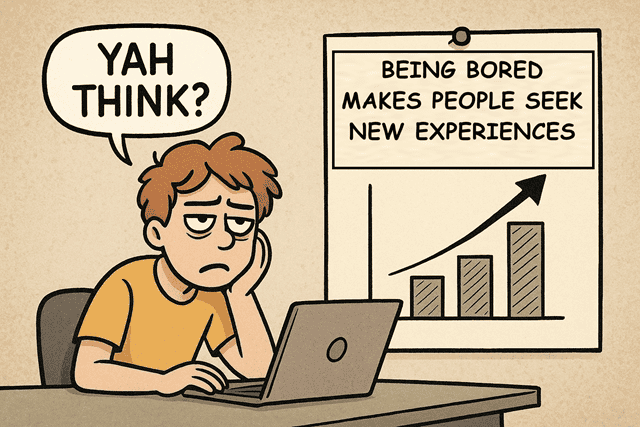
Apparently, we’ve reached the stage of human progress where we need peer-reviewed studies to tell us that boredom makes people want to do something else.
Groundbreaking stuff, really.
According to a new paper in the journal Emotion (because, of course, it’s called Emotion), researchers at Utah State University Eastern and Texas A&M decided to poke at a question that has haunted humankind for millennia: What happens when people get bored? Spoiler alert: they look for something new. Sometimes, even something gross.
This revelation comes from psychologists Shane Bench and Heather Lench, who ran a series of experiments proving that when you’re tired of the same old routine, you’ll take whatever comes next — even if it involves staring at pictures of cockroaches or dirty dishes. Somewhere out there, someone’s grant money paid for this discovery.
The Study That Proved the Obvious — Three Times
In their first experiment, Bench and Lench recruited 55 college students (because undergrads will do anything for extra credit) and had them look at a bunch of neutral images. We’re talking thrilling stuff like leaves, lightbulbs, and buildings — the kind of slideshow guaranteed to make anyone’s soul leave their body out of sheer ennui.
Then, the students were offered a choice: keep watching similar neutral images or switch to a batch of unpleasant ones. Over half chose the gross pictures. Apparently, staring at a cockroach beats another round of “generic office building façade.”
The researchers seemed genuinely surprised. “They were not pleasant,” Bench said, probably while double-checking his data to make sure people really volunteered for disgust. But it turns out that boredom isn’t passive. It’s pushy — it nags you until you do something, anything, to feel different.
Study Two: We’re Still Bored, Now With Statistics
The second study scaled things up with 150 participants, because replication makes everything more “sciencey.” Once again, people were subjected to the world’s least exciting image gallery. And again, they fled toward novelty — even the unpleasant kind.
This time, the researchers got fancy with mediation analysis (the statistical version of squinting and saying, “Yes, that seems related”). They found that the more bored people were, the stronger their “desire for novelty,” which predicted their willingness to endure bad vibes. Translation: when you’re over it, you’ll try literally anything different.
Which, if you’ve ever eaten gas-station sushi just to “mix things up,” you already knew.
Study Three: Positive Things Are Boring Too
In the final round, the researchers wondered, “Could people get bored even with good stuff?” Shockingly, yes. Give someone too many happy images — sunsets, puppies, desserts — and they’ll start craving disaster. Participants who were bored by cheerful photos chose to view negative ones (plane crashes, snarling dogs, and so on). Meanwhile, people sick of sad pictures went running for the uplifting ones.
In other words, humans are emotional toddlers: we want the toy we don’t have.
Boredom: The Unsung Life Coach
For decades, psychologists treated boredom like the ugly cousin of real emotions, annoying but ultimately harmless. Now we know it’s a functional signal. When you feel bored, it’s your brain’s polite way of saying, “Hey, this isn’t working anymore. Maybe stop scrolling through the same three apps and do something that matters.”
Heather Lench puts it more academically: boredom “motivates people to pursue new experiences,” even at an emotional cost. Translation: yes, your mid-meeting urge to dye your hair green or start an argument on Reddit has a scientific explanation. You’re not impulsive; you’re functionally emotional.
The Upside and the Downside of Restlessness
Before we crown boredom the new mindfulness guru, let’s remember it cuts both ways. Some people channel it into creative projects, while others turn to online shopping at 2 a.m. or start that ill-fated text to an ex.
Lench points out that boredom can spark both productivity and self-destruction. It’s the emotional equivalent of caffeine, great in moderation, terrible when left unchecked. You can use it to brainstorm your next big idea, or you can end up watching reality TV marathons, wondering where your dignity went.
Why We Needed Research to Tell Us This
Of course, some might wonder why we need a multi-study academic paper to confirm what every bored teenager has known since the dawn of algebra homework. But that’s science for you: it’s not official until someone measures it with p-values and publishes it in Emotion.
Still, this research does something valuable. It reframes boredom not as a character flaw but as a feature — a nudge from your brain to change course. The next time you find yourself daydreaming during a meeting, instead of feeling guilty, just tell your boss you’re following a functional emotional signal backed by peer-reviewed evidence. That’ll go over great.
Bottom Line: The Bigger Picture (and the Endless Scroll)
In a world where we carry infinite distractions in our pockets, boredom might be the last remaining spark of curiosity. It’s the space between “I’m fine” and “I need something new.” Whether that “something new” is learning Italian or doomscrolling apocalypse news is up to us.
So, yes, boredom drives people to seek new experiences. Sometimes we paint masterpieces; sometimes we microwave questionable leftovers at midnight. Either way, it’s all part of the grand experiment of being human.
And somewhere out there, a researcher is nodding sagely, saying, “Our data support that conclusion.”
— Steve

Yah Think? Science Finally Confirms That People Hate Being Bored
Apparently, we’ve reached the stage of human progress where we need peer-reviewed studies to tell us that boredom makes people want to do something else.
Groundbreaking stuff, really.
According to a new paper in the journal Emotion (because, of course, it’s called Emotion), researchers at Utah State University Eastern and Texas A&M decided to poke at a question that has haunted humankind for millennia: What happens when people get bored? Spoiler alert: they look for something new. Sometimes, even something gross.
This revelation comes from psychologists Shane Bench and Heather Lench, who ran a series of experiments proving that when you’re tired of the same old routine, you’ll take whatever comes next — even if it involves staring at pictures of cockroaches or dirty dishes. Somewhere out there, someone’s grant money paid for this discovery.
The Study That Proved the Obvious — Three Times
In their first experiment, Bench and Lench recruited 55 college students (because undergrads will do anything for extra credit) and had them look at a bunch of neutral images. We’re talking thrilling stuff like leaves, lightbulbs, and buildings — the kind of slideshow guaranteed to make anyone’s soul leave their body out of sheer ennui.
Then, the students were offered a choice: keep watching similar neutral images or switch to a batch of unpleasant ones. Over half chose the gross pictures. Apparently, staring at a cockroach beats another round of “generic office building façade.”
The researchers seemed genuinely surprised. “They were not pleasant,” Bench said, probably while double-checking his data to make sure people really volunteered for disgust. But it turns out that boredom isn’t passive. It’s pushy — it nags you until you do something, anything, to feel different.
Study Two: We’re Still Bored, Now With Statistics
The second study scaled things up with 150 participants, because replication makes everything more “sciencey.” Once again, people were subjected to the world’s least exciting image gallery. And again, they fled toward novelty — even the unpleasant kind.
This time, the researchers got fancy with mediation analysis (the statistical version of squinting and saying, “Yes, that seems related”). They found that the more bored people were, the stronger their “desire for novelty,” which predicted their willingness to endure bad vibes. Translation: when you’re over it, you’ll try literally anything different.
Which, if you’ve ever eaten gas-station sushi just to “mix things up,” you already knew.
Study Three: Positive Things Are Boring Too
In the final round, the researchers wondered, “Could people get bored even with good stuff?” Shockingly, yes. Give someone too many happy images — sunsets, puppies, desserts — and they’ll start craving disaster. Participants who were bored by cheerful photos chose to view negative ones (plane crashes, snarling dogs, and so on). Meanwhile, people sick of sad pictures went running for the uplifting ones.
In other words, humans are emotional toddlers: we want the toy we don’t have.
Boredom: The Unsung Life Coach
For decades, psychologists treated boredom like the ugly cousin of real emotions, annoying but ultimately harmless. Now we know it’s a functional signal. When you feel bored, it’s your brain’s polite way of saying, “Hey, this isn’t working anymore. Maybe stop scrolling through the same three apps and do something that matters.”
Heather Lench puts it more academically: boredom “motivates people to pursue new experiences,” even at an emotional cost. Translation: yes, your mid-meeting urge to dye your hair green or start an argument on Reddit has a scientific explanation. You’re not impulsive; you’re functionally emotional.
The Upside and the Downside of Restlessness
Before we crown boredom the new mindfulness guru, let’s remember it cuts both ways. Some people channel it into creative projects, while others turn to online shopping at 2 a.m. or start that ill-fated text to an ex.
Lench points out that boredom can spark both productivity and self-destruction. It’s the emotional equivalent of caffeine, great in moderation, terrible when left unchecked. You can use it to brainstorm your next big idea, or you can end up watching reality TV marathons, wondering where your dignity went.
Why We Needed Research to Tell Us This
Of course, some might wonder why we need a multi-study academic paper to confirm what every bored teenager has known since the dawn of algebra homework. But that’s science for you: it’s not official until someone measures it with p-values and publishes it in Emotion.
Still, this research does something valuable. It reframes boredom not as a character flaw but as a feature — a nudge from your brain to change course. The next time you find yourself daydreaming during a meeting, instead of feeling guilty, just tell your boss you’re following a functional emotional signal backed by peer-reviewed evidence. That’ll go over great.
Bottom Line: The Bigger Picture (and the Endless Scroll)
In a world where we carry infinite distractions in our pockets, boredom might be the last remaining spark of curiosity. It’s the space between “I’m fine” and “I need something new.” Whether that “something new” is learning Italian or doomscrolling apocalypse news is up to us.
So, yes, boredom drives people to seek new experiences. Sometimes we paint masterpieces; sometimes we microwave questionable leftovers at midnight. Either way, it’s all part of the grand experiment of being human.
And somewhere out there, a researcher is nodding sagely, saying, “Our data support that conclusion.”
— Steve
Thank you for visiting with us today. — Steve
“The object in life is not to be on the side of the majority, but to escape finding oneself in the ranks of the insane.” — Marcus Aurelius
“Nullius in verba”– take nobody’s word for it!
“Acta non verba” — actions not words
About Me
I have over 40 years of experience in management consulting, spanning finance, technology, media, education, and political data processing.
From sole proprietorships to Fortune 500 companies, I have turned around companies and managed their decline. All of which gives me a unique perspective on screwing and getting screwed.
Feel free to e-mail me at steve@onecitizenspeaking.com
Recent Posts ((Clickable))
Categories ((Clickable))
Archives ((Clickable))
© 2007-2026 One Citizen Speaking