When Outrage Replaces Evidence, Credibility Collapses: The Performance Masquerading As Oversight
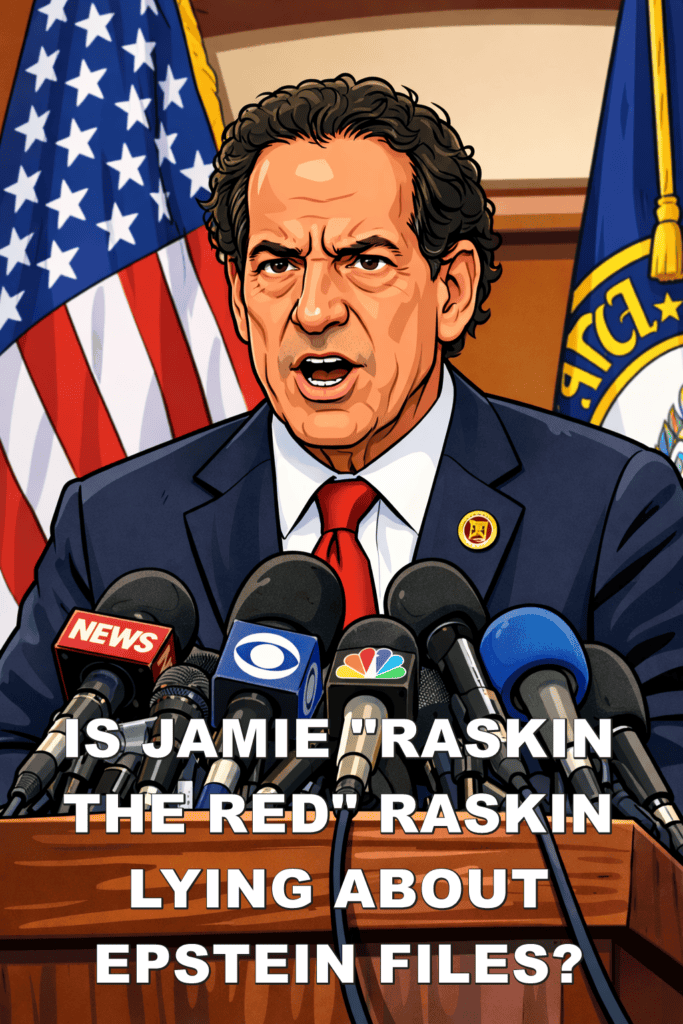
There’s congressional oversight, and then there’s political theater dressed up as truth-seeking. Maryland Representative Jamie Raskin’s latest comments about the Epstein files land squarely in the second category. What we’re being asked to swallow is not a careful presentation of facts, but a breathless narrative delivered by one of Washington’s most aggressive hyper-partisans. Critics on the right have nicknamed him “Raskin the Red,” and whether you like the label or not, the behavior fueling it is impossible to miss.
Raskin didn’t review the full Epstein file. He didn’t review most of it. By his own admission, he looked at roughly 30 to 40 documents out of millions. Yet from this sliver of material, he confidently suggests bombshell conclusions, casts doubt on political enemies, and waves around an unverifiable implication like it’s a settled truth. That’s not an investigation. That’s insinuation.
The “I Haven’t Seen It, But Trust Me” Problem
Here’s the core issue: Raskin is asking the public to believe claims he cannot substantiate. He openly says that roughly three million documents remain unreleased. He also openly says he hasn’t seen them. Yet the implication is always the same: somewhere in that unseen mountain of paper lies proof of something terrible, and you should assume it exists.
This is the oldest rhetorical trick in the book. Absence of evidence is rebranded as evidence of concealment. If proof isn’t available, that doesn’t disprove the claim—it just means the proof is hidden. By that logic, any accusation can live forever, immune to disconfirmation. It’s a perfect setup for lying without consequence, because the missing evidence can always be blamed on a cover-up.
Redactions, Rumors, And Narrative Laundering
Raskin’s headline-friendly moment came from describing a redacted email summary allegedly contradicting Donald Trump’s long-standing claim that Epstein was kicked out of Mar-a-Lago. But what did Raskin actually see? Not a firsthand statement. Not sworn testimony. Not a contemporaneous record from Trump himself. He described a second-hand email recounting what lawyers supposedly said years earlier, filtered through Epstein’s own correspondence.
That’s not a smoking gun. That’s hearsay stacked on hearsay, polished into a talking point. Yet it’s rolled out to reporters as if it definitively rewrites history. The redaction becomes the star of the show, not the source’s reliability. This is narrative laundering: take something weak, ambiguous, or unverifiable, and push it through the authority of Congress until it looks solid.
Selective Skepticism As A Political Weapon
Notice how skepticism works here. When Trump denies wrongdoing, Raskin treats those denials as inherently suspect. When survivors speak, they must be believed. When the DOJ withholds documents, it’s proof of a cover-up. But when Raskin makes claims based on documents he hasn’t read, we’re told to accept them on faith.
That’s not principled inquiry. That’s confirmation bias with a press badge. Critics argue this is part of a long pattern: leaks when convenient, moral outrage when useful, and certainty without proof when it advances the cause. You don’t need to call it “communist” or “progressive extremism” to see the danger. It’s raw partisanship overriding basic standards of evidence.
Bottom Line
If you’re going to accuse, imply, and insinuate on matters this serious, you’d better bring more than vibes and hypotheticals. Jamie Raskin hasn’t. He’s offered fragments, second-hand summaries, and a giant, invisible pile of “trust me” documents. That may play well on cable news, but it’s a terrible foundation for truth. When a lawmaker treats missing evidence as proof and outrage as a substitute for verification, skepticism isn’t cynical—it’s necessary.
Why this piece of shit is not behind bars for serving as the lead House manager for Donald Trump’s second impeachment and as a member of the House Select Committee to Investigate the January 6th Attack is beyond me.
We are so screwed.
— Steve