Asinine stupidity is asinine stupidity — and when a sitting congressman starts sounding like a censorious commissar, you don’t get to blame the other side for your own authoritarian fever dream.
Rep. Clay Higgins’s grandstanding plea to “cancel with extreme prejudice” anyone who celebrated the assassination of Charlie Kirk isn’t righteous wrath — it’s a blueprint for the same illiberal machinery conservatives claim to oppose.
He’s promising to use congressional authority, influence over Big Tech, even business licenses and driver’s licenses as weapons of punishment. That isn’t defending the dead — it’s weaponizing government against speech.
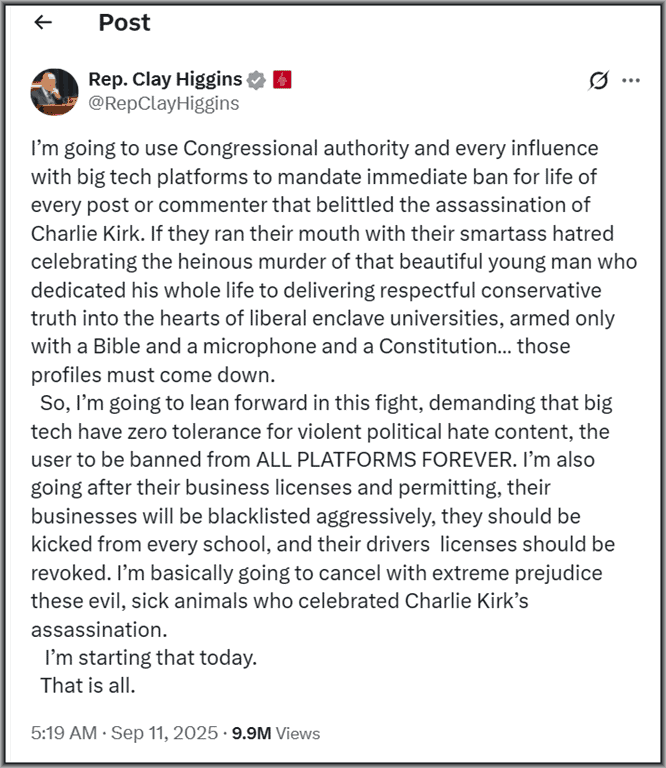
Let me be blunt: mourning a life taken and wanting accountability for threats and violent rhetoric are one thing. Proposing to strip people of licenses, livelihoods, or access to platforms forever because you don’t like what they said is another.
It’s the quick slide from disgust to dictatorship. Higgins parrots the language of “zero tolerance” and “ban for life” like a man who read one paragraph in a civics textbook and decided he’d skip the rest. The Constitution was written to protect speech — even rotten, vile speech — precisely because the alternative is a tyranny of whoever’s madder and louder in any moment.
And here’s the sick irony. For years, many on the right have been the first to scream when the state or platforms moved to silence conservatives. They called it censorship, cancel culture, suppression. Now, facing a noxious response from the left, some of those same voices eagerly reach for the exact censorship levers they once denounced. That hypocrisy isn’t accidental; it reveals something deeper: power and punishment appeal to authoritarians of every stripe. If you’re willing to weaponize the government or corporate pressure against speech you dislike, congratulations — you are part of the problem. You’re not the free-speech champion you pretend to be; you’re just a partisan with a badge.
Think about the consequences.
If Congress can demand permanent bans, blacklist small businesses, revoke permits or drivers’ licenses for political speech, what happens when the political winds shift? Today’s enemies become tomorrow’s victims. Someone in a future administration could treat that list like a hit list. That’s not accountability — that’s a file for political retribution and a recipe for chilling millions into silence. The founding framers knew this; they saw how easily laws meant for order became tools for vendetta. Higgins is flirting with that danger in the name of righteous fury. Fury is not a legal doctrine. Fury does not become constitutional text. Fury becomes lawless.
And before anyone claims this is “only” about the fringe celebrating an assassination: where do you draw the line?
Who decides what counts as “belittling” or “celebrating”? What’s a lifetime ban versus a temporary suspension? What about parody, stupidity, or poorly worded hyperbole? Rights don’t get parceled out across spreadsheets of moral outrage — they’re universal by design, because humans are fallible and the next outrage will land on your head. If we replace the messy marketplace of ideas with permanent blacklists, we don’t eradicate hatred — we institutionalize revenge. We build a system where punishment is the first answer and persuasion is a forgotten art.
Make no mistake: condemning violent acts and urging platforms to remove explicit threats or calls to imminent violence is entirely legitimate. Criminal threats should be referred to law enforcement. Platforms should enforce their rules consistently. But there’s a difference between removing direct threats and erasing people for disagreeable or even vile commentary. The former protects safety; the latter empowers censorship. Public officials who conflate the two are either dangerously uninformed or cynically playing to the crowd. Neither is acceptable.
If Clay Higgins — or any elected official — wants to honor the memory of someone who died, the honorable path is to strengthen protections against real threats, fund mental-health and violence-prevention programs, and encourage civic discourse that reduces dehumanization. The dishonorable path is to mobilize government power to punish speech because it offends. One is constructive and forward-looking; the other is revenge dressed up as policy.
Here’s the real test: if you truly believe in free speech, you must defend it even when speech repels you. Not because vile speech deserves praise, but because protecting awful speech protects the idea that speech will remain free for everyone — including you. If you refuse to do that, you’re not preserving liberty. You’re trading liberty for the sweet, immediate satisfaction of silencing someone you loathe. And that trade has a cost we all will pay.
So spare us the sanctimony.
Call out the celebrants of violence, yes. Use law enforcement where threats are real, yes. But don’t pretend that using the levers of government to erase your political enemies is anything but authoritarianism. If you’re the type who screams about censorship when Twitter suspends a conservative, you don’t get to moonlight as a censor when it’s politically convenient. Principles aren’t seasonal. They aren’t hashtags. They’re the guardrails that stop anger from becoming oppression.
Bottom Line
If Rep. Higgins wants to be taken seriously as a defender of civilized discourse, he’ll stop chanting for permanent bans and start fighting for consistent rule of law — even when the speech in question makes him sick.
Until then, his rhetoric will read less like justice and more like the first drafts of tyranny. And that should anger everyone who values freedom, regardless of political stripe.
— Steve