Another Preventable Tragedy in Racine, Wisconsin
Another crash. Another set of victims. Another reminder that progressive “justice” policies are not abstract experiments — they have real, often deadly consequences.
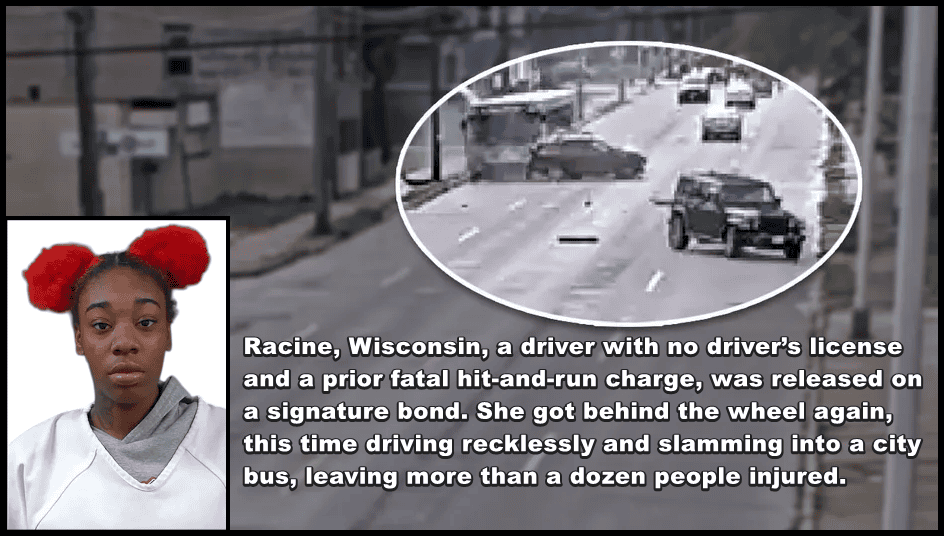
In Racine, Wisconsin, a young woman with no driver’s license and a prior fatal hit-and-run charge was released on a signature bond. Essentially, the system trusted her word over public safety. No jail. No real accountability. Just a promise to behave.
Predictably, she got behind the wheel again. This time, she drove recklessly, slammed into a city bus, and left more than a dozen people injured. She wasn’t just endangering strangers — she had children riding in her own car when she lost control.
The Ideology That Endangers Lives
This wasn’t bad luck or a rare fluke. This was the inevitable result of a justice system that treats criminals as victims and actual victims as collateral damage. Judges steeped in progressive ideology, backed by Soros-funded prosecutors, preach “restorative” or “redistributive” justice. They measure success not by safety or accountability but by statistics: lower incarceration rates, fewer convictions, and political points for leniency.
National Patterns of “Catch-and-Release”
Racine is far from unique. Consider Chicago, where the city’s top prosecutor has repeatedly embraced policies that release repeat offenders on minimal or no bail. In 2022, a man charged with multiple armed robberies was released repeatedly and went on to commit another violent crime just weeks later. Or San Francisco, where pretrial leniency has allowed felons to roam free, contributing to a surge in repeat crimes. New York’s recent bail reforms have followed a similar pattern: repeat offenders released on their own recognizance, only to harm innocent people again. These policies are hailed by progressives as “compassionate,” yet the victims pay the price with their lives and safety.
Another Example: Philadelphia’s No-Cash-Bail Fallout
Another glaring example comes from Philadelphia. In 2021, a woman released early under the city’s “no cash bail” initiative was charged with assault after previously being implicated in a violent robbery. Within months of release, she attacked another victim, leaving that person hospitalized. Prosecutors defended her freedom as a commitment to fairness, but the community saw it for what it was: a preventable tragedy caused by a system prioritizing ideology over safety.
Families and Communities Pay the Price
Back in Racine, the human cost is unbearable. The family of the woman’s previous victim lost a loved one, and now they must endure another crisis created by the same person. Communities are left to wonder: how many more tragedies will it take before courts act decisively? When someone kills and then is allowed to drive again, are we really enforcing law and order, or are we experimenting with public safety as if it were a laboratory test?
These judges and prosecutors justify their approach by labeling crime a “systemic problem” rather than a choice. They frame dangerous offenders as misunderstood, as products of circumstances beyond their control. But that framing ignores the reality of repeated criminal behavior. Some people make choices that harm others. They must face consequences. Justice exists to protect the innocent, not to shield the guilty from accountability.
Leniency Emboldens Repeat Offenders
The consequences of ignoring this are not theoretical. They are concrete and painful. Victims are left grieving. Communities are terrified. Children ride the bus to school in fear of reckless drivers, not knowing that the system intended to stop such behavior may have failed them. And the message sent to law-abiding citizens is clear: obey the law, and you are powerless against those who choose to ignore it.
Progressive criminal justice reformers claim their policies are about fairness, compassion, and second chances. But fairness and compassion must start with victims, not perpetrators. The principle of justice is simple: commit a crime, face consequences. Allow dangerous people to walk free, and the only thing you redistribute is pain.
The Time for Common-Sense Justice Is Now
Across the country, the evidence is overwhelming: leniency breeds repeat offenses. Dangerous offenders are emboldened. Families are left devastated. Courts continue to hand down policies that prioritize ideology over safety. The consequences are not abstract statistics — they are broken lives, destroyed families, and communities living in fear.
The Racine crash is a tragic case study, but it is emblematic of a broader national problem. When courts prioritize theory over practice and ideology over enforcement, innocent people suffer. Dangerous criminals make choices that harm others, and the system looks the other way. Enough is enough.
It’s time to demand a return to common sense: meaningful pretrial detention for serious offenders, accountability for repeat criminals, and a justice system that protects the innocent instead of coddling the guilty. Crime is not a systemic inevitability; it is a moral choice. And if those tasked with enforcing the law refuse to uphold it, they share the responsibility for the next tragedy.
Until policies change, more lives will be ruined — not by accidents, but by a system that confuses leniency with justice and ideology with morality. Victims deserve better. Communities deserve better. And the next preventable tragedy should be the last.
Bottom Line
Where are the judicial review commissions, boards of judicial conduct, or judicial oversight committees who are supposed to review complaints about judges’ conduct. Its purpose is oversight of judicial behavior, not case outcomes. And when a judge exhibits a pattern and practice harmful to the community, ideological or not, recommending disciplinary actions, which can range from warnings, reassignment to a different court, to suspension, or, in rare cases, removal.
Unless judges start acting in the interests of justice and community safety, we are screwed.
— Steve