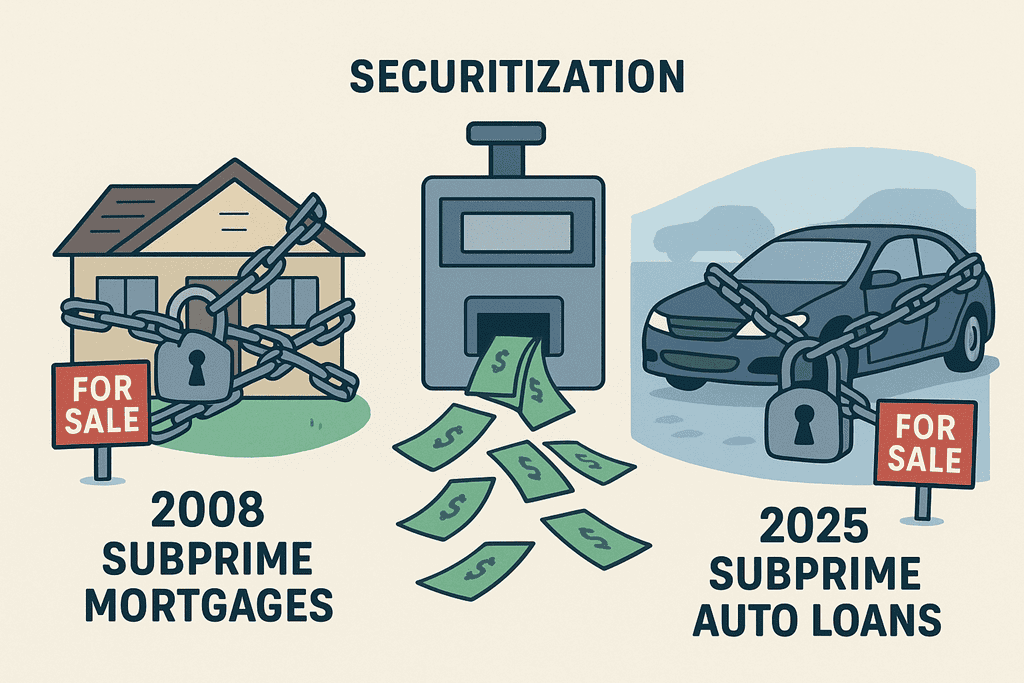
The collapse of Tricolor Auto Group—a Texas-based used car lender specializing in subprime borrowers—has revived uncomfortable echoes of 2008. While the underlying assets this time are cars instead of homes, the structure of risk, incentives, and eventual fallout looks eerily familiar.
The 2008 Playbook: Homes as Risky Assets
In the run-up to the 2008 financial crisis, banks issued home mortgages to millions of borrowers who often couldn’t afford them. These “subprime” mortgages were bundled into mortgage-backed securities (MBS) and sold to investors.
On paper, this looked like magic: banks moved risky loans off their balance sheets, investors earned steady returns, and Wall Street engineered ever-more complex derivatives to slice, dice, and repackage that risk.
The problem? When borrowers started defaulting, the entire securitization tower wobbled. Home values collapsed, credit froze, and the global financial system nearly toppled.
Fast-Forward to Tricolor: Cars Instead of Homes
Tricolor’s model revolved around financing vehicles for borrowers with low credit scores, often immigrants and working-class families with limited banking access. Like mortgage lenders before them, Tricolor packaged these subprime auto loans into securities and sold them to investors hungry for yield.
Attractive on paper, the business assumed two things:
-
Borrowers would keep making payments even on overpriced used cars.
-
The collateral—the cars themselves—would retain enough value if repossessed.
But used car values have been volatile post-pandemic, repossession costs are high, and many borrowers simply cannot sustain sky-high monthly payments. Defaults climbed, securities soured, and eventually Tricolor was pushed into bankruptcy.
The Similarities
-
Securitization of Risk: In both cases, risky loans were bundled, rated, and sold to investors far removed from the borrowers’ realities.
-
Perverse Incentives: Originators made money on loan volume, not loan quality. The quicker loans were packaged and sold, the faster profits rolled in—until defaults surged.
-
Fragile Collateral: Homes in 2008, cars in 2025. Both were assumed to have stable resale value. When markets corrected, that assumption cracked.
-
Vulnerable Borrowers: Low-income families bore the brunt, often losing their homes in 2008 and now their cars—the very asset many depend on for work.
The Differences
-
Scale: Housing is the largest asset class in the U.S. The collapse of mortgage-backed securities threatened the global financial system. Subprime auto loans, though large, are a fraction of that size, more a sectoral crisis than a systemic one.
-
Recovery Potential: Houses generally hold long-term value; cars depreciate rapidly. That makes auto-loan securitization inherently riskier but less capable of sparking global contagion.
-
Regulation: Post-2008 reforms tightened mortgage oversight but left auto lending far looser, allowing lenders like Tricolor to operate aggressively.
Why This Matters
Financial engineering built on shaky consumer credit can spiral quickly when the economic floor shifts. Investors chasing yield, lenders chasing volume, and borrowers grasping for opportunity create a combustible mix.
If 2008 was the earthquake, Tricolor may be one of the aftershocks, smaller but signaling that the same fault lines remain.
Bottom Line
The Tricolor bankruptcy isn’t “another 2008,” but it’s a flashing caution sign. Anytime risky consumer debt gets bundled into securities and sold as safe investments, history has a way of rhyming. Investors, regulators, and borrowers should watch for:
- Rising defaults on subprime auto loans as household budgets tighten.
- Used car price volatility, which undermines collateral assumptions.
- Aggressive securitization practices that shift risk from lenders to unsuspecting investors.
- Regulatory blind spots, since auto lending hasn’t faced the same scrutiny as housing did post-2008.
If left unchecked, the fallout from subprime auto lending won’t topple the global system—but it could ripple across credit markets, squeeze working families, and erode trust in financial innovation all over again.
Ditto for increasing securitized credit card debt.
We are so screwed.
— Steve