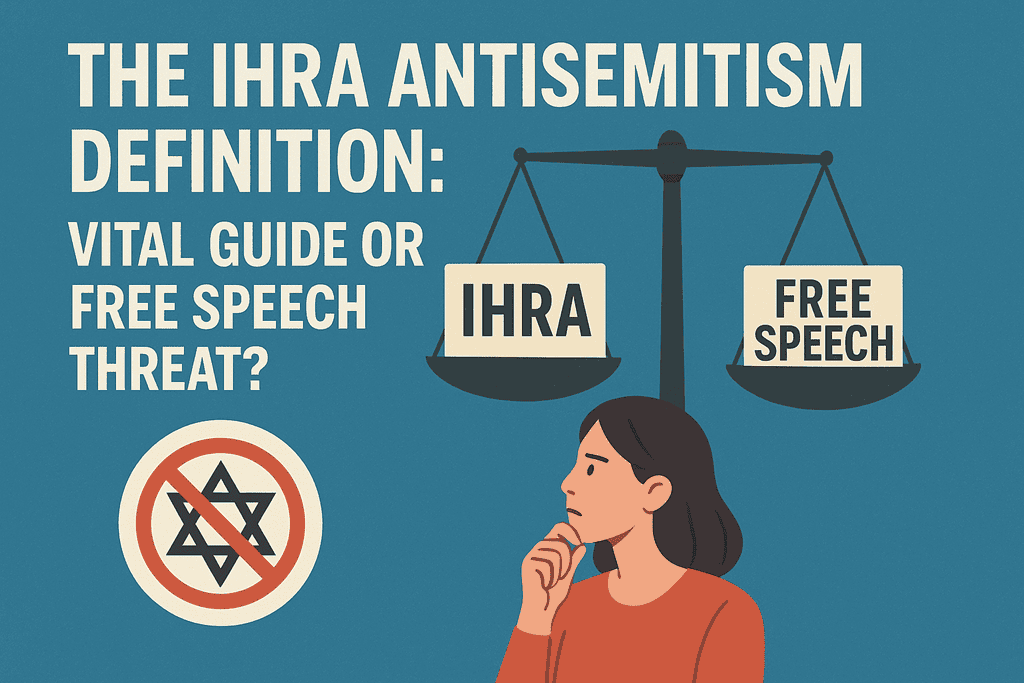
Is it simply free speech, legitimate analysis, or commentary—or is it something far more sinister: anti-Semitic hate speech?
It is crucial to recognize the challenge of defining inherently subjective concepts like anti-Semitism, where interpretation often depends on one’s worldview, one’s connection to the affected community, and membership within the targeted group.
What Is the IHRA Definition of Anti-Semitism?
In 2016, the International Holocaust Remembrance Alliance (IHRA) unveiled a working definition of anti-Semitism that has since become a global benchmark.
According to IHRA:
“Antisemitism is a certain perception of Jews, which may be expressed as hatred toward Jews. Rhetorical and physical manifestations of antisemitism are directed toward Jewish or non-Jewish individuals and/or their property, toward Jewish community institutions and religious facilities.”
The definition also includes 11 illustrative examples, several of which connect antisemitism to discussions about Israel.
Examples include:
- Holding Jews collectively responsible for the actions of Israel,
- Comparing Israeli policy to Nazi Germany,
- Applying double standards to Israel is not expected of other democratic nations.
Governments, universities, and organizations worldwide have adopted this framework, seeing it as a critical tool for identifying antisemitism in all its modern forms.
Why Critics Say the IHRA Definition Is Problematic
Despite widespread adoption, the IHRA definition is far from uncontroversial. Critics argue that it blurs the line between anti-Semitism and legitimate criticism of Israel, potentially stifling free speech.
- Free Speech Concerns: Academics, journalists, and human rights groups warn that citing IHRA examples could silence debate on Israeli government policies. For instance, comparing Israel’s treatment of Palestinians to apartheid or criticizing settlement expansion has occasionally been flagged as anti-Semitic under IHRA guidelines — even when the critique focuses on policy, not religion or ethnicity.
- Chilling Academic and Public Debate: University organizations and activists say that fear of being labeled anti-Semitic under IHRA rules can discourage research, lectures, and protests that explore the Israeli-Palestinian conflict. This has sparked a heated discussion about whether IHRA is protecting Jews or unintentionally curbing free inquiry.
Alternative Approaches: The Jerusalem Declaration on Antisemitism
In response, progressive scholars, sensitive to the Palestinian cause, drafted the Jerusalem Declaration on Anti-Semitism (JDA) in 2021. The JDA emphasizes that criticism of Israel is not inherently anti-Semitic, aiming to protect political discourse while still recognizing genuine anti-Semitic patterns. It is mostly an academic exercise as the IHRA definition is broadly used in crafting policies and legislation.
This alternative attempts to draw a clear line between hatred of Jews and criticism of a state’s policies, addressing the core criticism many have of the IHRA examples.
Supporters Defend IHRA as a Crucial Tool
Supporters counter that IHRA does not ban criticism of Israel, only flags rhetoric that demonizes, delegitimizes, or collectively blames Jews. They argue that modern antisemitism often hides behind anti-Israel sentiment, and the IHRA framework provides a necessary guideline for governments, educators, and institutions to respond.
Without such a definition, they warn, anti-Semitic tropes could proliferate unchecked, disguised as political debate.
Bottom Line
The IHRA definition sits at the intersection of Holocaust education, human rights, and free speech. While it is widely recognized as the international standard for identifying antisemitism, its examples relating to Israel remain hotly contested, sparking debate over whether it protects Jews or threatens open discourse.
For anyone navigating discussions about anti-Semitism today, the IHRA definition is essential knowledge, but understanding its limits and criticisms is equally critical.
Whether you view it as a necessary shield against modern anti-Semitism or a potential muzzle on free speech, the conversation around IHRA shows just how complex addressing hate in the 21st century has become.
My personal definition is simple: If you damage property associated with Jewish individuals or groups or incite/commit violence against Jewish individuals or Jewish groups, it is no longer free speech or legitimate protest. And if it is violence or the overt imminent threat of violence, it is a legitimate justification for proportionate self-defense. Other than that, haters are free to bark at the moon.
— Steve
The 11 Illustrative Examples (These “may serve as illustrations” and are not legally binding. Context still matters.)
- Calling for, aiding, or justifying the killing or harming of Jews in the name of a radical ideology or an extremist view of religion.
- Making mendacious, dehumanizing, demonizing or stereotypical allegations about Jews as such or the power of Jews as a collective — for example, denying the fact that Jews are a people, or alleging that Jews have a world‑wide conspiracy or control the media, economy, government or other societal institutions.
- Accusing Jews as a people of being responsible for real or imagined wrongdoing committed by a single Jewish person or group, or even for acts committed by non‑Jews.
- Denying the fact, scope, mechanisms (for example gas chambers) or intentionality of the genocide of the Jewish people at the hands of National Socialist Germany and its supporters and accomplices (the Holocaust).
- Accusing the Jews as a people, or Israel as a state, of inventing or exaggerating the Holocaust.
- Accusing Jewish citizens of being more loyal to Israel, or to the alleged priorities of Jews worldwide, than to the interests of their own nations.
- Denying the Jewish people their right to self‑determination, e.g., by claiming that the existence of a State of Israel is a racist endeavor.
- Applying double standards by requiring of Israel a behavior not expected or demanded of any other democratic nation.
- Using the symbols and images associated with classic antisemitism (for example: claims of Jews killing Jesus or blood‑libel) to characterize Israel or Israelis.
- Drawing comparisons of contemporary Israeli policy to that of the Nazis.
- Holding Jews collectively responsible for actions of the state of Israel.
Reference Links:
IHRA – “Working Definition of Antisemitism”
IHRA – “What is Antisemitism?” webpage