The Cease-Fire That Changed Everything—Or Did It?
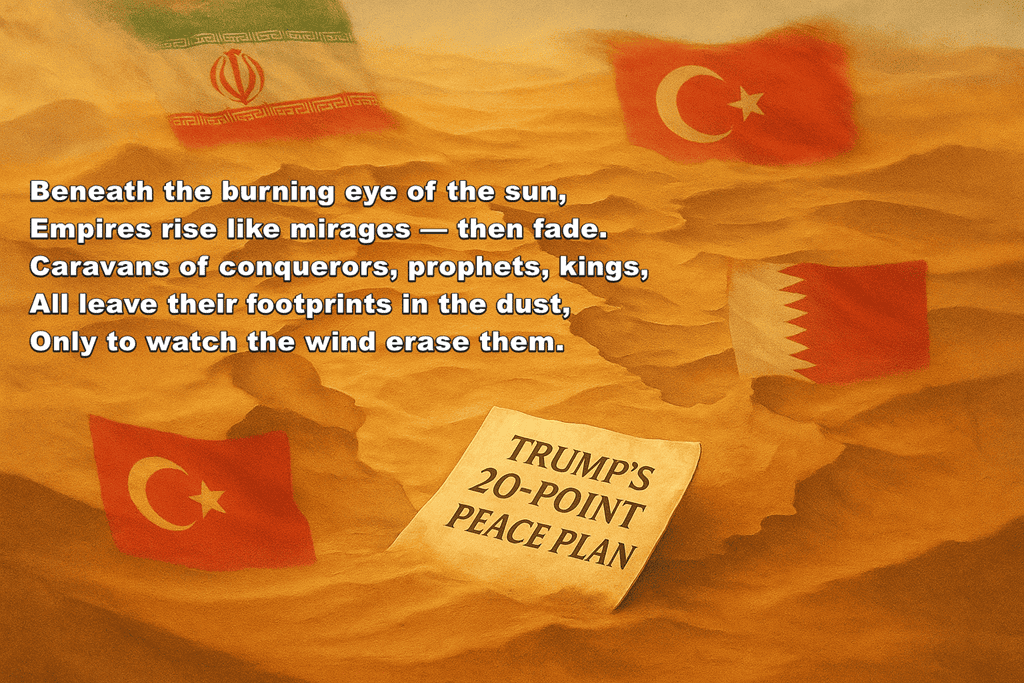
After two years of relentless warfare, President Donald Trump’s 20-point peace plan has brought a fragile calm to Gaza and its neighbors. Yet beneath this uneasy quiet lies a dramatic reshuffling of power. While the plan’s long-term success remains uncertain—especially with several Muslim nations tasked with policing fellow Muslims in Gaza—its short-term effects have already revealed clear winners and losers.
And in a region where alliances shift like desert sands, two nations stand out as the real beneficiaries: Turkey and Qatar, longtime masters at playing both sides of Middle Eastern conflicts.
Iran’s Bloc: Bloodied, but Still Standing
Before the horrors of October 7, 2023, the Middle East simmered under three shadowy blocs, each vying for dominance. At the heart stood Iran’s sprawling “Axis of Resistance”—a Shiite network stretching from Tehran to Yemen, united by one aim: to expel U.S. influence and erase Israel from the map.
Two years later, that grand design lies in ruins. Israeli and American strikes degraded Iran’s nuclear program, turning labs to rubble and safehouses to craters. Hezbollah’s once-massive rocket arsenal was gutted, its commanders vaporized. The Red Sea raiders, the Houthis, faced American, Israeli, and British airstrikes in response to attacks on Red Sea shipping. Iraq’s militias poked at U.S. bases, then vanished under retaliatory strikes. And in Gaza, Hamas and Islamic Jihad bled out in urban infernos, losing leaders, ground, and morale.
Even Iran itself took hits: crippled infrastructure, collapsing proxies, and a treasury drained. Tehran is regrouping, not retreating, but the once-feared “resistance axis” has been battered into the shadows. Its dream of regional dominance is postponed, perhaps indefinitely.
Assad’s Fall: The Lone Total Collapse
Amid the wreckage, one domino fell completely: Bashar al-Assad’s regime. By December 2024, after years of siege and sanctions, Syria’s strongman finally crumbled. From the ruins rose Hayat Tahrir al-Sham, a Sunni Islamist movement backed, discreetly, by Turkey and Qatar.
This wasn’t a victory for Western-style democracy; it was a shift of power between the Muslim factions and fighting forces in the region. Assad’s fall marked the transfer of influence from Iran’s Shiite bloc to a new Sunni Islamist axis, pragmatic yet ideological, cloaking ambition in diplomacy.
The Sunni Sly Foxes: Turkey and Qatar’s Masterstroke
While Iran’s proxies licked their wounds, a quieter power play unfolded. Turkey and Qatar, long masters of the double-agent and triple-agent game, emerged as the region’s new brokers.
Formally allied with the West, Turkey, through NATO, Qatar, through U.S.-occupied Al Udeid Air Base, they have simultaneously nurtured Islamist movements from the Muslim Brotherhood to Hamas. This duality, once seen as duplicity, has become their greatest weapon.
When Trump’s peace plan demanded Muslim mediators to enforce calm in Gaza, Ankara and Doha seized the stage. Their intervention wasn’t about peace; it was about preservation. They convinced Hamas to accept a cease-fire without actual disarmament, ensuring the group’s survival and their own continued leverage in Gaza.
In Syria, they filled the vacuum left by Assad’s fall. Across the region, they’ve turned chaos into capital—transforming contradictions into influence.
The West: Strong but Stagnant
Militarily, the U.S. and Israel remain unchallenged. Yet victory proved elusive. Iran’s proxies are weakened but not erased; the “axis of resistance” is wounded, not dead.
Meanwhile, Washington’s gaze is drifting eastward, toward strategic partnerships like the U.S.–Australia rare-earth deal as a hedge against China. That pivot leaves a Middle Eastern void, one that Turkey and Qatar are eagerly filling.
The Scorecard: Winners and Losers in the New Middle East
Winners:
- Turkey and Qatar — Cunning mediators turned kingmakers, balancing Islamism and diplomacy.
- Hamas (for now) — Survived annihilation under Turkish and Qatari protection.
Losers:
- Iran and its proxies — Militarily crushed, politically isolated.
- Assad’s Syria fell completely, replaced by Sunni hardliners.
- The West’s credibility — Powerful, but unable and unlikely to secure a lasting peace among people who have been warring for a millennium.
Bottom Line: The Quiet Triumph of Opportunists
The new Middle East isn’t ruled by the strongest armies, but by the smartest opportunists. Turkey and Qatar have transformed ambiguity into strategy, chaos into advantage.
Trump’s 20-point peace plan may yet fail or succeed, but one truth has emerged: while others bleed and rebuild, Doha and Ankara are quietly writing the next chapter of regional power.
In this endless contest, victory belongs not to those who conquer, but to those who endure. And all are mindful that President Trump will be gone in 2028.
We are so screwed if Israel does not finish the job and remain the sole regional power.
— Steve