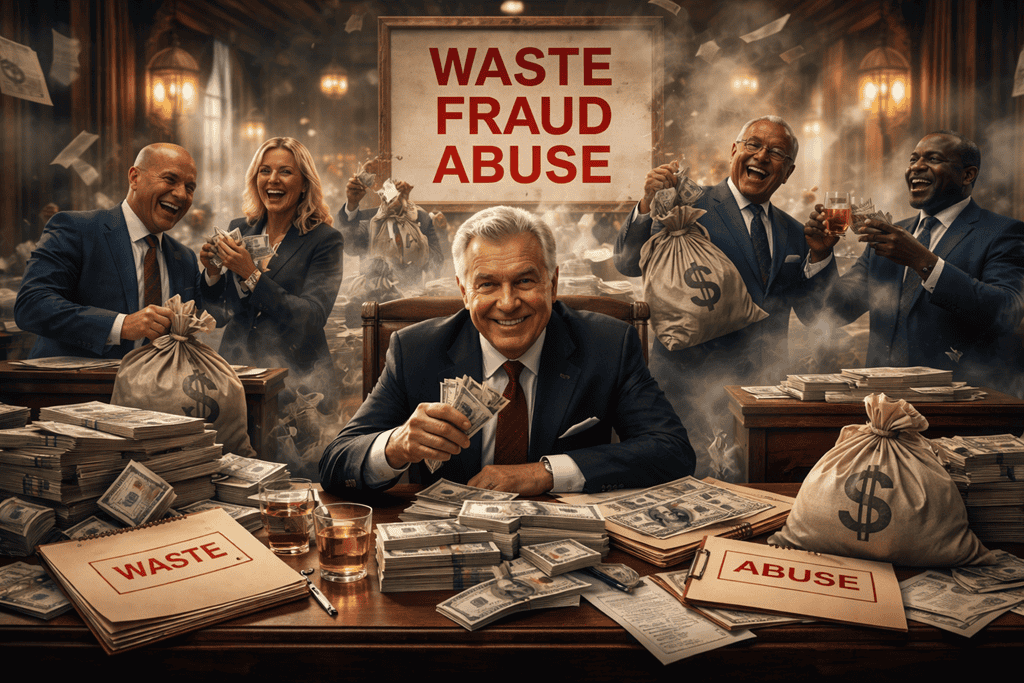
The Oldest Grift In Human History, Rebranded As “Public Service.”
“Nothing new to see here, move along.” That’s the shrug we’re expected to offer every time another scandal bubbles up, showing politicians shoveling taxpayer money toward favored constituencies in exchange for loyalty at the ballot box. We’re told it’s complicated. We’re told it’s compassionate. We’re told it’s necessary. What we’re never told is the truth: this is the most primitive form of corruption imaginable, dressed up in policy jargon and moral posturing.
Human beings form tribes. Tribes select leaders. Leaders reward the tribe and punish outsiders. That part is ancient and predictable. What’s galling is how shamelessly modern politicians exploit this instinct, not with their own money, but with yours. They don’t just buy votes—they launder the purchase through government programs so opaque that even trained auditors struggle to follow the trail.
Folklore calls prostitution the world’s oldest profession. That’s generous. Politicians and lobbyists have been trading favors for loyalty since the first village elder figured out how to control the food supply.
When Tribal Loyalty Becomes Asset Stripping
There’s a critical difference between leaders favoring their own supporters and leaders actively damaging the broader tribe to do it. The former is bad enough. The latter is destructive. And that’s exactly what happens when governments allow non-affiliated interlopers—politically useful, legally shielded, and often aggressively protected—to siphon off public assets under the soothing euphemisms of “waste,” “fraud,” and “abuse.”
Those words are treated like rounding errors, not crimes. They’re budget line items, not handcuffs. The public is trained to see them as inevitable leakage, not as the predictable outcome of systems designed to be gamed.
Ask yourself a few uncomfortable questions. Why are massive spending programs engineered for opaque complexity rather than radical transparency? Why are there shockingly few auditors assigned to multi-billion-dollar block grants and “emergency” funding schemes? Why can’t ordinary citizens cross-reference government disbursement checks by name and legal entity in real time? And why do we continue the legal fiction that corporations are “people” for political power, but magically immune from prison when they steal on an industrial scale?
None of this is accidental.
Complexity Is Not A Bug—It’s The Shield
Every layer of bureaucracy, every overlapping agency, every vague eligibility rule serves a purpose: plausible deniability. Complexity is the armor that protects politicians when the money inevitably walks out the door. They can always claim ignorance, blame contractors, or point to regulations written by someone else.
Recent reports out of Minnesota—now echoing across other deep-blue strongholds—have reignited public anger precisely because they ripped the mask off the process. Allegations of widespread fraud in government-funded programs, including learning centers with no students and benefits flowing to entities that exist mostly on paper, aren’t just scandals. They’re case studies.
What has Americans furious isn’t just the scale of the alleged abuse. It’s the growing suspicion that political leaders knew—or chose not to know—because the money flow served an electoral purpose. When public funds become a mechanism to secure permanent voting blocs, oversight ceases to be a priority and becomes a threat.
Vote Buying, The Polite Way
Old-school vote buying was crude: cash, liquor, or favors handed out on election day. Today’s version is cleaner, safer, and infinitely more profitable. It’s embedded in legislation, administered by agencies, and defended by press secretaries. The transaction is simple: loyalty for largesse, silence for subsidies, turnout for transfers.
Sen. Joni Ernst’s renewed push to tackle waste, fraud, and abuse through a consolidated reform package has exposed just how sensitive this issue is in Washington. Efforts to close loopholes, demand accountability, and claw back stolen funds are treated not as governance, but as political warfare. Why? Because cutting off the money cuts off the leverage.
When programs like pandemic-era relief funds are rushed out with minimal safeguards, the fraud isn’t a surprise—it’s the feature. Billions move fast, oversight moves slow, and by the time anyone asks questions, the political damage is already done.
Why Prison Is For Individuals, Not Power Structures
One of the great moral absurdities of modern governance is how we punish theft. An individual who steals thousands faces jail. An organization that siphons millions through fraudulent billing, shell entities, or fake compliance pays a fine—often smaller than the profit—and calls it a cost of doing business.
This double standard exists because accountability threatens the entire ecosystem. If real consequences were applied—prison time for executives, lifetime bans for officials, asset seizures for complicit entities—the vote-buying machine would grind to a halt. So instead, we get settlements, task forces, and sternly worded reports that quietly disappear.
Bottom Line
Politicians buying votes with taxpayer money isn’t a conspiracy theory. It’s a governing strategy. It thrives on tribal instincts, bureaucratic fog, and a public trained to accept corruption as background noise. The moment transparency becomes real, the moment disbursements are traceable and accountability is personal, the game ends. That’s why the game is defended so fiercely. This isn’t about left versus right. It’s about rulers versus the ruled—and who’s paying for the privilege.
We are so screwed.
— Steve