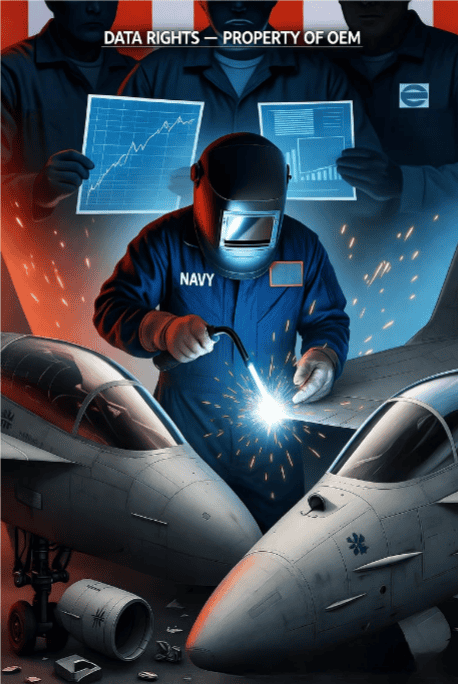
A Nation That Can’t Fix Its Own Fighters
The “right to repair” movement was born in the barns of America and the basements of frustrated iPhone users. Farmers are furious at John Deere’s software lockouts, which deny tech owners the right to replace their own batteries, and are demanding the freedom to fix what they already own.
Now that same battle has reached the unlikeliest front: the United States military.
According to a blistering new report from the Government Accountability Office (GAO), the U.S. Navy is being forced to cannibalize parts from grounded aircraft and submarines just to keep others flying or afloat. The reason? The Pentagon doesn’t own the intellectual property, the repair manuals, technical drawings, and manufacturing data for many of its own weapon systems.
Let that sink in: The world’s most powerful military can’t fix its own hardware without permission from private contractors.
From Tractors to Torpedoes
For years, corporations like John Deere, Apple, and automakers have treated repair information as a state secret. They’ve fought legislation that would let consumers or independent technicians fix their own products. Instead, they insist repairs must go through their “authorized service” networks — at whatever price and timeline they dictate.
Now the same playbook has migrated to the defense industry. Defense giants have locked up technical data so tightly that even the Pentagon is forced into “vendor lock.” When an F-35 jet or a Virginia-class submarine needs a crucial part, military mechanics can’t just make or replace it — they have to ask permission from the contractor that built it.
And when the contractor drags its feet or inflates costs, what’s left for our sailors and airmen to do? Scavenge parts from other machines. The GAO confirmed it: Navy maintainers are “repurposing” components from grounded equipment to keep others mission-ready. It’s the military equivalent of stealing spark plugs from one tractor to make another run — except these “tractors” are $100 million fighter jets.
The Silent Sabotage of Readiness
This isn’t just a bureaucratic inconvenience. It’s a national security vulnerability. Every delay in maintenance, every missing spare part, every unavailable schematic ripples through the fleet.
An F/A-18E grounded due to a component shortage means one less aircraft is ready for a carrier deployment. A Virginia-class submarine stuck in drydock because the OEM controls the repair manual means one less hunter-killer prowling beneath the seas. And every time the Navy cannibalizes a component from another platform, both assets degrade.
It’s not incompetence — it’s structural sabotage baked into procurement contracts. The Pentagon’s acquisition system practically invites it. Contractors deliver the product but retain the blueprints, ensuring the government must return, cap in hand, for every future fix. The longer the dependency, the fatter the profits.
Meanwhile, taxpayers foot the bill for “sustainment contracts” that grow more expensive every year — while the actual readiness of the fleet declines.
A Government Held Hostage by Its Own Contractors
This is what happens when national defense becomes a subscription service. The Pentagon has become addicted to corporate “solutions” that turn independence into dependence.
Incredibly, the GAO found that none of the major programs it examined, including the F-35, the Littoral Combat Ship, and the Stryker vehicle, had obtained the full data rights they needed for sustainment. None.
The result is a grotesque parody of self-reliance: The Department of Defense spends hundreds of billions on weapons it cannot fully maintain without corporate approval. That’s not partnership — that’s hostage-taking.
When the Navy scavenges parts from grounded planes to keep others in the air, that’s not “efficiency.” That’s desperation. It’s what happens when America’s warriors are forced to work around corporate gatekeepers to defend their own country.
The Right to Repair Is Now a Matter of National Defense
It’s time Congress recognized that the “right to repair” isn’t just about consumers or farmers anymore, it’s about sovereignty.
If American citizens have the right to fix their tractors and phones, the United States military must have the right to fix its fighters, ships, and subs.
The GAO’s recommendations point in the right direction: change the law, force contractors to hand over detailed manufacturing data, and require every procurement contract to include complete IP transfer for maintenance and sustainment. But laws mean little without political will. Defense contractors will howl that releasing this information threatens “trade secrets.” Yet what’s truly at risk is our ability to fight and win wars.
When corporate secrecy becomes a greater threat to readiness than foreign adversaries, we’ve crossed a line from capitalism into capture.
Bottom Line: Time to Cut the Chains
The right to repair isn’t just an economic issue anymore; it’s a patriotic duty. America must be able to repair what it builds, whether it’s an iPhone, a John Deere combine, or an F-35 fighter jet.
No soldier, sailor, or taxpayer should ever be at the mercy of a contractor’s backlog. No defense program should depend on corporate gatekeeping to stay operational.
If the Pentagon truly wants to “support the troops,” it should start by freeing them — and itself — from the tyranny of vendor lock because no nation can defend freedom when it doesn’t even own the tools of its own defense.
We are so screwed.
— Steve
Reference: GAO-25-107468 Weapon System Sustainment: DOD Can Improve Planning and Management of Data Rights