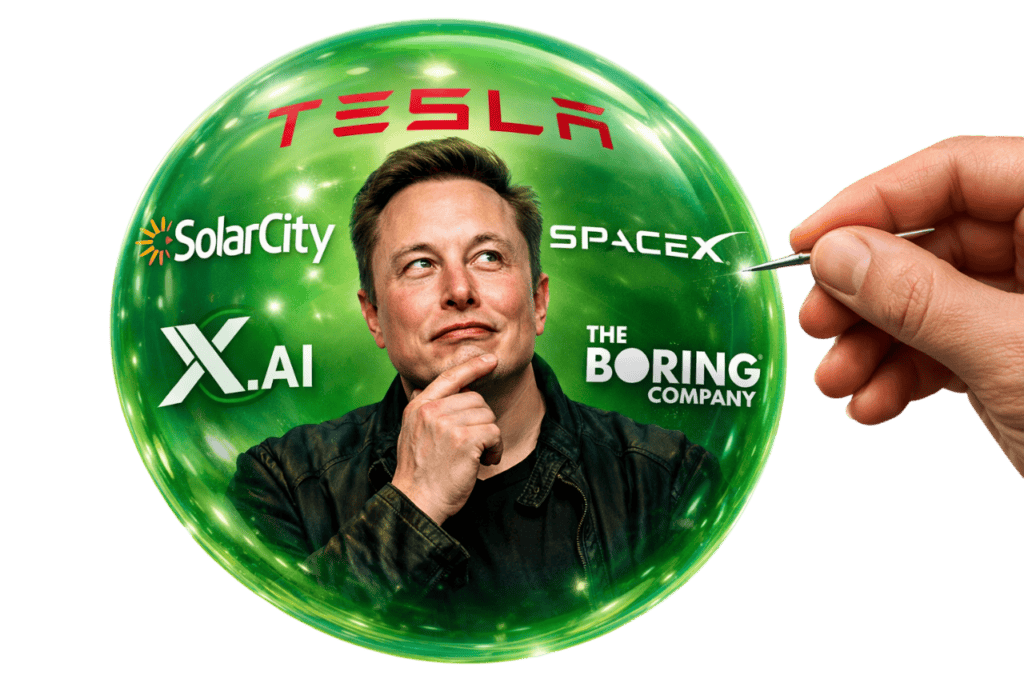
When Financial Engineering Becomes Performance Art
There is little doubt Elon Musk is the P.T. Barnum of modern finance. Not an inventor in the Edison sense, not a builder in the Ford sense—but a master ringmaster of capital. Musk’s real genius isn’t rockets or cars. It’s constructing corporate scaffolding so complex, so interlocked, and so politically protected that it becomes effectively untouchable. Each layer props up the next. Each crisis becomes a justification for consolidation. Each rescue is rebranded as vision.
Investors aren’t buying balance sheets. They’re buying belief. And belief, when packaged correctly, can be converted into cold, hard cash.
SolarCity: The Bailout Wrapped In A Vision Statement
If you want a clean case study, look no further than SolarCity. In the years before Tesla swallowed it whole, SolarCity was circling the drain. It never made money. It carried billions in debt. It burned cash like a bonfire in a windstorm. Nearly half its obligations were coming due fast, and the company was struggling to raise capital without increasingly desperate maneuvers.
This wasn’t a growth story. It was a liquidity crisis.
Insiders knew it. Bond markets knew it. And the fact that another Musk-adjacent company quietly stepped in to buy SolarCity debt to keep the lights on should have set off klaxons. Strip away the branding, and SolarCity looked less like a clean-energy pioneer and more like a company one bad quarter away from insolvency.
Then came Tesla—the white knight with a checkbook.
Who Actually Won The SolarCity Deal
On paper, the acquisition was framed as a synergy: solar panels feeding batteries, which feed electric vehicles, which feed a cleaner future. In practice, the benefits were far more concentrated.
Tesla, the company, gained an energy division, but the solar business itself never became the star. Batteries did the heavy lifting. Solar panels remained a slog.
Musk personally came out far better. As the largest shareholder on both sides of the transaction, he converted shaky SolarCity equity into far more valuable Tesla stock. That alone insulated him from a SolarCity collapse that would have been reputationally disastrous.
SolarCity insiders—many of them family or close associates—also walked away with Tesla shares rather than face bankruptcy. The risk didn’t disappear. It was transferred.
Tesla shareholders? They inherited the debt, the distraction, and the obligation to pretend this was all part of a master plan.
Courts later declared the price “fair.” Courts rule on process, not morality. That distinction matters.
The Empire Pattern: Consolidate Before Collapse
Fast forward, and the pattern is unmistakable. Musk’s empire increasingly resembles a closed financial ecosystem where assets, liabilities, and narratives circulate internally. One company props up another. One valuation justifies the next. When pressure builds, consolidation is sold as destiny.
Rolling AI into rockets. Folding social media into machine learning. Tying energy, transportation, defense, and data into one sprawling constellation of influence. This isn’t just about efficiency. It’s about scale so vast that failure becomes politically and economically inconvenient.
Too big to fail isn’t an accident. It’s the business model.
The Risks Investors Keep Ignoring
For all the spectacle, the risks are very real:
Tesla faces brutal global competition, shrinking subsidies, price wars, and slowing demand growth. Margins are under constant pressure.
Capital intensity remains extreme. Every new vision requires massive upfront spending before profits—if they ever arrive.
Regulatory exposure spans energy, transportation, defense, AI, and communications. One hostile administration could change the math overnight.
Key-man risk is off the charts. The entire ecosystem is tied to one personality, one narrative engine, one tolerance for chaos.
Belief can move markets. It can’t repeal gravity forever.
The xAI–SpaceX Merger: When Scale Becomes The Strategy
Just when the SolarCity episode might have been dismissed as a one-off, Elon Musk does it again—this time on a scale so vast it dares regulators, investors, and governments to blink first.
By rolling xAI into SpaceX, Musk isn’t merely combining two companies. He’s fusing launch infrastructure, satellite networks, artificial intelligence, and defense-adjacent technology into a single private behemoth now valued north of a trillion dollars. This isn’t vertical integration. It’s gravitational collapse.
The stated rationale is almost laughably grand: Earth can’t power AI, so the data centers must go to space. It’s classic Musk—take a legitimate constraint, inflate it into a civilizational crisis, then present the only possible solution as one that only he controls. Space, after all, has “space.” QED.
But strip away the cosmic rhetoric, and the pattern looks familiar. xAI, despite massive fundraising and eye-watering valuation, remains capital-hungry, compute-starved, and locked in a brutally competitive AI arms race against firms with deeper benches and clearer revenue models. SpaceX, meanwhile, is enormously valuable but also politically sensitive, regulation-heavy, and increasingly central to national security. Put them together, and suddenly neither can fail without causing systemic shock.
Sound familiar?
This merger also neatly tightens Musk’s personal control over the modern information stack. xAI already absorbed X, turning a global social media platform into a real-time data exhaust pipe for training models like Grok. Now, those models are being used for orbital infrastructure, satellite communications, and government launch contracts. Content, computation, and connectivity—under one corporate umbrella, largely shielded from public-market scrutiny.
And just like SolarCity, timing matters. SpaceX was flirting with an IPO. xAI needed scale, legitimacy, and power. The merger solves both problems at once. SpaceX gets an AI narrative to juice valuation and future growth stories. xAI gets physical infrastructure, political insulation, and a parent company that governments are reluctant to antagonize.
Once again, risk is not eliminated—it’s redistributed upward, into something too strategically important to unwind.
This is no longer just about business. When one individual controls rockets, satellites, AI models, social media distribution, and increasingly the data pipelines that feed them all, we are well past innovation and deep into concentration. Musk isn’t building companies anymore. He’s building a private-state ecosystem—one where failures are absorbed internally and sold externally as progress.
The lesson from SolarCity wasn’t learned. It was perfected.
Bottom Line
Elon Musk didn’t just save SolarCity. He perfected a playbook. When a Musk-backed venture falters, it doesn’t fail—it merges, reframes, and reemerges under a larger banner with a louder story. Investors aren’t asked to evaluate fundamentals. They’re asked to applaud the vision and trust the ringmaster.
That works—until it doesn’t.
And when belief finally collides with math, no amount of corporate pageantry will stop the fall.
We are so screwed.