The Illusion of Precision
We’ve all seen it: 1.23°C. 2.57°F. These numbers are paraded in headlines, reports, and charts as if they were carved in stone.
But here’s the inconvenient truth: in climatology, these decimal points are a cosmetic flourish, not a statement of certainty. Unlike physics or mathematics, where measurements can be tested, replicated, and expressed with rigorous accuracy, climate science often deals with error bands so wide that any claimed precision is, at best, misleading.
Decimal points in climate reports aren’t a reflection of scientific rigor; they’re a rhetorical trick designed to make approximations look exact. They’re a way to dazzle policymakers and the public with numbers that, in reality, have a huge margin of uncertainty.
Climate Models: More Fiction Than Forecast
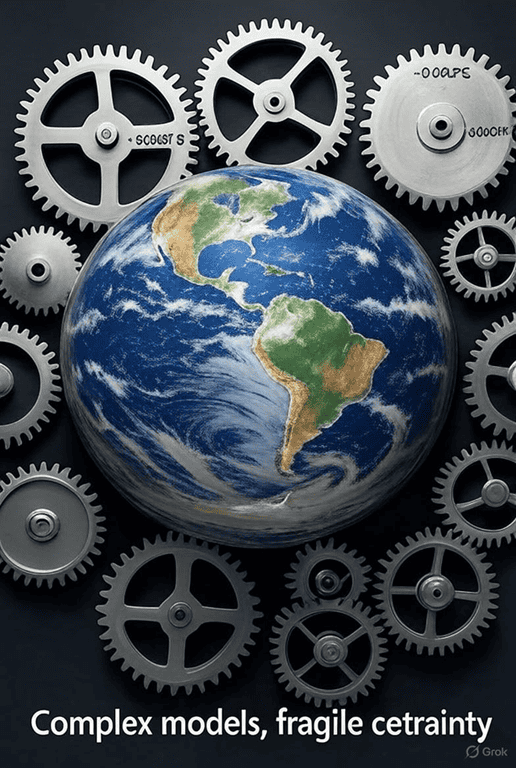
The real culprit behind this decimal-point illusion is the climate model. These impressive-looking simulations, with millions of lines of code and mountains of data, give the appearance of precision, but every input rests on questionable assumptions. Tiny uncertainties in these inputs multiply exponentially, turning outputs into speculative fiction rather than reliable predictions. Despite this, the projections are often presented as gospel, designed to convince the public that climate scientists possess near-supernatural foresight capable of guiding credible policy decisions. Spoiler alert: they don’t. The public is misled into believing that scientists can forecast the future with mathematical exactness—they cannot. Not yet, and maybe never.
Local Data, Global Lies
Here’s the kicker: much of what you read about global warming is based on local measurements stretched across the planet like a cheap blanket. Temperature readings from a handful of weather stations are treated as representative of the entire globe. That’s absurd. The climate gradient between the poles and the equator is massive; local data can never accurately predict global trends. Reporting 2.47°C warming for Earth based on a few scattered data points is not science; it’s deception dressed up in a lab coat.
Error Margins That Matter
Let’s talk numbers. In fundamental sciences, a measurement of 1.23 ± 0.01 is precise and meaningful. In climatology, however, error bands often exceed 1°C or more, especially when projections extend decades into the future. That means reporting 1.23°C in a global climate projection is akin to writing your lottery numbers in decimal form and claiming you know the winning ticket. The decimal is meaningless, a cosmetic flourish to create an illusion of certainty.
Bottom Line: Stop Pretending: Demand Real Accuracy
It’s time to stop worshiping the decimal point in climate science. Precision is a virtue in mathematics, physics, and chemistry, but in climatology, it’s often a smokescreen. Journalists, policymakers, and the public deserve transparency: if the data is uncertain, say so. If models are speculative, admit it. Inflating uncertainty with false precision is not science; it’s deception.
Next time you read a headline boasting about 2.47°C warming, remember this: the number is less about scientific truth and more about narrative theater. Don’t be dazzled by decimals. Ask the hard questions. Demand honesty. And don’t let pseudo-precision masquerade as science.
We are so screwed.
— Steve