Equality Under The Law Means Exactly That
How many more times do we have to relearn this lesson? In the United States, every citizen stands equal under the law. That principle doesn’t change based on race, religion, income, or sexual orientation. It doesn’t require special branding. It doesn’t need a marketing campaign. And it certainly doesn’t require Congress to elevate every cause to the level of a national emblem.
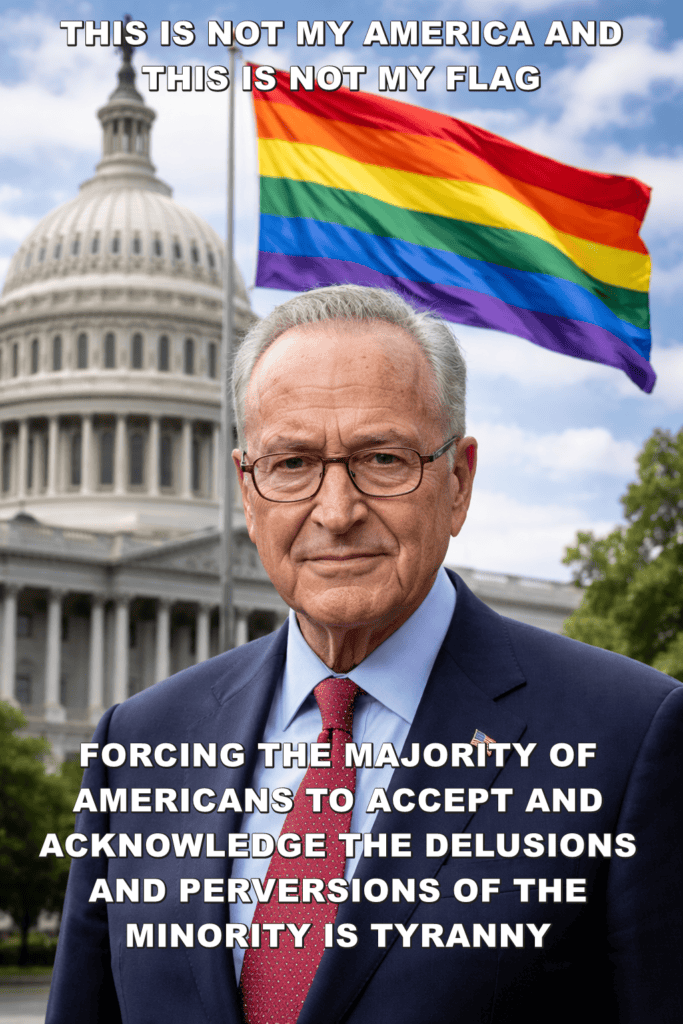
The latest push by Chuck Schumer to give the Pride flag the same federal legal standing as the American flag is just the newest chapter in a long-running drama: progressive communist Democrats turning symbols into battlegrounds for political power.
This isn’t about denying anyone’s dignity. It’s about preserving the meaning of national symbols meant to unite 330 million Americans—not divide them into competing identity blocs.
The Flag That Represents Everyone
The American flag already represents every citizen. Gay, straight, Black, white, rich, poor, immigrant, native-born—it doesn’t matter. The Stars and Stripes are not a niche banner. They are the banner.
When lawmakers attempt to grant the Pride flag equivalent federal protections, they’re not just “adding inclusion.” They’re redefining what national symbolism means. The U.S. flag is tied to the Constitution, to military service, to shared sacrifice, and to the idea of a single republic. It is not a rotating billboard for social movements, no matter how passionately held.
If every movement that claims historical significance receives equal federal standing, where does it end? Do we create tiers of national flags? A patchwork of government-approved causes?
A nation cannot function on symbolic fragmentation.
Stonewall, History, And Political Theater
The dispute surrounding Stonewall National Monument has been framed as an existential battle over civil rights. Let’s be honest: it’s political theater.
Yes, Stonewall Inn is historically significant. Yes, the 1969 riots played a major role in the modern LGBTQ rights movement. That history is not erased because a federal directive limits which flags can fly on government property.
National parks are governed by rules. Those rules specify that U.S., military, historical, and tribal nation flags are permitted. That’s not “hate.” That’s standardization.
When politicians rush to re-raise flags for dramatic press conferences, they aren’t defending liberty—they’re feeding a culture war that keeps voters emotionally charged and divided.
The Trap Of Class And Identity Pandering
Progressive politics today often hinges on slicing Americans into narrower and narrower categories—class identities, grievance identities, protected identities. The strategy is clear: if you can convince enough groups that they are uniquely aggrieved, you can consolidate political power.
But the American promise was never about ranked victimhood. It was about equal justice.
Elevating one group’s symbol to federal parity with the American flag sends a message, intentional or not, that some identities deserve institutional spotlight. That’s not equality. That’s hierarchy by another name.
Civil rights are secured by law, not by flagpoles.
A Nation, Not A Collection Of Factions
National symbols matter because they unify. The moment the government begins treating advocacy flags as national equivalents, it blurs the line between shared citizenship and partisan ideology.
The Pride flag can and should be flown by private citizens, businesses, advocacy groups, and communities who choose to celebrate it. That is freedom. But federal elevation is different. Federal recognition carries weight, permanence, and the force of collective identity.
America’s strength has always been that the Constitution applies to everyone. No additional emblem is required to validate that promise.
Bottom Line
Enough with the divisive politics. Enough with the symbolic escalation. Equality under the law is not improved by multiplying national flags. The American flag already stands for liberty and justice for all. When leaders prioritize identity symbolism over shared citizenship, they weaken the very unity they claim to protect.
If we truly believe every person is equal, then we don’t need separate national symbols to prove it.
We are so screwed.
— Steve