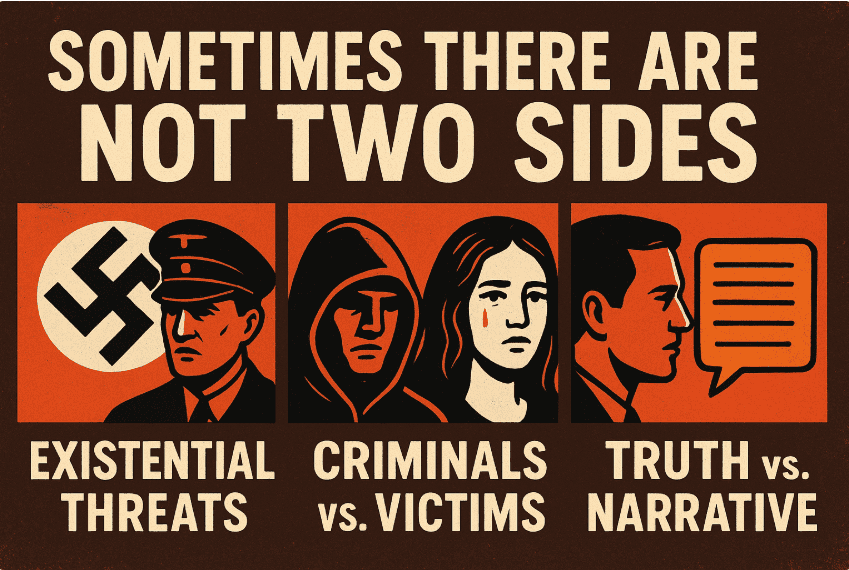
In modern discourse, we are often told that every issue has two sides. That every conflict, every debate, every disagreement deserves balance, nuance, and empathy for both perspectives. Yet sometimes, this insistence on duality obscures a fundamental truth: not all conflicts are symmetrical. Not every story can—or should—be reduced to a “both sides” narrative.
When Cultures Represent Existential Threats
History and current events remind us that some cultures or ideologies are not simply “different points of view” but existential threats to human life, liberty, or dignity. Nazi Germany’s ideology was not just an alternative worldview—it was a blueprint for mass extermination. Today, extremist groups in various parts of the world openly advocate violence against entire populations. Framing these actors as one perspective among many is not just naïve; it can be morally catastrophic.
We see this pattern in authoritarian regimes that systematically oppress, silence, or eradicate minority groups. Here, “both sides” thinking ignores reality: one side seeks survival, the other destruction. To equate them is to betray truth itself.
Criminals Versus Victims: Not a Moral Grey Area
On a smaller scale, individual actions can also defy the false symmetry of “both sides.” When a person commits a violent crime, the distinction between perpetrator and victim is stark. Empathizing with a criminal’s background or motives is human—but equating their suffering with the suffering they caused is morally and factually wrong.
Consider the rise of organized crime, human trafficking, or even routine acts of assault. The victims endure trauma, loss, and fear. The perpetrators wield power to harm. In these scenarios, insisting on moral equivalence distorts justice and erodes social accountability. Some lines cannot—and should not—be blurred.
Truth Versus Narrative
In today’s information landscape, the battle between fact and spin has become relentless. Social media, opinion journalism, and algorithm-driven content often create the illusion of symmetry: every narrative deserves equal attention. But some narratives are intentionally destructive, misleading, or false.
Take climate change denial, election disinformation, or medical misinformation. These narratives are not mere alternate perspectives—they are attacks on human welfare, democracy, and survival. Treating them as “one side of the story” is a moral and intellectual failure. There are times when truth must be defended, even if protecting it makes others uncomfortable.
The Danger of False Equivalencies
The insistence on always presenting “both sides” comes from a desire for fairness, but fairness is not always the measure of truth or morality. False equivalencies create confusion, erode trust, and, in extreme cases, enable violence. When both sides are not morally or existentially equal, pretending they are can have catastrophic consequences.
History offers countless warnings: appeasement of totalitarian regimes, silencing victims to protect perpetrators, and amplifying disinformation while pretending neutrality. In each case, failure to recognize the asymmetry between right and wrong, survival and destruction, truth and lies, led to suffering that could have been mitigated.
Bottom Line
Recognizing that some issues have no “two sides” is uncomfortable. It challenges our instincts to hear every voice and weigh every perspective. But moral clarity is not bias; it is a necessity. Some truths are immutable, some harms are undeniable, and some threats are existential. To ignore this in the name of balance is not open-mindedness; it is complicity.
Sometimes, the world is not a debate stage. Sometimes, it is a battlefield between creation and destruction, justice and harm, truth and deception. In those moments, the courage to recognize the right side is not optional—it is essential.
— Steve