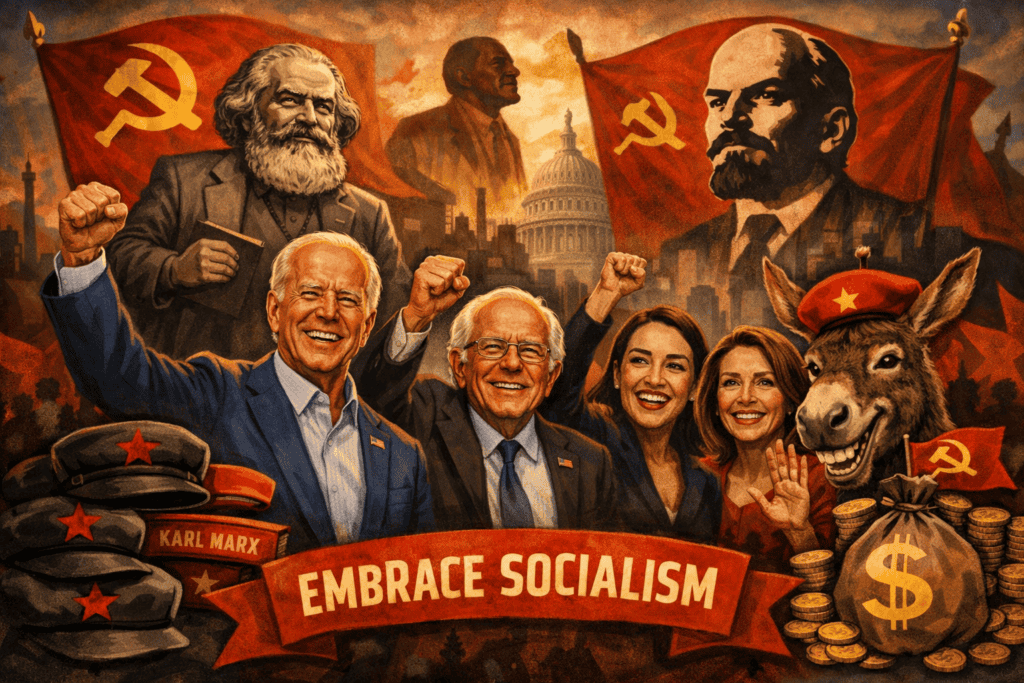
The Soft Sell Of An Easy World
Let’s stop pretending we don’t see what’s happening. Socialism is being rebranded as compassion, fairness, and moral enlightenment. In reality, it’s being marketed to the weak-minded, the chronically resentful, and the something-for-nothing crowd who find competition offensive and achievement intimidating.
Yes, that sounds harsh. It’s meant to.
Because at its core, socialism promises protection from the very forces that build strength: risk, competition, accountability, and consequence. It whispers to the insecure that the system—not their effort—is the problem. It soothes the unaccomplished by telling them that success is theft. It assures the lazy that redistribution is justice.
And it’s working.
Competition Is Not Cruelty
Capitalism isn’t perfect. No human system is. But it is brutally honest. It says: produce value, and you will be rewarded. Fail to do so, and someone else will take your place. That’s not cruelty—that’s reality.
The principles were articulated most famously by Adam Smith in The Wealth of Nations, where he described how voluntary exchange and self-interest, channeled through markets, create prosperity on a scale no central planner could ever design.
Capitalism produces winners and losers because life does. Socialism, by contrast, attempts to eliminate disparity by eliminating the scoreboard. No winners. No losers. Just managed mediocrity overseen by bureaucrats who somehow always end up more equal than everyone else.
If that sounds familiar, it should.
The Education Gap Nobody Wants To Admit
Part of the problem is ignorance. Economics education in America is embarrassingly shallow. Many students graduate from high school without understanding the difference between markets and mandates, between incentives and intentions, and between profit and exploitation.
They’re taught how to balance a budget—but not how nations grow. They learn about “fairness” but not scarcity. They debate income inequality but never grapple with the miracle of wealth creation.
So when social media feeds them a steady diet of outrage—student debt, housing costs, billionaire net worth—they lack the intellectual tools to respond critically. Instead of asking, “How is wealth created?” they demand, “Why don’t I have more of it?”
That question, unmoored from economic literacy, becomes a gateway to grievance politics.
Envy In The Age Of Infinite Comparison
Social media has weaponized comparison. You don’t just compete with your neighbors anymore—you compete with curated illusions of success from around the globe. Every scroll is a reminder that someone else has more.
More money. More beauty. More status. More ease.
And instead of asking how to build, we are encouraged to resent.
Capitalism’s alleged sins—greed, inequality, profit—are magnified endlessly. Its virtues—abundance, innovation, upward mobility—are treated as accidents or privileges. The fact that market-driven growth has lifted hundreds of millions out of extreme poverty worldwide rarely trends on anyone’s feed.
Even countries that once embraced rigid central planning have shifted toward market mechanisms to generate growth. That’s not ideology. That’s evidence.
The Comfort Of Lowered Expectations
Socialism appeals emotionally because it lowers the bar. It promises security without excellence. Stability without striving. Provision without production.
For those afraid of failure, this is intoxicating.
If outcomes are guaranteed, effort becomes optional. If success is suspect, ambition becomes shameful. If the state redistributes rewards, why bother competing in the first place?
That mindset doesn’t produce innovators. It produces dependents.
There is a profound difference between helping those who cannot compete and restructuring society so that no one must. Compassion is noble. Compulsory leveling is corrosive.
Hard Truth: Growth Requires Grit
Progress is uncomfortable. It requires resilience, delayed gratification, and a willingness to lose before you win. It demands that individuals take responsibility for their choices and accept that others may outperform them.
That’s not oppression. That’s adulthood.
If you want to share your wealth, capitalism gives you the freedom to do so. Earn it. Build it. Donate it. Invest it. Create foundations. Start co-ops. The system does not prevent generosity—it enables it.
But you cannot redistribute what has not been created.
What Are The Democrats Selling?
Progressive communist democrat policy proposals share a common assumption: when life is tough, the federal government should step in.
- Healthcare? Expand federal coverage.
- College affordability? Federal funding and debt forgiveness.
- Climate change? Large-scale public investment programs.
- Wealth redistribution through guaranteed income, reparations, etc.
This framework aligns with strands of socialist thought that prioritize centralized coordination over decentralized markets. While progressive communist democrats typically stop short of advocating full state ownership of industry, their cumulative regulation, taxation, and entitlement expansion move policy incrementally in that direction.
Bottom Line
Socialism thrives on insecurity and resentment. It flatters the fearful, excuses the unaccomplished, and seduces the lazy with promises of guaranteed outcomes. Capitalism, flawed but functional, demands effort and rewards value.
One system asks, “What can I build?”
The other asks, “What am I owed?”
The future will belong to those who choose the harder question. The present will belong to the Democrats who refuse to even ask the questions.
Democrats embrace elements of socialism for a mix of ideological conviction, generational alignment, and political strategy. Rising economic anxiety, shifting voter demographics, and frustration with inequality have created fertile ground for government-centered solutions.
The debate now isn’t whether socialist ideas have influence within the party—they clearly do. The real question is how far that influence will go, and whether voters see expanded government as the answer to economic insecurity—or as a step too far.
We are so screwed. And the Republicans do not have an answer or a counterproposal.
— Steve