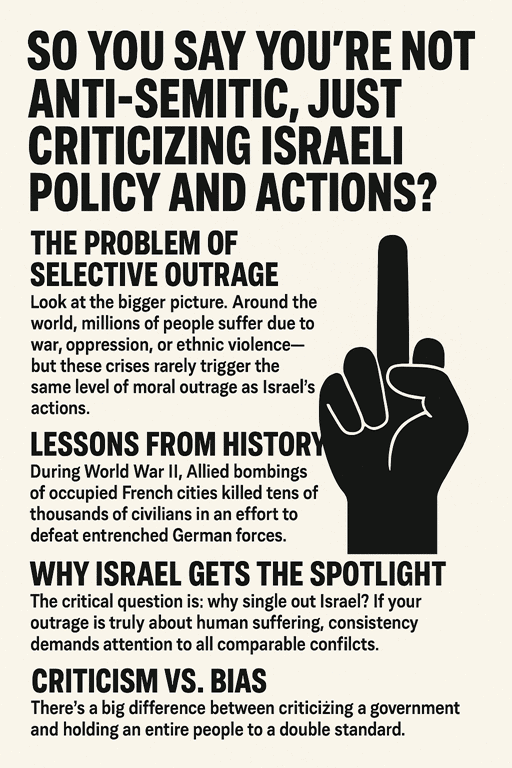
It’s a line you hear all the time: “I’m not anti-Semitic—I’m just criticizing Israel.” At first glance, it sounds harmless, even reasonable. Governments deserve scrutiny. But when that critique is laser-focused on Israel, while ignoring far worse conflicts around the world, the selective outrage tells a different story.
The Problem of Selective Outrage
Look at the bigger picture. Around the world, millions of people suffer due to war, oppression, or ethnic violence, but these crises rarely trigger the same level of moral outrage as Israel’s actions. In Nigeria, extremist groups like Boko Haram have killed tens of thousands and displaced millions, yet these atrocities rarely dominate headlines. In Northern Cyprus, decades of occupation led to the forced displacement of Greek Cypriots. Armenians in the contested regions of Azerbaijan have faced ethnic cleansing. These are clear-cut cases of mass violence and human suffering, yet they are seldom singled out for condemnation.
Meanwhile, Israel, often acting in self-defense against terrorist attacks on civilians, is constantly under fire in the United Nations, government assemblies, and most of all, the media.. Operations in urban areas where militants do not wear uniforms and deliberately hide among civilians are scrutinized for collateral damage, even though similar tactics have occurred in countless other conflicts—context matters. Critiquing Israel without acknowledging comparable situations elsewhere is not just incomplete, it’s selective, biased, and misleading.
Lessons from History
History makes this even clearer. During World War II, Allied bombings of occupied French cities killed tens of thousands of civilians in an effort to defeat entrenched German forces. In Okinawa, U.S. forces faced Japanese troops embedded in caves, resulting in over 100,000 deaths, including civilians. Modern urban conflicts, like Fallujah, Iraq, involved U.S. Marines navigating booby-trapped streets while militants deliberately hid among civilians. These campaigns were brutal, but they rarely prompt the same moral condemnation Israel faces for defending its citizens.
Why Israel Gets the Spotlight
The critical question is: why single out Israel? If your outrage is truly about human suffering, consistency demands attention to all comparable conflicts. When criticism repeatedly targets Israel while ignoring other global atrocities, it risks crossing the line from policy critique into prejudice. Focusing solely on Israel while overlooking similar or worse violence elsewhere raises a troubling question: Is the critique really about policy, or about the people themselves?
Criticism vs. Bias
There’s a big difference between criticizing a government and holding an entire people to a double standard. Legitimate policy criticism is necessary, even healthy. But when it becomes one-sided and divorced from context, it starts to resemble prejudice. Repeatedly singling out Israel while ignoring other conflicts turns a discussion about policy into a narrative that unfairly targets a people rather than a state.
Bottom Line: Ask the Hard Questions
Next time someone claims, “I’m just criticizing Israel,” ask: Why Israel? Why only Israel? If the critique is truly about human rights or military ethics, it should apply universally —not selectively—because context, proportionality, and consistency matter. Without them, critique is not critique, it’s bias by another name.
Selective outrage is a subtle trap. It looks like moral concern on the surface, but it conceals a deeper, often unfair focus. If your goal is genuinely to fight injustice, it must extend beyond borders and ideologies. Otherwise, it’s not moral reasoning, it’s anti-Semitic prejudice dressed up as policy debate.
We are so screwed.
— Steve