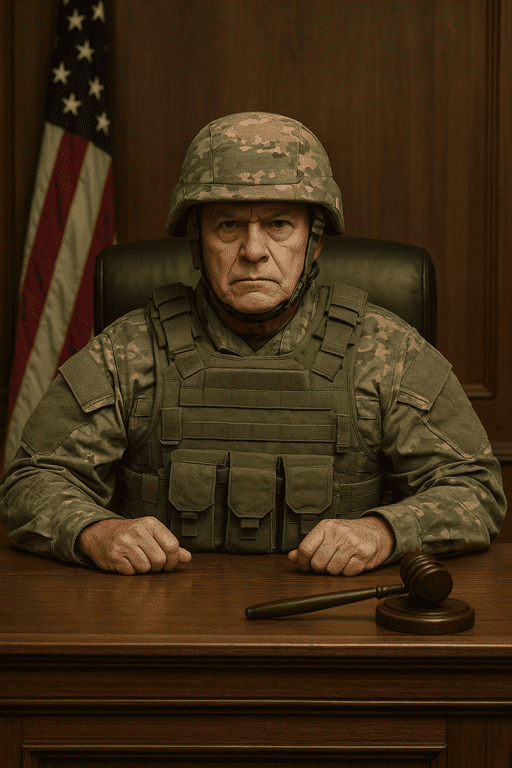
The Bench Is Not the Battlefield
Once again, we find ourselves watching unelected federal judges step into roles they were never meant to fill—directing, obstructing, and sometimes outright undermining the actions of the U.S. military and the President of the United States.
Since when did black robes become part of the chain of command?
When courts start dictating how, when, or if the U.S. military can protect national interests or enforce federal law, something fundamental is breaking down. Judicial review has its place—but commanding troops, defining battlefields, or second-guessing the Commander-in-Chief in real time is not it.
Civilian Judges vs. the Military Mission
Our founders established civilian oversight of the military—not judicial micromanagement of military operations. Civilian control means the President, as Commander-in-Chief, sets the mission. Congress declares war or funds operations.
Judges were never meant to insert themselves into battlefield decisions or national security strategy.
Yet time after time, we’ve seen courts stepping in to block military policies—from detention of enemy combatants, to restrictions on who can serve, to operational rules meant to protect American troops. Judges are deciding questions of military readiness, foreign intelligence, and combatant status—issues for which they have neither training nor a constitutional mandate.
The result? Confusion, paralysis, and danger. Commanders in the field hesitate. Policies stall. Enemies exploit the cracks in our system—because they see that America’s legal elite can now halt a military order faster than a missile can launch.
Due Process for Terrorists, But Not for Soldiers?
We’ve entered an era where terror suspects captured on battlefields—people who have never worn a uniform, who murder civilians, who hide among the innocent—are granted “due process” protections as if they were U.S. citizens picked up at a traffic stop.
Meanwhile, American troops facing impossible situations overseas have to consult legal teams before firing back.
This inversion of justice has turned war into litigation. The courts, in the name of fairness, have given the enemies of America a new battlefield: the courtroom.
Example: The Gitmo Paradox
Take Guantánamo Bay. Detained foreign fighters—many of whom were captured shooting at Americans—used our own court system to challenge their detentions. Some federal judges, from comfortable chambers thousands of miles away, ordered the release of people who went on to rejoin terror groups.
This is not justice. It’s judicial interference masquerading as morality.
The Limits of Presidential Power—Or the Limits of Judicial Power?
There’s a growing illusion that federal judges are the ultimate authority on all things—including military readiness, border security, and national defense. That was never the design.
The President is constitutionally bound to protect the nation. That means enforcing immigration law, securing the borders, and using the tools provided by Congress—including the Insurrection Act—when governors or local officials refuse to uphold federal law.
When state leaders openly defy federal immigration enforcement, or provide sanctuary to those who broke U.S. law to enter, the President doesn’t just have the right to act—he has the obligation to act. Yet, when he tries, federal courts too often step in to stop him.
Governors Playing Politics With National Security
Consider the governors who have refused to cooperate with federal immigration enforcement, even as human trafficking, cartel violence, and fentanyl deaths surge.
Some have even blocked National Guard deployments or prevented state law enforcement from assisting in border operations.
This isn’t a debate over policy—it’s a rebellion against federal law. The Posse Comitatus Act restricts military involvement in domestic law enforcement, yes—but the Insurrection Act was written precisely to deal with situations where state or local officials refuse to uphold federal authority.
When that happens, the President must step in—not to seize power, but to restore it.
Congress: Siding With the Enemies of the State?
Now we see members of Congress employing legal maneuvers, holding endless hearings, and filing court cases to sabotage executive authority during moments of crisis. Instead of supporting national defense, they align themselves—sometimes deliberately—with those who seek to weaken it.
Look at Venezuela. Judicial and legislative interference paralyzed that country’s leadership and hollowed out its ability to maintain order. Foreign powers filled the vacuum, and the people suffered as a result. We’re watching the same dynamics take root in Washington.
When lawmakers and judges decide they can override the President’s duty to enforce laws, we no longer have three coequal branches. We have one dominant branch—the judiciary—wielding a veto over national survival.
When the Rule of Law Becomes a Weapon
We are witnessing a slow-motion progressive communist democrat coup—not through violence, but through paperwork. Federal courts block executive actions. State officials ignore lawful orders. Congress weaponizes procedure to neutralize authority.
And through it all, the enemies of the United States—terrorists, cartels, adversarial regimes—watch and smile.
Bottom Line
If judges want to sit in the war room, let them take the oath, wear the uniform, and face the consequences of command.
Otherwise, they should stay in their lane because national defense cannot run through a courtroom docket.
We are so screwed.
— Steve