When spray-painted images suddenly appear across a city, people often ask the same question: Is this art, or is it graffiti? The answer should be straightforward. If the images are placed on private or public property without the owner’s permission, they are considered graffiti—regardless of how artistic, famous the creator, or socially conscious the message.
Graffiti is vandalism by definition. It defaces buildings, costs property owners money, and leaves neighborhoods scarred. The First Amendment protects speech, but it does not protect destroying or damaging other people’s property in the name of protest or expression.
Disturbing Imagery in Eureka
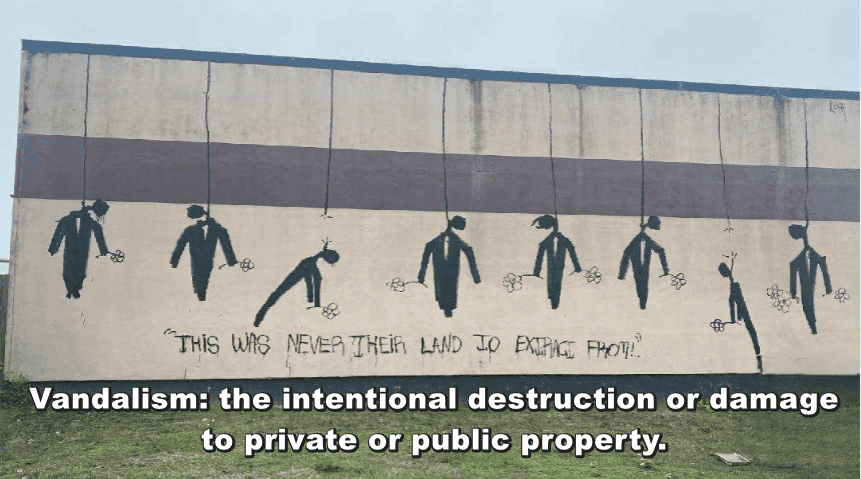
This debate is once again front and center in Northern California, where the city of Eureka has been hit with a string of disturbing graffiti. Police reported spray-painted silhouettes of human bodies hanging from ropes, some with tilted necks and flowers in their hands. The images appeared on several buildings, including a massage shop, on Friday morning.
Chief Brian Stephens of the Eureka Police Department called the figures “disturbing” and confirmed that investigators are treating the graffiti as felony vandalism. Photos posted on the department’s social media accounts show suited bodies suspended from ropes, some falling, others flanked by painted flowers.
One of the tags included the phrase “The Death of Greed,” while another scrawl beneath six painted silhouettes read, “This was never their land to extract from.” The imagery and language sparked fierce online debate. Some saw it as a statement against corporate exploitation and historic injustices. Others called it a grotesque act of defacement that inflicted emotional harm on the community.
The Limits of Protest
Supporters of the graffiti were quick to label the images “art” or “protest.” They argued the figures symbolized societal inequities and long-buried Indigenous struggles in the Eureka area, which was once home to the Wiyot people before settlers brought conflict and disease.
One social media commenter wrote, “The truth hurts and is messy. Just like killing all the natives here on this land was.” Another said, “The message is clear—people are fed up with societal injustices and protesting peacefully via artwork.”
But here lies the fundamental problem: protest, however noble the cause, has limits. Free expression does not extend to spray-painting violent images on someone else’s wall. Property owners did not consent to their buildings being used as canvases for political statements. Cleaning and repainting costs money, and in some cases, the vandalism lowers property values and drives away customers.
No matter how powerful the message, graffiti crosses the line when it is imposed on unwilling parties. The ends do not justify the means.
Graffiti as Vandalism
It’s tempting to romanticize graffiti, especially when it comes with a political edge. Famous artists like Banksy have blurred the line between vandalism and art, creating works that fetch millions on the open market. Yet even Banksy’s defenders can’t deny that his street art often involves breaking the law and defacing property without consent.
The law is clear. Graffiti is vandalism when it is unwanted. It is not a protected form of speech simply because it carries a message. A mural painted with permission is art; a mural painted without permission is graffiti, regardless of the talent behind it.
In Eureka, the images weren’t merely decorative tags or colorful designs. They depicted bodies swinging from ropes—a disturbing sight for residents and children walking the streets. While some interpret the imagery as symbolic, others see only violence and trauma. Police are correct to classify it as felony vandalism.
The Community Cost
Beyond property damage, graffiti has broader consequences. Neighborhoods marked by graffiti often see increases in crime and decreases in business activity. It signals neglect and disorder, leaving residents feeling unsafe and disheartened.
In Eureka, the graffiti does not appear to target any specific group or race, according to police. But that does not erase the unease created by seeing human bodies painted in grotesque positions on public walls. To many, the images evoke death, despair, and violence—not a call to justice.
Property owners, meanwhile, are left with the burden of removal. They must pay out of pocket to erase someone else’s “statement.” And unlike sanctioned murals or community projects, which can beautify a city and spark dialogue, graffiti forces the conversation in an intrusive, damaging way.
Where to Draw the Line
Supporters of graffiti often argue that it is the “voice of the voiceless.” But voices can be raised without vandalizing someone else’s property. Public rallies, art installations with permission, digital platforms, and organized protests are all legitimate outlets for dissent.
The line must be clear. Without property rights, without mutual respect, society unravels. If every person decided to spray-paint their political beliefs on the nearest wall, cities would descend into chaos. Protest does not excuse vandalism. Free speech does not override private ownership.
Bottom Line
Eureka’s “hanging silhouettes” may provoke strong reactions, but they are not art in the legal or ethical sense. They are graffiti—unsanctioned, damaging, and disturbing. One person’s protest may be another person’s trauma. One person’s “art” may be another person’s costly repair bill.
Society can and should wrestle with hard truths about greed, exploitation, and injustice. However, those conversations must occur without compromising the property and peace of others. The limits of protest end where vandalism begins. In Eureka, the debate is loud—but the law is clear.
We are so screwed.
— Steve