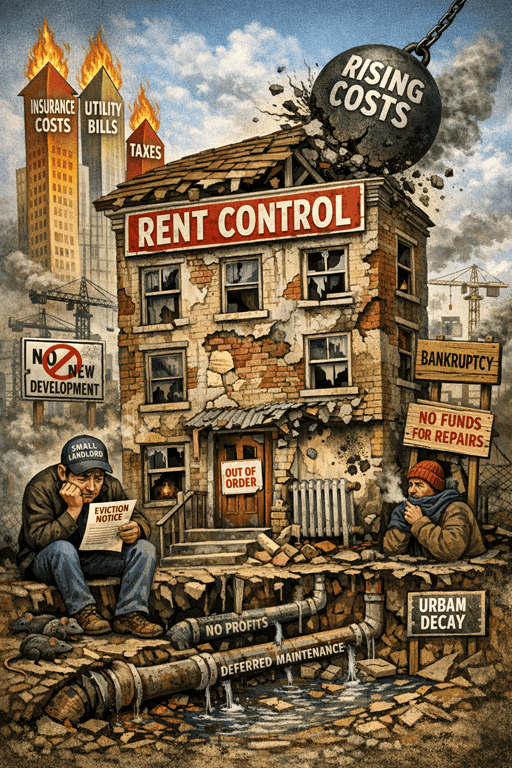
The Policy That Eats Its Own Young.
Rent control is sold as compassion. In reality, it’s economic self-harm dressed up as virtue. When politicians freeze rents in a world of unconstrained, relentlessly rising costs, they aren’t “protecting tenants.” They’re detonating the housing stock from the inside. Insurance spikes. Labor costs surge. Materials inflate. Utilities climb. Taxes never go down. And yet rent is capped by decree, as if gravity itself can be legislated away.
This is not a market failure. It’s a policy failure—self-inflicted and entirely predictable.
Rising Costs Don’t Freeze Just Because Rent Does
When expenses rise faster than allowed rent increases, landlords are forced into triage. Boilers get patched instead of replaced. Roofs get tar instead of rebuilt. Preventive maintenance becomes a luxury item. Eventually, the math turns negative. Buildings slide into deferred maintenance, violations pile up, and tenants suffer the very conditions rent control was supposed to prevent.
Then comes the theater: politicians tour crumbling buildings, wag fingers, and promise “immediate relief.” Relief from what? The rules they imposed. It’s like banning food, then blaming grocers for hunger.
Why Rent Control Strangles New Construction
Developers are not charities. Capital flows where risk-adjusted returns make sense. Rent control tells builders one thing loud and clear: don’t bother. If future income is capped while future costs are not, new construction becomes a gamble with loaded dice. Financing dries up. Projects get shelved. The supply pipeline narrows.
Less supply means higher market rents elsewhere, longer waits, worse quality, and a brutal squeeze on anyone not lucky enough to already be inside a regulated unit. Rent control doesn’t make housing affordable—it makes it scarce.
The Maintenance Death Spiral
Politicians love to pretend neglect is a moral failing. In truth, it’s arithmetic. When revenue is capped below sustainable levels, proper maintenance becomes impossible. The worst irony? Rent-regulated buildings consistently generate more complaints—heat outages, mold, rodents, failing infrastructure—than market-rate ones. That’s not because landlords suddenly became villains. It’s because the system guarantees decay.
And when owners finally throw in the towel, the same officials who caused the damage float takeovers, freezes, or “collective” ownership schemes—often pointing to public housing agencies with their own long histories of dysfunction and disrepair.
The Forgotten Victims: Small Landlords
Lost in the shouting are small landlords who did everything “right.” They bought modest apartment houses as a retirement income. They followed the rules. They maintained their properties. They planned around predictable returns—only to have the goalposts moved repeatedly by lawmakers chasing applause.
What are these owners supposed to do when rent freezes collide with insurance renewals up 30%, labor up 25%, and materials up 40%? Sell at a loss? Default? Defer maintenance and get vilified? Their “greed” is often nothing more than a pension plan that no longer pencils out.
This isn’t sticking it to faceless corporations. It’s wiping out middle-class savers and replacing them with bankrupt buildings and courtroom drama.
When Ideology Replaces Reality
Rent control rests on a fantasy: that housing can be commanded into affordability without consequences. The real world answers back with slums, shortages, and lawsuits. Buildings must practically collapse before renovation is permitted. Investors flee. Tenants get trapped in decaying units. And politicians demand even more control, as if doubling down will fix what doubling down broke.
Bottom Line
Rent control in a rising-cost environment is economic suicide. It discourages new construction, guarantees deferred maintenance, punishes responsible small landlords, and ultimately harms tenants. You can’t freeze one line of the ledger and expect the rest of reality to comply. Housing needs supply, capital, and incentives—not slogans and rent freezes. Ignore that, and the city pays the price in peeling paint, cold radiators, and empty promises.
We are so screwed.
— Steve