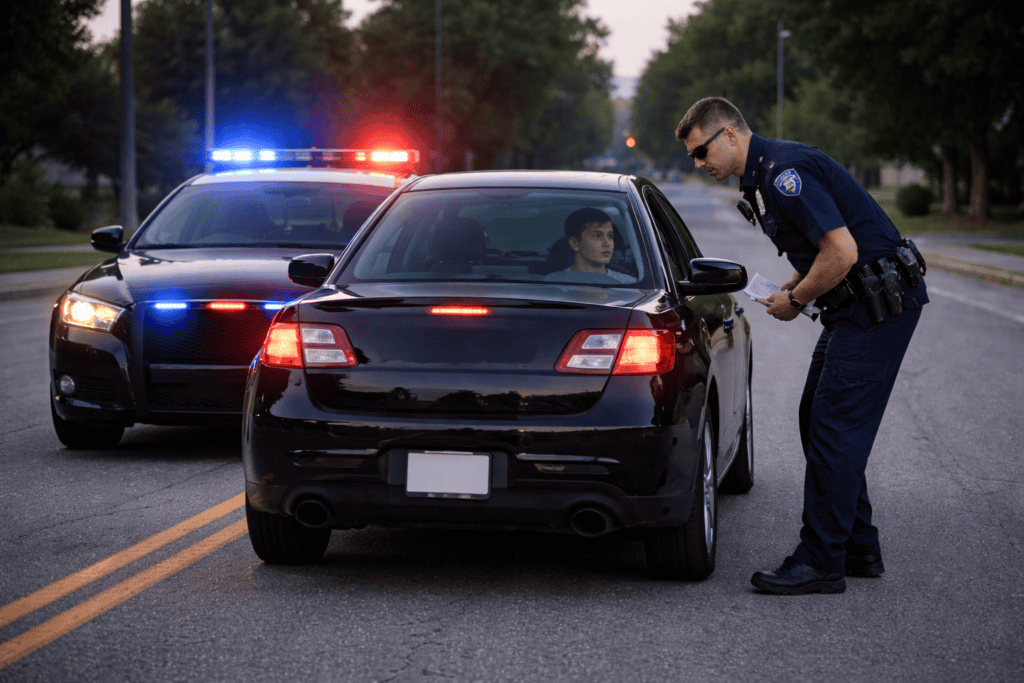
Red and blue lights flash in your rearview mirror. Your pulse jumps. An officer approaches your window and asks a simple question. What you say in the next 10 seconds can shape everything that follows.
Traffic stops feel like conversations. Legally, they are not. They are structured encounters governed by constitutional rules, officer training, and recorded evidence. Body cameras capture your words, tone, and timing. Prosecutors can later replay those seconds in court.
Understanding officer psychology and tactical training—while calmly asserting your rights—can dramatically change the outcome of a stop.
This is educational information, not legal advice. For specific guidance, consult a qualified attorney in your state.
Why Talking Too Much Hurts You
Officers are trained investigators. Their goal during a stop is to confirm or dispel suspicion and gather admissible evidence. Casual admissions, apologies, and explanations often become the strongest evidence in a case.
When an officer asks, “Do you know why I pulled you over?” many drivers try to be helpful:
- “I was probably speeding.”
- “I didn’t see the sign.”
- “I’m sorry, I was going a little fast.”
Those statements are admissions.
Under Salinas v. Texas, the Supreme Court held that you must explicitly invoke your Fifth Amendment right for it to apply. Simply answering questions—or staying silent without invoking—can waive protections.
The Protective Phrase: “No, officer.”
When asked if you know why you were stopped:
“No, officer.”
Calm. Polite. Clear. Nothing more.
This forces the officer to state the alleged violation on record without you supplying evidence.
The Fourth Amendment Trap: Consent Searches
After issuing a warning or ticket, an officer may casually ask:
“You don’t mind if I take a quick look in your car, do you?”
That phrasing is intentional. Officers know many people consent to avoid appearing guilty.
If police already had probable cause, they would not need your permission. When they ask, it is often because they do not yet have legal grounds.
The Fourth Amendment protects against unreasonable searches—but you can waive that protection voluntarily.
The Protective Phrase: “I do not consent to searches.”
Say it calmly and firmly. If repeated, repeat your refusal.
If a search occurs anyway, your refusal may allow a court challenge later. If you consent, courts generally treat the search as lawful.
Detention Or Free To Leave? Know The Difference
There are three basic types of police encounters:
- Voluntary encounter (you are free to leave)
- Investigative detention (a “Terry stop”)
- Arrest
The authority for brief detentions comes from Terry v. Ohio. Officers must have reasonable suspicion supported by specific facts.
In Rodriguez v. United States, the Court ruled police may not prolong a traffic stop beyond its traffic-related purpose without additional reasonable suspicion.
After a ticket is written, the original mission is complete. Continued questioning may require a new justification.
The Protective Phrase: “Am I free to leave?”
If the answer is yes, leave calmly.
If the answer is no, you are detained. At that point, combine your refusal to consent with invocation of your right to remain silent.
Silence Alone Is Not Enough
Many drivers believe staying quiet automatically protects them. It does not.
Under Salinas v. Texas, silence without explicit invocation can be used against you in court.
Jurors may interpret unexplained silence as guilt.
The Protective Phrase: “I invoke my Fifth Amendment right to remain silent.”
or
“I plead the Fifth.”Say it clearly. Then stop talking.
Explicit invocation transforms silence into constitutionally protected conduct.
Miranda And Asking For A Lawyer
If questioning becomes custodial—meaning you are not free to leave and are effectively under arrest—Miranda v. Arizona requires officers to advise you of your rights before interrogation.
The Protective Phrase To Stop Questioning: “I want a lawyer.”
This must be clear and unequivocal. Once invoked, interrogation must stop.
Recording Police: Your First Amendment Shield
Officers sometimes demand that drivers stop recording.
Federal courts, including in Glik v. Cunniffe, have recognized a First Amendment right to record police performing duties in public, as long as you are not interfering.
The Protective Phrase: “I am exercising my First Amendment right to record. I am not interfering.”
Stay calm. Do not argue. Simply state the right.
If told to delete footage: “I will not delete this recording.”
Deletion destroys evidence. Courts have treated forced deletion as a constitutional violation.
Your Phone Is Not A Glove Box
In Riley v. California, the Supreme Court held police generally need a warrant to search the digital contents of a cell phone—even after arrest.
Handing over an unlocked phone can be treated as consent.
If asked for your phone: “I do not consent to any search of my device.”
Do not unlock it voluntarily.
Officer Psychology: Why These Tactics Work
Police are trained in:
- Eliciting admissions through casual conversation
- Framing requests as friendly suggestions
- Using silence and pauses strategically
- Interpreting nervousness as suspicious behavior
Most drivers incriminate themselves within the first minute—not because they are guilty, but because they are uncomfortable.
Calm repetition of short, legally precise phrases disrupts that psychological dynamic without escalating the encounter.
Preparation Matters
- Keep license, registration, and insurance accessible
- Turn on interior lights at night
- Keep hands visible
- Stay polite and non-confrontational
- Cooperation means complying with lawful orders—not volunteering evidence.
- Do not argue roadside. Courts exist for legal disputes. Highways do not.
The Four Core Phrases To Memorize
- “No, officer.”
- “I do not consent to searches.”
- “Am I free to leave?”
- “I invoke my Fifth Amendment right to remain silent.”
These phrases do not guarantee you avoid a ticket. They do help protect constitutional rights and preserve legal defenses.
Bottom Line
Traffic stops are legal encounters, not conversations. Officer psychology and tactical training are designed to gather evidence quickly and efficiently.
The law does not reward nervous explanations. It rewards clarity and restraint.
Stay calm. Stay polite. Use precise language. Assert rights without attitude. Document, do not debate.
In moments when adrenaline is high and decisions are fast, preparation is power.
Do not screw yourself.
— Steve