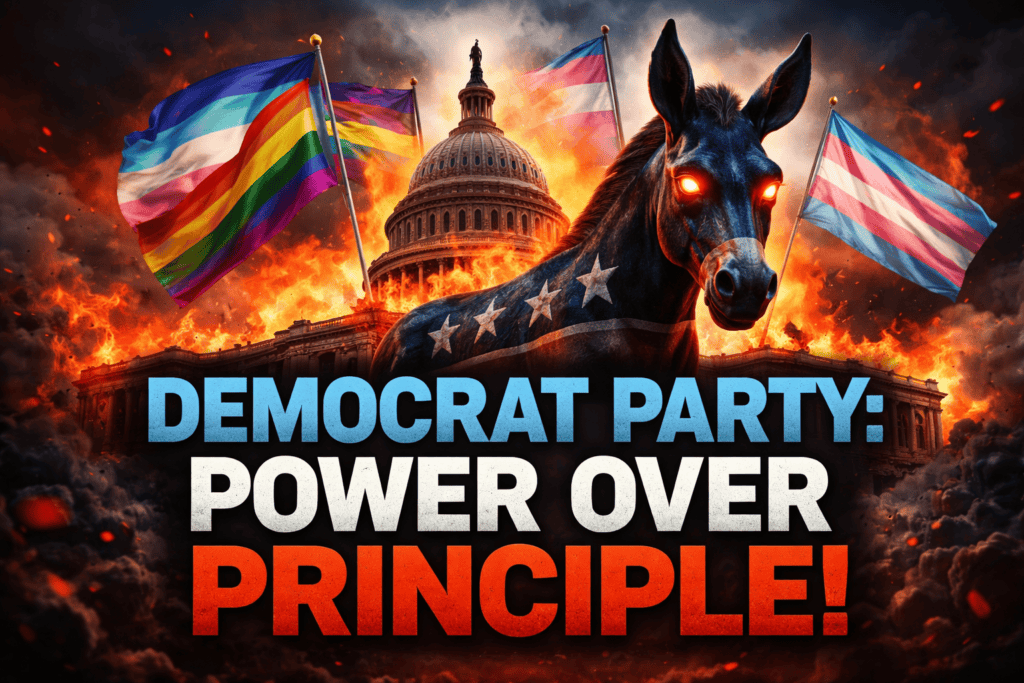
The Party That Abandoned Moderation.
There was a time when Democrats campaigned as pragmatic moderates. They talked about working families, fiscal responsibility, and compromise. That era is gone. Today’s Democratic Party increasingly revolves around ideological purity tests, identity politics, and the aggressive enforcement of cultural orthodoxy.
Moderation has become a political costume rather than a genuine philosophy. Candidates frequently present themselves as centrist during elections, carefully avoiding controversial topics and speaking in vague platitudes about unity and fairness. But once the ballots are counted and the cameras move on, those same politicians often align with the most aggressive elements of their party’s agenda.
The pattern has become predictable. Campaign quietly. Govern radically.
Identity Politics As A Tool Of Power
At the center of this political transformation sits identity politics. Issues surrounding gender ideology, sexuality, and cultural identity have become powerful tools for mobilizing political loyalty and silencing dissent.
Rather than encouraging open debate, many progressive activists attempt to redefine language itself. Basic concepts like gender, sex, and identity are reinterpreted through political frameworks that demand ideological compliance. Those who question these changes risk being labeled extremists, bigots, or enemies of progress.
Language control is not just cultural—it is political. When words lose their common meaning, institutions gain the power to redefine reality. That power then shapes laws, education systems, corporate policies, and media narratives.
The goal isn’t merely cultural influence. It’s political dominance.
Bureaucracy, Regulation, And Expanding Control
The modern progressive agenda often extends beyond cultural debates into a sweeping expansion of bureaucratic power. Policies such as Diversity, Equity, and Inclusion programs, Environmental, Social, and Governance mandates, and various regulatory frameworks increasingly influence hiring practices, corporate governance, and educational priorities.
Supporters argue these policies promote fairness and social justice. Critics argue they undermine merit, individual achievement, and equal opportunity by prioritizing identity categories over qualifications.
At the same time, government institutions have grown more comfortable using administrative authority to regulate speech, finance, and public discourse. Social media censorship, financial deplatforming, and regulatory pressure have all become flashpoints in the debate over political freedom.
For critics of the Democratic Party’s direction, these trends represent more than policy disagreements. They see a growing system designed to reward ideological conformity and punish dissent.
The Hidden Cost Of Cultural Experiments
Another controversial area involves medical and psychological treatments related to gender transition. Critics argue that the rapid expansion of these treatments—especially among young people—has outpaced long-term research and public discussion.
Some former patients, known as detransitioners, claim they were rushed into life-altering medical decisions without adequate evaluation. They point to potential long-term consequences involving fertility, bone density, and psychological health.
These cases have intensified the national debate. Supporters of gender-affirming care argue that it saves lives and provides necessary support. Critics argue that political pressure has suppressed legitimate medical questions.
The deeper issue is whether complex medical decisions are being driven by science—or by ideology.
The Disappearing Moderate Democrat
Perhaps the most troubling trend is the widening gap between campaign rhetoric and governing reality. Democratic candidates often avoid detailed policy discussions during elections, presenting themselves as pragmatic problem-solvers rather than ideological crusaders.
But once elected, many quickly align with sweeping progressive policies that were barely mentioned during the campaign.
This pattern has created growing distrust among voters who feel they were promised moderation but received radical change instead.
Whether intentional or not, the result is the same: a political system where voters struggle to know what candidates truly believe.
Bottom Line
American politics has always involved fierce disagreement, but today’s ideological battles feel different. Cultural identity, language control, and bureaucratic authority are increasingly intertwined with electoral strategy.
For critics of the modern Democratic Party, the concern is simple: when cultural revolution becomes a political tool, power—not principle—drives the agenda.
And once political power becomes the ultimate goal, nearly any social experiment can be justified in its pursuit.
We are so screwed.
— Steve