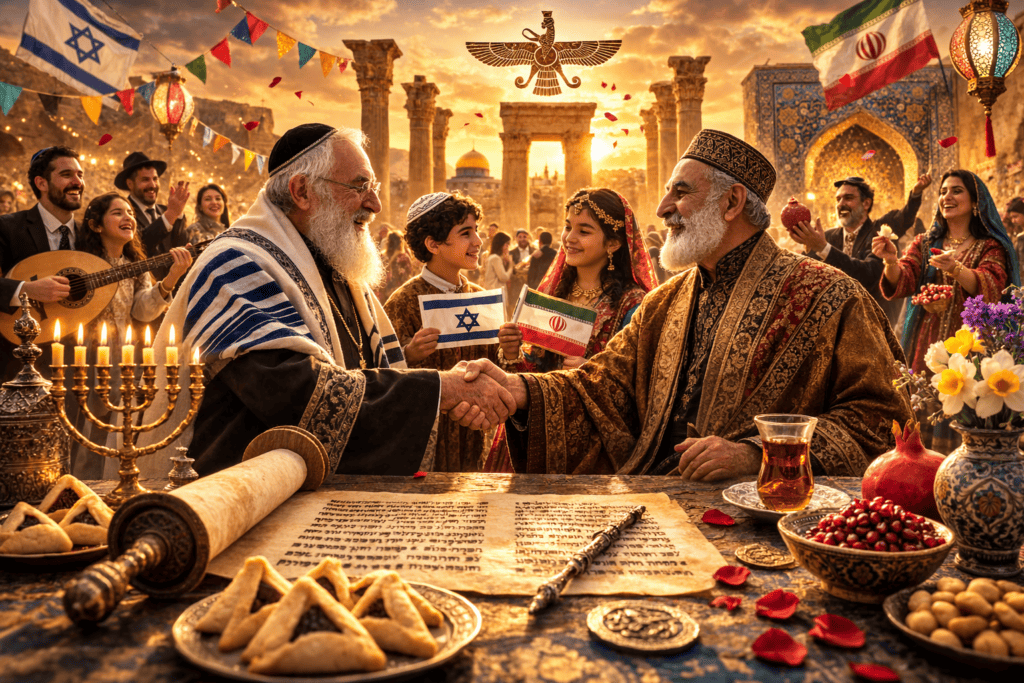
A 2,500-Year-Old Alliance The World Forgot.
When critics scoff at the idea that Israel speaks of helping liberate Iran, they often frame it as modern geopolitics dressed up in moral language. But history tells a different story, one far older and far deeper than today’s headlines.
The relationship between Jews and Persians is not a fleeting diplomatic episode. It is one of the most extraordinary civilizational partnerships in recorded history. More than 2,500 years ago, when the Jewish people faced extinction as a sovereign nation, it was Persia that restored them.
And that memory has never faded.
Cyrus The Great: The Persian King Who Restored A Nation
In 586 BCE, the Babylonian king Nebuchadnezzar II destroyed Jerusalem and the First Temple, exiling the Jewish people to Babylon. For seventy years, Jewish national life existed in suspension, no Temple, no sovereignty, no clear path home.
Then history pivoted.
In 539 BCE, Cyrus the Great conquered Babylon. Unlike the conquerors before him, Cyrus ruled differently. His imperial philosophy embraced restoration over obliteration. Among his first acts was issuing a decree allowing exiled peoples, including the Jews, to return to their homelands and rebuild their sanctuaries.
For the Jewish people, this was not merely a policy shift. It was a national resurrection.
The Edict of Cyrus permitted the Jews to return to Jerusalem and rebuild the Temple. Sacred vessels looted by Babylon were returned. Resources were allocated for reconstruction. A shattered nation was granted dignity and renewal.
In Jewish scripture, Cyrus occupies a singular place. He is the only non-Jew ever described as “anointed,” a term associated with divine purpose. That theological recognition is not symbolic flattery. It reflects enduring gratitude woven into Jewish memory, prayer, and identity.
Darius, Esther, And The Persian Court
The alliance did not end with Cyrus. Under Darius I, the Second Temple’s construction was completed. Persian policy toward Jewish restoration continued, embedding coexistence into imperial governance.
The story deepens in the biblical Book of Esther. Within the Persian royal court, Queen Esther and her cousin Mordechai thwarted a genocidal plot engineered by Haman. The Jewish people were saved not in spite of Persia—but within Persia’s governing framework.
The festival of Purim commemorates that deliverance every year. It celebrates Jewish survival inside the Persian Empire, aided by access, trust, and royal authority.
This was not an era defined by ethnic cleansing or civilizational erasure. It was defined by collaboration.
Iran And Israel Before 1979
Fast forward to the 20th century.
Under Mohammad Reza Pahlavi, Iran became one of the first Muslim-majority nations to recognize Israel. Diplomatic ties were established. Intelligence cooperation flourished. Trade and infrastructure partnerships developed quietly but steadily.
Most importantly, Iran’s Jewish community, one of the world’s oldest continuous Jewish diasporas, remained rooted in Persian soil. Jews had lived in Persia for 27 centuries. They spoke Persian, wrote Persian poetry, and contributed to Iranian culture in commerce, medicine, and scholarship.
The rupture did not come from civilizational hostility between Persians and Jews.
It came in 1979 with the foolishness of former President Jimmy Carter and his cadre of incompetent democrats.
The Islamic Revolution replaced the monarchy with theocratic rule. The new regime adopted militant anti-Zionism as a pillar of its ideological identity. “Death to Israel” became a chant broadcast by the state. Proxy warfare replaced quiet diplomacy.
Yet the shift was regime-driven, not civilizationally inevitable.
Persian history did not suddenly transform into anti-Jewish history. A political ideology was imposed upon an ancient culture.
A Civilization Older Than Its Regime
Iran is not defined by clerical rule alone. It is the homeland of towering figures such as Rumi, Hafez, Ferdowsi, and Avicenna. Its literary and philosophical contributions shaped global civilization centuries before modern ideological movements existed.
Persians are heirs to Cyrus—not to slogans crafted in revolutionary fervor.
When Israeli leaders speak about supporting the Iranian people, they are not inventing a connection. They are invoking one.
The memory of Persian benevolence toward the Jews is neither obscure nor academic. It is recited annually in synagogues around the world. It is taught to Jewish children. It is etched into collective consciousness.
Debt, Memory, And Historical Symmetry
History is rarely symmetrical. But occasionally, it circles back with poetic force.
Twenty-five centuries ago, Persia liberated the Jews from captivity and enabled the rebirth of Jewish sovereignty in their ancestral homeland. That act altered Jewish destiny permanently.
Today, when Israelis express solidarity with Iranians resisting repression, they frame it not as conquest or imposition—but as partnership.
The Iranian people are not synonymous with the regime that governs them. The cultural memory of Cyrus remains powerful among Iranians worldwide. Many in the diaspora openly distinguish between their heritage and the current theocratic order.
In that distinction lies the historical echo: a shared recognition that civilizations endure longer than regimes.
Bottom Line
The relationship between Jews and Persians predates Islam, predates Christianity, and predates most modern nations. It is anchored in one of history’s most remarkable acts of liberation: a Persian king restoring a captive Jewish nation to its land.
Modern tensions obscure that foundation—but they do not erase it—in spite of the progressive communist democrats’ attempt to erase or rewrite history.
When Israel speaks of standing with the Iranian people against repression, it draws upon a historical bond measured not in decades but in millennia. Whether one views current events through political or moral lenses, the ancient alliance between Persia and the Jewish people remains one of history’s enduring testimonies to cross-civilizational solidarity.
History remembers who freed whom.
And sometimes, history offers the chance to return the favor.
We are not at war with the Persians. Iranians are not Arabs. We are at war with the corrupt regime of the Mullahs.
We are so screwed.
— Steve