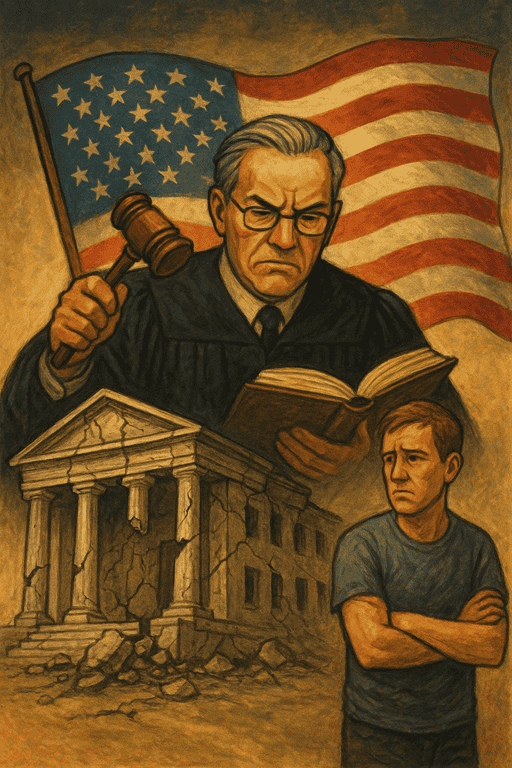
Something has gone fundamentally wrong in America.
The institutions that once symbolized fairness, accountability, and representative government are breaking down under their own contradictions. Judges are behaving like legislators. Bureaucrats operate beyond public oversight. Law enforcement has become political. And ordinary citizens, watching helplessly, wonder whether their voices still matter.
At the core of this institutional crisis lies a betrayal of America’s founding idea: that power belongs to the people and flows upward through their elected representatives. Yet decisions that shape national policy are increasingly made not by Congress, but by federal judges, regulatory boards, and administrative agencies that answer to no electorate. What was once self-government has given way to rule by decree, government by the unelected and unaccountable.
The Rise of a Judicial Aristocracy
Judges were never meant to govern. Their role was to interpret the law, not to write it from the bench. But in modern America, federal courts frequently overstep their boundaries — blocking executive orders, rewriting immigration policy, and shaping regulations through creative reinterpretation.
It defies common sense that a single federal judge can stop the deportation of convicted felons or illegal entrants based on vague and shifting notions of “human rights.” These rulings override the will of the people and the authority of their representatives. When courts become the final arbiters of every political dispute, democracy turns into judicial rule, an unelected aristocracy in robes.
The impact is profound. Judicial interference undermines national security, immigration enforcement, and the balance of powers itself. It fuels the perception that laws are enforced unequally — that ordinary Americans must obey the rules, while elites rewrite them at will.
Two-Tier Justice and the Politicized Police
Even the institutions charged with enforcing the law have grown inconsistent. Across major cities, violent crime rises while prosecutors downgrade felonies to misdemeanors or decline to pursue them at all. Citizens who report crimes are told there aren’t enough officers available, yet those same agencies seem to find abundant resources to police speech and opinion.
When citizens are questioned for “offensive” social media posts or for participating in politically unfashionable protests, it’s clear that enforcement is no longer neutral. Meanwhile, those aligned with establishment-approved causes receive sympathetic coverage, lenient treatment, or outright exemption.
This double standard has bred a dangerous cynicism: one set of laws for the favored, another for everyone else. Protesters from some movements are treated as activists; others as threats. Hate crimes against certain groups are broadcast nationwide, while similar attacks on others are ignored or downplayed.
When justice depends on who you are or what you believe, it ceases to be justice at all. It becomes a weapon of ideology, and once that weapon turns inward, no one is safe.
Immigration Without Consent
The same pattern of overreach and evasion defines immigration policy. For decades, Americans have demanded secure borders and an orderly, lawful process for entry. Instead, they’ve received confusion, obstruction, and courtroom interference.
Time after time, judges and bureaucrats have blocked deportations, delayed enforcement, or reinterpreted statutes to favor open-ended migration. These decisions are often framed as compassionate, yet they bypass the democratic process entirely. The result is not fairness, but frustration, a population that feels its consent no longer matters.
The question is not whether America should be open or closed, but who decides. If courts and agencies, rather than voters and legislators, determine who enters and stays, sovereignty itself becomes an illusion.
The Cultural Unraveling
Beneath these institutional failures runs a deeper moral fracture. Once, Americans shared a cultural core, a common belief in fairness, order, and mutual respect. Today, that unity has eroded. Working-class communities are dismissed as “backward.” Expressions of faith or patriotism are mocked. Entire segments of the population are told their concerns about crime, borders, or identity are unacceptable.
This moral arrogance from elite institutions is the glue dissolving America’s cohesion. When millions of citizens feel unheard or vilified, polarization deepens. Civic life withers. Communities crumble under rising crime and cultural drift.
What we see today is not strength but fragmentation, a society breaking apart under the weight of imported ideologies, bureaucratic excess, and moral confusion. Those insulated by wealth or privilege remain untouched, while ordinary citizens bear the cost of policies they never approved.
Bottom Line: Restoring Justice and Accountability
The crisis America faces is not only political, it is existential. When courts overrule the people, when police enforce ideology instead of law, and when citizens lose faith in their institutions, democracy itself begins to decay.
Rebuilding trust requires more than reform; it demands restoration. Judges must return to interpreting law, not inventing it. Law enforcement must serve all citizens equally, without regard to politics. Bureaucrats must remember they exist to implement the people’s will, not to replace it.
True democracy is not merely voting every few years; it is the constant assurance that those in power remain answerable to those they govern. America’s exceptionalism was built on that principle. If it is to survive, power must return to its rightful owners: the American people.
We are so screwed.
— Steve