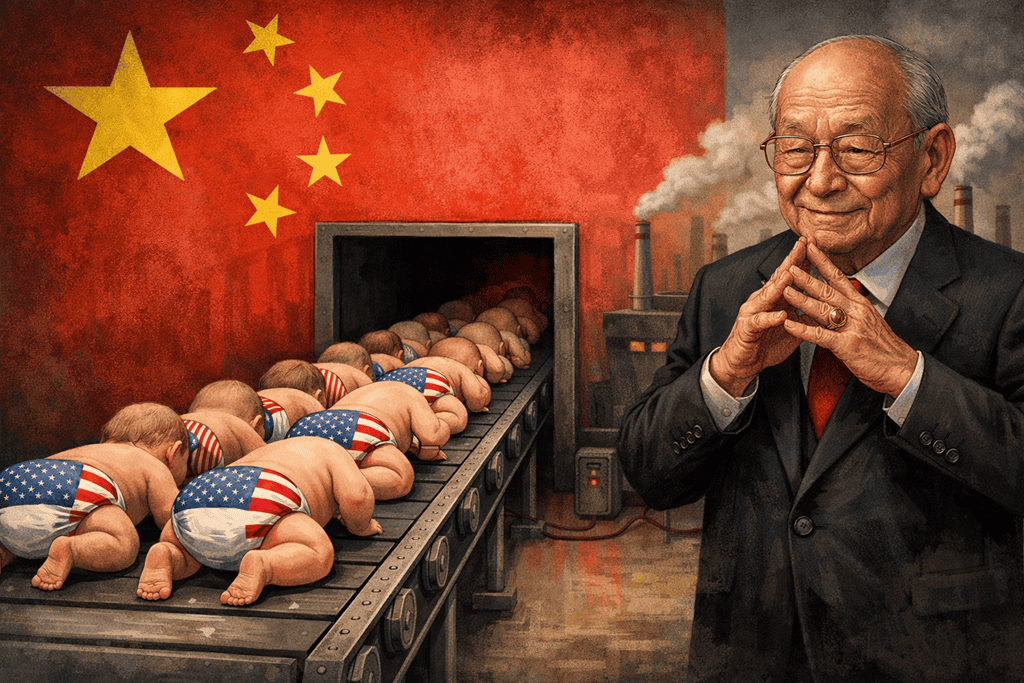
An egregious violation.
The Chinese billionaires having dozens of US.-born babies via surrogate
Clerks working for family court Judge Amy Pellman were reviewing routine surrogacy petitions when they spotted an unusual pattern: the same name, again and again.
A Chinese billionaire was seeking parental rights to at least four unborn children, and the court’s additional research showed that he had already fathered or was in the process of fathering at least eight more—all through surrogates.
When Pellman called Xu Bo in for a confidential hearing in the summer of 2023, he never entered the courtroom, according to people who attended the hearing. The maker of fantasy videogames lived in China and appeared via video, speaking through an interpreter. He said he hoped to have 20 or so U.S.-born children through surrogacy—boys, because they’re superior to girls—to one day take over his business.
Several of his kids were being raised by nannies in nearby Irvine as they awaited paperwork to travel to China. He hadn’t yet met them, he told the judge, because work had been busy.
Pellman was alarmed, according to the people who attended the hearing. Surrogacy was a tool to help people build families, but what Xu was describing didn’t seem like parenting, the people said.
The judge denied his request for parentage—normally quickly approved for the intended parents of a baby born through surrogacy, experts say. The decision left the children he’d paid for to be born in legal limbo.
The court declined to comment on Xu’s case.
Another wealthy Chinese executive, Wang Huiwu, hired U.S. models and others as egg donors to have 10 girls, with the aim of one day marrying them off to powerful men, according to people close to the executive’s education company.
Other Chinese clients, usually seeking more typical numbers of babies, are high-powered executives lacking the time and inclination to bear their own children, older parents or same-sex couples, according to people who arrange surrogacy deals and work in surrogacy law. All have the wealth to go outside China while maintaining the privacy needed to manage potential logistical, publicity and legal issues back home. Some have the political clout to avoid censure.
The market has grown so sophisticated, experts say, that at times Chinese parents have had U.S.-born children without stepping foot in the country. A thriving mini-industry of American surrogacy agencies, law firms, clinics, delivery agencies and nanny services—even to pick up the newborns from hospitals—has risen to accommodate the demand, permitting parents to ship their genetic material abroad and get a baby delivered back, at a cost of up to $200,000 per child. <Source>
A Founding-Era Question With Modern-Day Consequences
Who is a natural born citizen? That question isn’t academic trivia. It is a constitutional gatekeeper designed to protect American sovereignty, citizenship, and exceptionalism. Yet today, it’s treated like an inconvenience—something to be massaged, blurred, or redefined whenever political power demands it. The Founders didn’t stumble into this phrase by accident. They deliberately chose it, and they understood exactly what it meant.
The real question now is simple and explosive: will the Supreme Court do the right thing, or will it continue to let constitutional clarity drown in political cowardice?
The Founders Were Not Confused—We Are
The idea that the Founders left “natural born citizen” vague is historical nonsense. In the late 18th century, legal and political thinkers shared a common vocabulary. One of the most influential sources was Emer de Vattel’s The Law of Nations, which clearly defined natural-born citizens as those born in a country to parents who were citizens.
This wasn’t obscure theory gathering dust on a shelf. The Founders read it, cited it, circulated it, and relied on it. They were obsessed with one overriding concern: preventing foreign influence from capturing the highest office in the land. That concern wasn’t paranoia—it was prudence earned through revolution, espionage, and imperial meddling.
A president was not meant to merely be born on American soil. He was meant to be born into American allegiance.
Why Parental Citizenship Actually Matters
The modern obsession with geography alone—pinning everything on birthplace—misses the entire point. Allegiance does not magically attach itself to a newborn because of longitude and latitude. Loyalty, culture, and national identity begin in the home. The Founders understood that children inherit more than eye color from their parents; they inherit political identity.
That is why parental citizenship mattered then and still matters now. The presidency was designed to be insulated from divided loyalties, foreign attachments, and imported ambitions. Pretending otherwise isn’t enlightened—it’s reckless.
How The Courts Muddy What Was Once Clear
Over time, especially after late-19th-century court decisions, the legal waters were intentionally muddied. Judicial shortcuts blurred the distinction between general citizenship and natural-born citizenship, even though the Constitution treats them as separate concepts with distinct purposes.
The Fourteenth Amendment addressed citizenship broadly. It did not rewrite presidential qualifications. That silence was not an accident. Yet modern legal interpretations act as though silence equals permission to redefine the Constitution by judicial drift.
That’s not constitutional interpretation. That’s constitutional erosion.
Why This Debate Is About Sovereignty, Not Personalities
This isn’t about liking or disliking individual politicians. It’s about whether the United States still takes its own founding rules seriously. If “natural born citizen” can mean whatever is politically convenient in a given election cycle, then the Constitution isn’t supreme—politics is.
A nation that cannot define its own citizenship standards for its highest office is a nation surrendering control over its future. Exceptionalism doesn’t survive on slogans. It survives on boundaries, standards, and the courage to enforce them.
The Supreme Court’s Moment Of Truth
The Supreme Court exists to defend the Constitution, not reinterpret it into harmless mush. This is one of those moments that will define whether the Court serves the Founders’ intent or modern political pressure.
Dodging the issue preserves nothing. Clarifying it preserves everything.
Bottom Line
The Founders knew exactly what a natural-born citizen was, and they designed the presidency accordingly. Pretending otherwise insults history, weakens sovereignty, and invites foreign influence by design. If the Supreme Court wants to preserve American citizenship and constitutional integrity, it must stop hiding from clarity and start defending it.
We are so screwed.
— Steve