Even as a free-speech proponent, one must admit that common sense dictates a clear boundary: you do not compromise national security by giving civilians with a press pass unfettered access to roam the halls of a military facility.
Yet that is precisely what Pentagon reporters enjoyed for decades—walking into sensitive areas, overhearing imprudent conversations, and cultivating a “gotcha” culture that too often undermined American security.
Worse still, a significant portion of the corporate press corps is not only skeptical of the military but also openly hostile. Their political ideology often runs counter to American values, and their pursuit of “scandals” regularly aids our adversaries. Some reporters, intentionally or not, have even acted as conduits for hostile foreign powers.
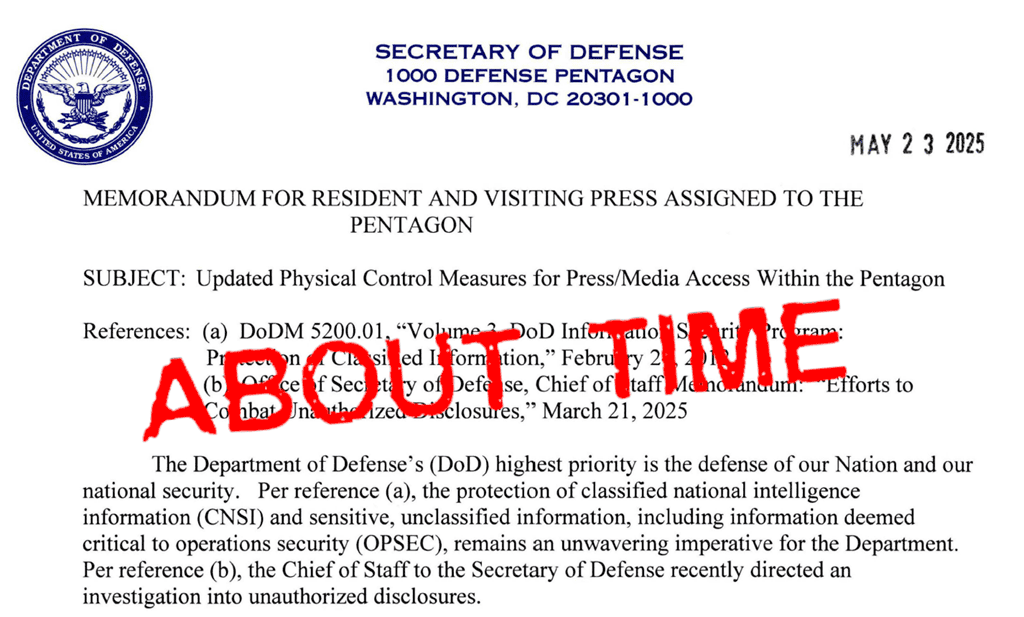
That’s why I can only congratulate Secretary of War Pete Hegseth for having the courage to sign a 17-page memo that finally places commonsense restrictions on the media’s access and conduct inside the Pentagon.
What the New Rules Say
The memo and supporting directives, issued between May and September 2025, lay out the following key restrictions:
- Mandatory pledge: Journalists must sign a written pledge not to publish any information that has not been formally authorized for release. This includes not only classified material but also “controlled unclassified information” (CUI)—a category of sensitive data that, while not secret, can still harm national security if exposed.
- Unauthorized disclosure ban: Any release of restricted or unapproved information could result in immediate loss of credentials.
- Credential suspension: Reporters who fail to comply—or who are reasonably deemed a “security or safety risk”—can have their access suspended or revoked.
- Physical access limits:
- Reporters can move unescorted only in limited areas, such as the press office, food court, and courtyard.
- To reach most offices, including those of the Secretary of Defense or the Joint Staff, an official escort is now mandatory.
- Entire floors of the Pentagon are now off-limits without prior approval.
- Escorted reporting: Journalists must request and receive escorts for interviews or coverage outside the designated press areas.
Why These Rules Were Needed
For decades, the Pentagon’s press corps enjoyed access privileges far beyond those available at any other secure government facility. This is not how national-security institutions operate.
Consider:
- The New York Times has published multiple leaks that materially damaged U.S. military operations.
- Major outlets have revealed troop movements, covert operations, and classified methods—all in the name of “transparency.”
- “Accidental” disclosures by careless Pentagon personnel were often overheard by journalists roaming the halls.
In any other context, this would be treated as reckless negligence. Yet the press considered it their entitlement.
Secretary Hegseth is right to draw the line. As he bluntly put it:
“The press is no longer allowed to roam the halls of a secure facility. Wear a badge and follow the rules — or go home.”
Predictable Media Outrage
The reaction from the corporate press was instant and furious. Veteran Pentagon reporters and press associations called it “intimidation,” a “direct assault on independent journalism,” and even “un-American.”
Kevin Baron, a longtime Pentagon reporter, whined to TIME: “It’s 100% an intimidation tactic. It’s 100% an attempt to kill transparency…”
Translation: reporters resent losing their privileged position to snoop around and publish what they please, even if it compromises security.
Press organizations claim the rules amount to “prior restraint.” In truth, they amount to restraint of reckless and irresponsible behavior that no serious military would tolerate.
Bottom Line
America cannot afford a press corps that acts as a fifth column inside the Department of War. Reporters are free to criticize policy, grill officials at briefings, and investigate with outside sources. Still, they do not have the right to jeopardize lives and national security by exploiting access to secure facilities.
Secretary Hegseth’s move is not an “attack on the First Amendment.” It is the long-overdue application of common sense.
For too long, a mostly hostile media has abused its access. Their wings have finally been clipped—and America is safer for it.
We are a little less screwed today.
— Steve