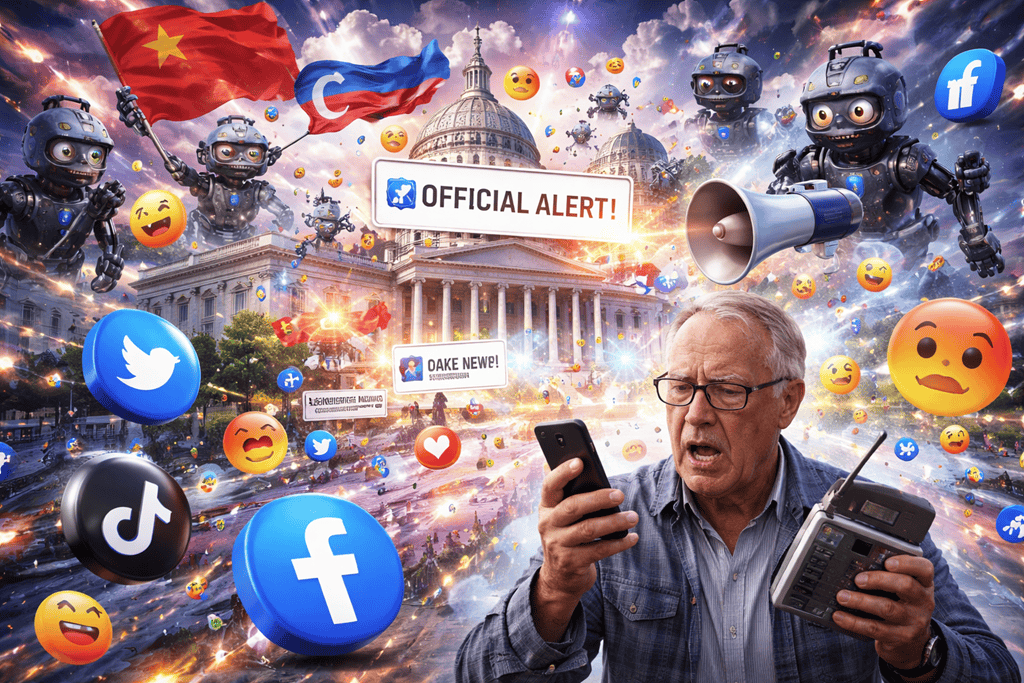
When “Official” Became Optional
Once upon a time, government announcements meant something. If your city changed a traffic pattern, if a state issued a health warning, if the federal government updated an emergency directive, you could reasonably expect to hear about it through channels designed to reach everyone. Today? Good luck. Increasingly, critical public information is being tossed onto social media platforms like it’s a meme, not a mandate.
This isn’t innovation. It’s abdication.
When agencies rely on platforms that require accounts, algorithms, constant scrolling, and tolerance for data harvesting, they automatically exclude millions of people. Older Americans. Rural residents. Privacy-conscious citizens. People who don’t want their civic awareness bundled with targeted ads and behavioral tracking. Public information is supposed to be public. Not gated behind a login screen and an engagement metric.
Democracy Shouldn’t Require A Smartphone
There is a dangerous assumption baked into modern government communication: that everyone is online, always connected, and fluent in the ever-changing grammar of social media. That assumption is false—and reckless.
A smartphone does not equal media literacy. A verified account does not equal credibility. And a trending post does not equal truth. Yet here we are, watching agencies replace press releases with posts, briefings with reels, and accountability with comment sections.
Worse, the same platforms used to share “official updates” allow anyone—literally anyone—to reply, remix, distort, and outright fabricate information in real time. The government speaks, and immediately a swarm of amateurs, ideologues, and algorithm-chasing provocateurs pile on. Truth gets buried under vibes.
Welcome To The Bot Swamp
Social media isn’t just noisy. It’s compromised.
Opaque foreign influence operations, automated bot armies, and coordinated misinformation campaigns thrive in these spaces. They don’t just respond to government posts; they shape the narrative around them. And because platforms are notoriously secretive about how content is amplified or suppressed, citizens have no way to know whether they’re seeing reality or a manipulated illusion.
This is not a hypothetical risk. It’s a documented one. And yet government agencies continue to pour official communications into systems they do not control, cannot audit, and refuse to seriously regulate.
The Collapse Of Legacy Media Left A Vacuum
Part of the blame lies with the slow-motion failure of legacy media. Once tasked with filtering, verifying, and contextualizing public information, many outlets now chase outrage, clicks, and partisan heat instead. Coverage is selective. Nuance is optional. Trust is gone.
Into that vacuum stepped social media—fast, chaotic, and utterly unsuited to serve as the backbone of a functioning civic information system. Instead of fixing what was broken, we replaced it with something worse and called it progress.
Why They’re Really Trying To Kill AM Radio
And then there’s AM terrestrial radio. The last truly universal broadcast medium. Free. Anonymous. Accessible. Especially in vehicles. Especially during emergencies.
No subscriptions. No algorithms. No data harvesting. Just signal.
So, of course, it has to go.
Phasing out AM radio in cars isn’t about sound quality or modernization. It’s about control. AM radio reaches people social media doesn’t—and never will. It reaches the disconnected, the skeptical, the elderly, the rural, and the independent-minded. In a world obsessed with curated narratives and platform dependency, that’s inconvenient.
Bottom Line
Public information should never depend on a private platform’s business model. Government communication should prioritize reach, clarity, and inclusivity—not engagement metrics and viral potential. When official updates are filtered through social media, democracy becomes performative, manipulable, and exclusionary.
If we keep mistaking platforms for infrastructure, we shouldn’t be surprised when the public loses trust, misses critical information, and checks out entirely. This isn’t modernization. It’s mismanagement—with consequences.
We are so screwed.
— Steve