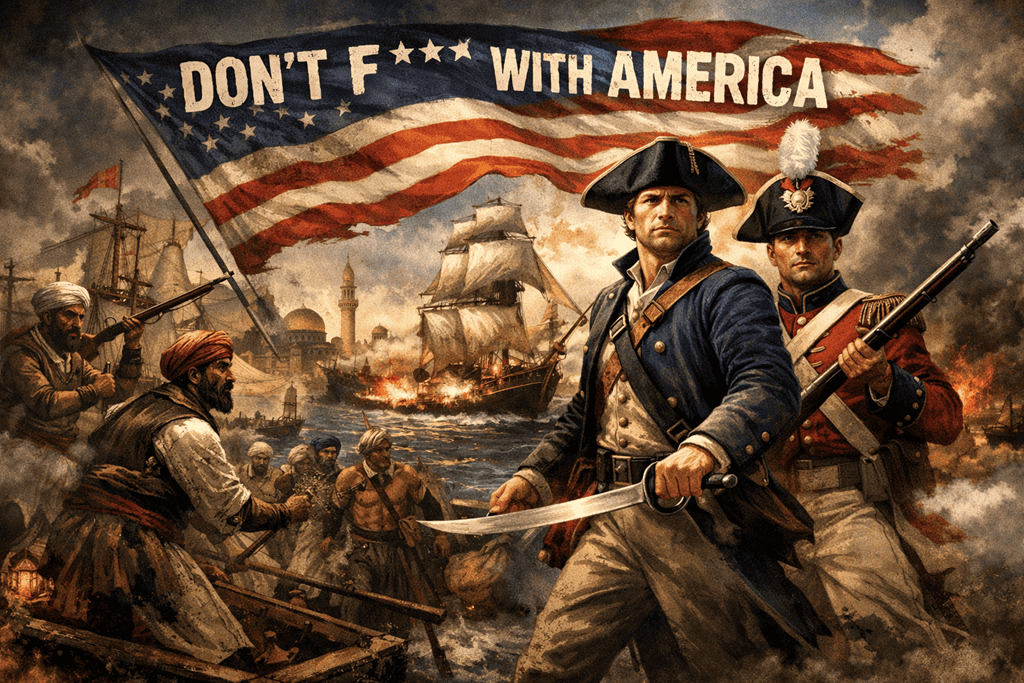
From the Halls of Montezuma
To the Shores of Tripoli;
We fight our country’s battles
In the air, on land and sea;
First to fight for right and freedom
And to keep our honor clean;
We are proud to claim the title
of United States Marine.
The Ottoman Empire was a major world power for nearly six hundred years. Its reach stretched across three continents, and its influence shaped trade, politics, and warfare from Eastern Europe to North Africa. But one of the least discussed, and most uncomfortable, chapters of that history involves the Ottoman-backed corsairs we now call the Barbary pirates.
For centuries, these pirates stalked the seas from the coast of Portugal, through the Strait of Gibraltar, and across much of the Mediterranean. They raided ships, coastal villages, and entire towns. Their goal was simple: profit through plunder and slavery.
Between roughly 1580 and 1780, historians estimate that more than two million Europeans were captured and enslaved by the Barbary states. Men, women, and children were taken back to North Africa and sold, ransomed, or forced into hard labor. This wasn’t a short-lived crisis. It went on for generations.
And Europe let it happen.
The Age of Appeasement
Rather than confront the problem head-on, Europe’s major powers chose a strategy that should sound familiar: appeasement.
Portugal, Spain, France, England, the Dutch Republic, Sweden, and other states agreed to pay tribute to the Barbary States. Vast sums of money, ships, weapons, and luxury goods flowed south in exchange for “protection.” As long as the payments kept coming, pirate attacks on those nations’ ships would be reduced—or so the theory went.
In reality, it was international extortion.
For literal centuries, Europe’s great powers decided it was cheaper, safer, and politically easier to pay pirates than to fight them. The most valuable trade routes in the world were effectively controlled by criminal regimes, and everyone knew it. But no one wanted to be the first to challenge the system.
Then America showed up.
When America Refused to Pay
After independence, American merchant ships lost the protection of the British Navy. Almost immediately, Barbary pirates began seizing American sailors and demanding ransom. The new United States, broke, militarily weak, and dismissed by Europe as a backwater experiment, was given the same offer everyone else had accepted.
Pay tribute, or else!
America didn’t have the money. More importantly, it didn’t have the patience.
When Tripoli demanded payments that the U.S. could not and would not provide, the response was blunt and unprecedented:
When they demanded tribute from funds we did not have, we declared war.
This became the First Barbary War (1801–1805), also known as the Tripolitan War. And it represented something almost unheard of in European history up to that point: a nation refusing to buy peace from pirates.
Let’s be clear, this wasn’t some overwhelming show of force. The United States Navy was small. The Marines were young. The country was divided and financially strained. By any rational calculation, America was hilariously outgunned.
But desperation has a way of clarifying priorities.
Changing the Power Dynamic
What followed wasn’t just a military conflict; it was a psychological rupture. For the first time in centuries, the Barbary states faced an enemy who would not negotiate, would not bribe, and would not accept extortion as the cost of doing business.
America’s refusal to play by the old rules shifted the balance. The idea that these regimes were untouchable, too entrenched, too dangerous, too powerful, was exposed as a myth. And once that myth cracked, the entire system began to unravel.
It took an act of desperation from a nation with no good options to challenge a status quo that everyone else had learned to live with.
And therein lies the lesson.
The Real Meaning of “Don’t F*** With America”
This isn’t about chest-thumping patriotism or pretending America has always been perfect. It hasn’t. But the story of the Barbary Wars reminds us of something deeper than military strength.
“Don’t f*** with America” doesn’t mean America is unbeatable.
- It means America is unpredictable when cornered.
- It means America has historically refused to accept inevitability.
- It means that when there are no viable choices left, Americans have often chosen the one that reshapes the board entirely.
History shows us, again and again, that no regime is too old to fall, no power too entrenched to be challenged, and no nation too small or weak to matter—if it’s willing to stop paying the price of submission.
Europe paid tribute for centuries. America picked a fight it wasn’t supposed to win.
And the world changed because of it.
The lesson: Don’t f*** with America.
— Steve