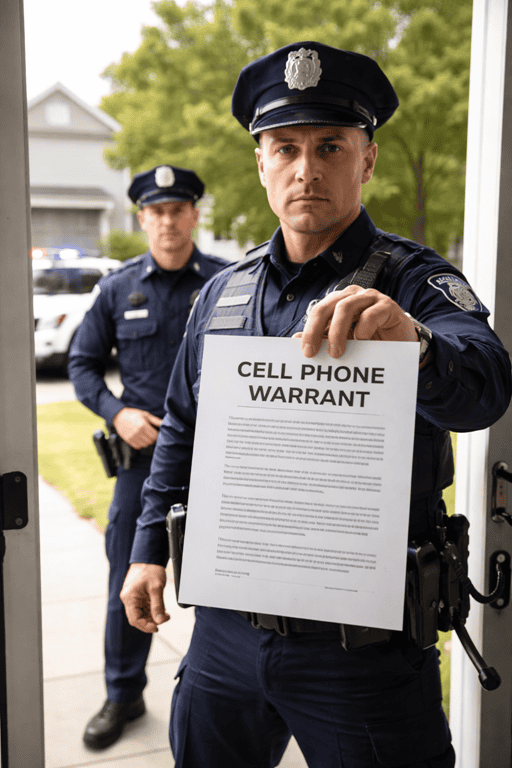
Your Pocket Spy Never Sleeps: Your Phone Knows Where You’ve Been — Now Cops Want To Know Too
You don’t need a warrant nailed to your door anymore. You’re carrying one. Every buzz, swipe, and “Allow While Using App” tap turns your cellphone into a roaming informant, quietly recording where you stand, where you walk, and who happens to be nearby. Now the Supreme Court is being asked a question that should terrify anyone who still believes the Fourth Amendment means something: does your phone give police a digital key to your life?
At the center of this fight are “geofence warrants,” a deceptively sterile term for something deeply invasive. Instead of identifying a suspect and then gathering evidence, police draw an invisible circle around a crime scene and demand location data for everyone inside it. Guilty, innocent, passing by, stopping for coffee — all swept up at once.
That’s not an investigation. That’s dragnet surveillance.
The Constitution Was Written To Stop This
The Fourth Amendment wasn’t drafted by people who trusted the government to behave itself. It was written by people who had lived under general warrants — broad authorizations that allowed authorities to rummage through people’s lives without cause. Geofence warrants look suspiciously like their modern, digitized cousin.
In one Virginia case now before the Court, police couldn’t identify a bank robbery suspect the old-fashioned way. So they went fishing. They demanded location data from Google for every device within range of the bank during the crime. That meant millions of data points belonging to people who had absolutely nothing to do with the robbery.
Let that sink in. To find one suspect, law enforcement vacuumed up the movements of countless innocent people. If that doesn’t qualify as “unreasonable search,” the phrase has lost all meaning.
“You Opted In” Is A Weak Excuse
The government’s defense is as flimsy as it is infuriating: users “opt in” to location services. As if agreeing to traffic updates or weather alerts is consent to be placed in a virtual police lineup.
That argument ignores reality. Smartphones are designed to nudge, pressure, and corner users into sharing data just to function normally. Try navigating a city, ordering food, or using basic apps without location permissions. The choice isn’t free — it’s coerced by design.
Consent under those conditions is a legal fiction, and pretending otherwise is how rights quietly evaporate.
Innocent People Pay The Price
Supporters of geofence warrants insist the data starts out “anonymized.” That’s cold comfort. Anonymized today doesn’t mean anonymous tomorrow. Once police narrow the list, they go back — sometimes without new warrants — and demand identities.
In the process, the whereabouts of ordinary people are exposed, stored, and scrutinized. You don’t get notified. You don’t get a lawyer. You don’t even get a chance to object. Your only crime was being nearby.
This isn’t targeted policing. It’s surveillance by proximity.
Even The Courts Can’t Agree
Lower courts are all over the map. Some judges say geofence warrants aren’t searches at all. Others admit they are searches but shrug and allow the evidence anyway under “good faith.” That kind of legal gymnastics should alarm everyone.
When judges can’t agree on whether the Constitution even applies, citizens are left unprotected. Tech companies are begging for clarity, not because they’re saints, but because the rules are chaos. Meanwhile, law enforcement keeps pushing the boundaries, betting courts will look the other way.
Technology Doesn’t Cancel Rights
The Supreme Court has already warned that modern technology gives the government unprecedented power to track people’s lives. That warning wasn’t theoretical. We’re living it.
Just because a tool exists doesn’t mean it should be used without limits. The Fourth Amendment doesn’t shrink because phones got smarter. If anything, it should be enforced more aggressively, not diluted into irrelevance.
Bottom Line
If geofence warrants are allowed to stand, your cellphone effectively becomes a standing invitation for government surveillance. Not because you did something wrong, but because you were there. That’s not how a free society operates. The Constitution demands suspicion before search, not search before suspicion. If the Court gets this wrong, your front door won’t be the only thing without a lock.
We are so screwed.
— Steve
Reference: Chatrie v. United States (Supreme Court (Docket 25-112) Whether the execution of a geofence warrant violated the Fourth Amendment.
This case concerns the constitutionality of geofence warrants. For cell phone users to use certain services, their cell phones must continuously transmit their exact locations to their service providers. A geofence warrant allows law enforcement to obtain, from the service provider, the identities of users who were in the vicinity of a particular location at a particular time.
In this case, law enforcement obtained, and served on Google, a geofence warrant seeking anonymized location data for every device within 150 meters of the location of a bank robbery within one hour of the robbery.
After Google returned an initial list, law enforcement sought—without seeking an additional warrant—information about the movements of certain devices for a longer, two-hour period, and Google complied with that request as well.
Then—again without seeking an additional warrant—law enforcement requested de-anonymized subscriber information for three devices. One of those devices belonged to petitioner Okello Chatrie. Based on the evidence derived from the geofence warrant, petitioner was convicted of armed robbery.
The questions presented are:
- Whether the execution of the geofence warrant violated the Fourth Amendment.
- Whether the exclusionary rule should apply to the evidence derived from the geofence warrant.