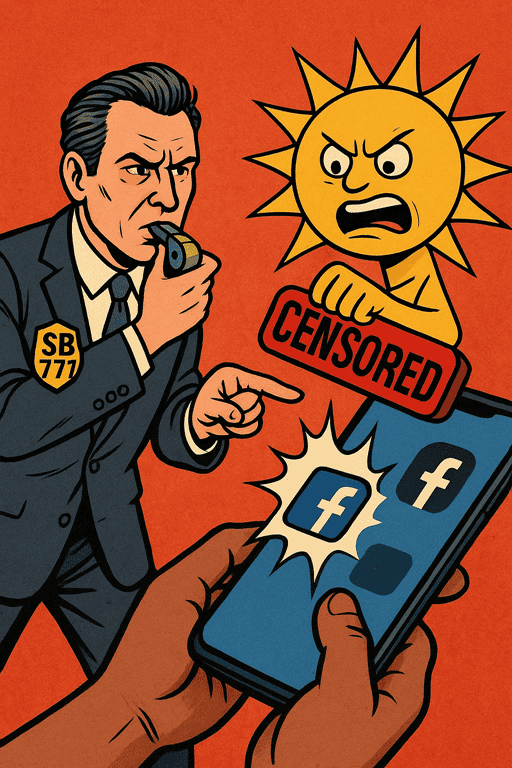
California lawmakers are once again stepping into the minefield of regulating online speech. Senate Bill 771, authored by Sen. Henry Stern (D–Los Angeles), is being falsely promoted as a measure to protect “personal rights” against hate speech and online intimidation. However, critics argue that it’s less about protecting people and more about controlling what Californians are allowed to say, see, and hear on social media.
What SB 771 Would Do
The bill targets social media platforms, making them liable for civil penalties if their algorithms or hosting decisions are found to “aid, abet, or conspire” in violations of personal rights, including content that involves: violence or intimidation, harassment based on race, religion, gender, sexual orientation, immigration status, or other protected categories.
On paper, that sounds like a move against online abuse. In practice, the law opens the door for state officials to decide which kinds of speech are acceptable and which are not. Any attempt by platforms to moderate content outside these vague definitions could expose them to lawsuits and potentially result in billions of dollars in penalties.
A Pattern of “Ministries of Truth”
This isn’t California’s first experiment in policing speech. In 2018, lawmakers floated a “Fake News Advisory Council,” which critics immediately dubbed a “Ministry of Truth.” At the federal level, the Biden administration’s short-lived Disinformation Governance Board faced massive backlash for similar reasons: Americans don’t trust government officials to be the arbiters of truth.
SB 771 appears to resurrect that impulse under a new label. Instead of advisory councils or boards, the mechanism here is liability and fines, powerful tools that can force platforms to over-remove lawful but politically inconvenient content.
The Constitutional Collision
The primary concern with SB 771 is its potential collision with the First Amendment and Section 230 of the Communications Decency Act.
First Amendment: Courts have repeatedly ruled (see NetChoice v. Paxton) that both users and platforms have free speech rights, including the right of platforms to curate and moderate content in accordance with their own policies.
Section 230: This federal law protects platforms from being held liable for third-party content while allowing them to remove material in good faith. SB 771’s liability framework appears to conflict directly with those protections.
Tech industry groups, such as the California Chamber of Commerce, the Computer & Communications Industry Association, and TechNet, have already warned that the bill will likely be struck down in court.
The Political Context
Supporters of SB 771 point to spikes in “hate speech” on platforms like X (formerly Twitter) and Meta after Elon Musk and Mark Zuckerberg rolled back moderation rules. But critics note that “hate speech” is an elastic category, often used to mean “speech we don’t like.”
This gets to the heart of the debate: is California protecting citizens from real harm, or is it criminalizing dissent under the banner of safety? The bill’s timing, coming after Trump’s reelection and a wider loosening of online moderation, suggests the latter.
Why It Matters
If SB 771 passes, it won’t just be social media companies under the microscope. Every day, Californians could find their posts flagged, removed, or used to justify penalties against platforms. The chilling effect on speech, political, cultural, and religious, could be massive.
Bottom Line
The progressive communist democrats want to control their preferred narrative and eliminate dissent before the upcoming presidential cycle to prevent further exposure of their betrayal of Californians, as well as other Americans.
We need to shut them down before they shut us down.
As George Orwell once warned, political language can be used “to make lies sound truthful and murder respectable.” Whether SB 771 is about protecting vulnerable communities or silencing unpopular views depends on who’s holding the pen, and in California, that’s a one-party progressive communist democrat state with a long memory of disliking dissent.
Even passing this clearly unconstitutional speech restraint legislation demonstrates the democrats’ un-American behavior.
We are so screwed.
— Steve