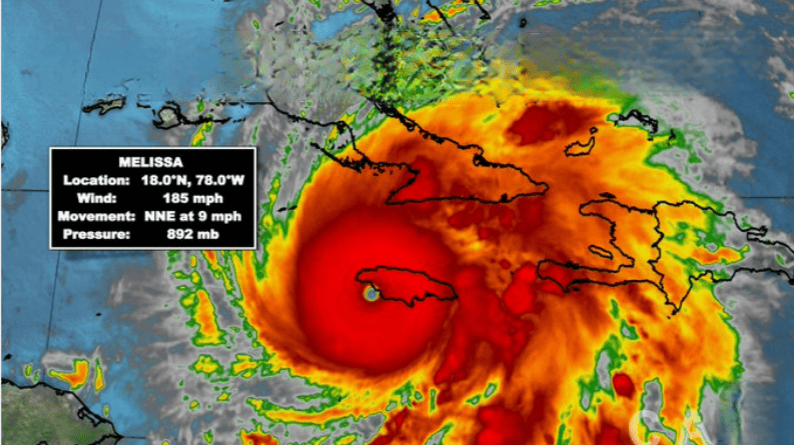
The Model Is Not the Storm
In the aftermath of Hurricane Melissa, the headlines wrote themselves: a record-breaking Category 5, proof of climate change, the storm we were warned about.
Scientists at Imperial College quickly deployed their IRIS storm model, claiming climate change had made a “Melissa-type” hurricane four times more likely today than in the pre-industrial era. The conclusion sounded definitive. The data seemed airtight.
But here’s the problem: models aren’t evidence, they’re approximations. They are elegant mathematical guesses built on layers of assumptions. When researchers “attribute” part of a hurricane’s strength to climate change, what they’re really saying is that, in a simulated world, storms look stronger when you raise global temperatures. That’s not the same thing as observing the real ocean heat content on the real day Melissa tore into Jamaica.
Science progresses by testing hypotheses, not by declaring simulations to be the last word.
Hypotheses, Not Holy Writ
Attribution science has grown into a powerful field, using sophisticated reanalysis data like ERA5 and models such as IRIS to estimate how much human activity changes the odds of extreme weather. But even its best practitioners admit the uncertainties. The inputs, sea-surface temperatures, wind shear, and ocean heat content, are vast and variable. Tiny tweaks in initial conditions can produce huge changes in modeled outcomes.
The IRIS team estimated that climate change raised the potential intensity of storms like Hurricane Melissa. Fair enough. But that’s an inference, not an observation. It’s a scientific hypothesis: a plausible explanation waiting to be confirmed, or refuted, by further data. Treating such results as “proof” risks turning science into ideology.
The scientific method demands that model outputs should be starting points for discussion, not ammunition for headlines. When we confuse confidence intervals with certainty, or simulations with the physical world, we stop doing science and start preaching faith.
Nature Has Its Own Rhythms
Researchers often point to El Niño and La Niña, the ocean’s natural oscillations, as equally powerful forces behind storm behavior. During an El Niño year, sea-surface temperatures in the Pacific rise dramatically, reshaping atmospheric circulation across the globe. These natural variations can supercharge hurricanes or suppress them, independent of long-term warming.
In that light, Hurricane Melissa could have been a product of short-term natural warming layered over a modest long-term trend, not simply the fingerprint of industrial-era emissions. The models may capture a statistical signal, but the ocean doesn’t read spreadsheets; it behaves according to physics, not forecasts.
The Danger of Overconfidence
Model-based certainty can be seductive. It turns complex natural systems into neat stories with clear villains and heroes. But the truth is messier. Climate change is real, but the precision with which we can link it to any single event, especially one governed by chaotic atmospheric processes, is still limited.
Those pejoratively labeled as “deniers” aren’t denying science; they’re defending its integrity. They’re asking for humility in the face of uncertainty. They want scientists and policymakers alike to remember that correlation is not causation, and that the atmosphere doesn’t always follow our equations.
In the end, Hurricane Melissa may be both a natural monster and an amplified one, driven by a warming world. But the exact balance remains uncertain. The honest answer is often the hardest to print: We don’t yet fully know.
Bottom Line: Science Works Best When It Doubts Itself
If the past few years have taught us anything, it’s that blind trust in models, whether epidemiological, economic, or climatic, can backfire. The IRIS model is an extraordinary tool for exploring “what ifs.” It is not, and never will be, a crystal ball.
Healthy skepticism doesn’t weaken climate science; it strengthens it. The moment we treat simulations as scripture, we lose the very spirit of inquiry that makes science worth believing in.
The researchers and their institutions have an investment in continued funding, so they are unlikely to moderate the narrative.
We are being screwed.
— Steve
The Media Narrative
Climate Change Made Hurricane Melissa 4 Times More Likely, Study Suggests
Unusually warm ocean temperatures fueled one of the worst hurricanes on record. New research finds climate change increased the storm’s likelihood.
Fueled by unusually warm waters, Hurricane Melissa this week turned into one of the strongest Atlantic storms ever recorded. Now a new rapid attribution study suggests human-induced climate change made the deadly tropical cyclone four times more likely. [Media Source]
From The Actual Report: Hurricane Melissa
SummaryMelissa was one of the most powerful landfalling hurricanes ever recorded. The IRIS model estimates that climate change increased the intensity of a hurricane of the type of “Melissa” to an exceptional Category 5 at landfall. A “Melissa” type hurricane at landfall is about four times more likely in the 2025 climate compared to a pre-industrial baseline. This event was unlikely without climate change.
Hurricane Melissa was Category 5 with a life-time minimum pressure of 892 hPa, making it one of the strongest storms ever recorded. Melissa was an exceptionally strong Category 5 hurricane at landfall in Jamaica on the 28th of October 2025. The IRIS model (Sparks and Toumi, 2024) can be used to infer the additional strengthening of a “Melissa” type storm that can be attributed to recent warming or more specifically to recent changes in potential intensity (PI). We first need to consider the change in the thermodynamic environment. There has been a recent global warming of about 0.2°C/decade putting the 2025 global mean temperature close to about 1.3°C above pre-industrial temperature. ERA5 reanalysis is used to calculate monthly mean PI fields between 1980 and 2024. We consider global warming to manifest itself differently with latitude. We have low confidence in attributing regional or longitude trends to global or anthropogenic warming. The regional changes are more likely to be caused by decadal variations and less likely to be sustained or representative of global warming. [Read More]