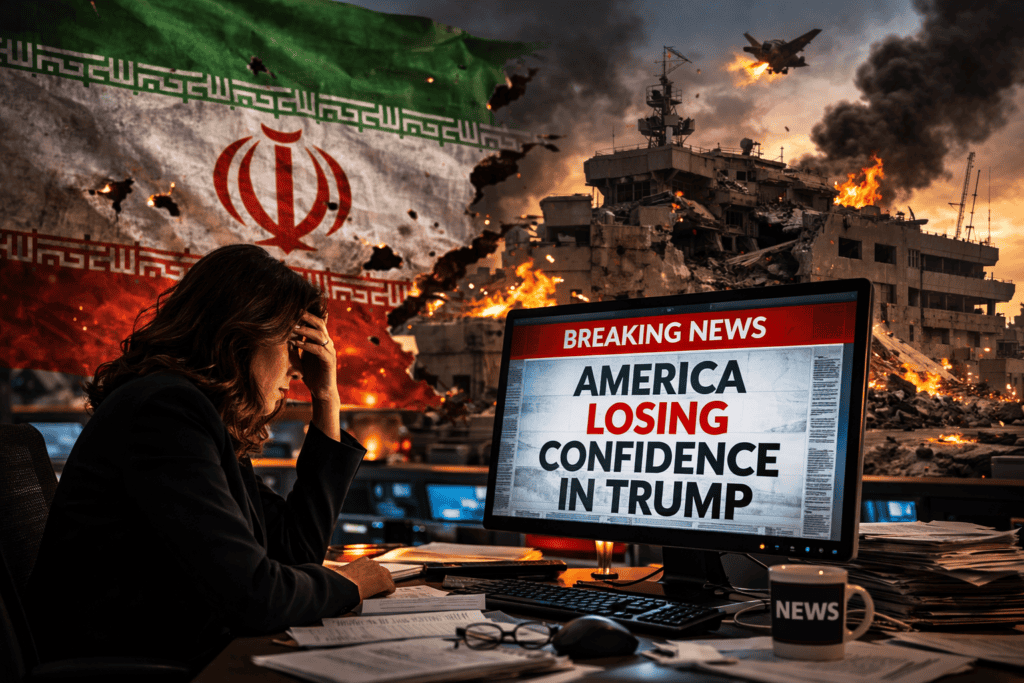
The Predictable Playbook Of The Anti-America Commentariat.
Once again, the same radical progressive communist democrat voices in politics and their media propagandists have dusted off their favorite wartime script: undermine American leadership, question the military, exaggerate enemy success, and flood the airwaves with pessimism.
It happens with clockwork reliability. The moment the United States enters a conflict, the political left and their media allies pivot away from reporting facts and toward constructing a narrative of inevitable American failure.
Instead of asking how America can win, they ask how quickly we will lose.
Instead of explaining military realities, they amplify anonymous sources, speculation, and worst-case scenarios. Meanwhile, panels of former intelligence officials and retired officers fill television screens, offering endless strategic “analysis” that conveniently doubles as a tactical briefing for America’s enemies.
In the middle of a war, America’s own media ecosystem sometimes looks less like journalism and more like an open-source intelligence feed.
Manufacturing Defeat Before The First Battle Is Finished
The pessimism has been astonishing. Only days into the current conflict with Iran, headlines warn of regional catastrophe, missile shortages, and global economic collapse.
If you listened only to cable news or social media pundits, you might assume American forces are already collapsing.
Yet the available facts tell a very different story.
Early strikes reportedly decapitated key Iranian political and military leadership. Missile launch capacity has been dramatically reduced. Drone attacks have fallen sharply from the opening stages of the conflict. U.S. air dominance has been so overwhelming that American forces are shifting from expensive standoff weapons to conventional precision bombs—something only possible when the enemy can barely contest the skies.
This is not the portrait of a military losing a war.
But those details receive far less attention than speculation about how everything might go wrong.
The Media’s Obsession With The Anti-Trump Narrative
For many in the press, the war is less about strategy, security, or the Iranian regime.
It is about Donald Trump.
Coverage frequently spends more time attacking the president’s motives than explaining battlefield developments. Every decision is framed through partisan outrage rather than military logic. Anonymous sources suddenly become authoritative when they criticize the administration, but inconvenient facts vanish into footnotes.
The result is a strange form of journalism where the primary storyline isn’t the war itself—it’s the ongoing attempt to politically damage the commander-in-chief.
When politics becomes the main story during wartime, the public receives propaganda rather than information.
Congress Members Echoing Enemy Talking Points
Some politicians have gone even further.
Congresswoman Rashida Tlaib issued a statement condemning the operation and accusing the United States and Israel of launching an “illegal war of aggression.” She claimed the conflict serves “violent fantasies” of political elites while demanding Congress move to stop the president.
Criticism of government policy is normal in a democracy.
But openly portraying America as the villain while U.S. troops are deployed and under fire crosses into deeply troubling territory. Statements that echo the propaganda narratives of hostile regimes send a message—not just to Americans, but to adversaries watching closely.
And those adversaries absolutely are watching.
Casualty Theater And The Inflation Of Enemy Narratives
Another familiar tactic is the manipulation of casualty narratives.
Every American loss is treated as proof the war is failing, replayed endlessly in heartbreaking detail. Meanwhile, inflated or unverified enemy casualty figures are circulated with little scrutiny, often elevating brutal regime figures with oddly respectful obituaries.
The result is a distorted picture of the battlefield, with American setbacks magnified and enemy losses minimized or sanitized.
It is less about informing the public and more about shaping emotion.
Bottom Line
War is dangerous, unpredictable, and tragic. Honest debate about strategy and policy is not only acceptable—it is necessary.
But there is a difference between debate and defeatism.
When media outlets and political figures rush to predict American humiliation before the outcome is even clear, they risk doing exactly what hostile regimes hope for: weakening domestic resolve and broadcasting doubt to the world.
America’s enemies don’t need better propaganda when they can simply quote American commentators.
History repeats itself in strange ways. In past wars, Americans understood that disagreement could wait until the battle was over. Today, too many voices appear eager to declare defeat before the first campaign has even concluded.
That isn’t skepticism. It’s sabotage disguised as analysis.
We are so screwed.
— Steve