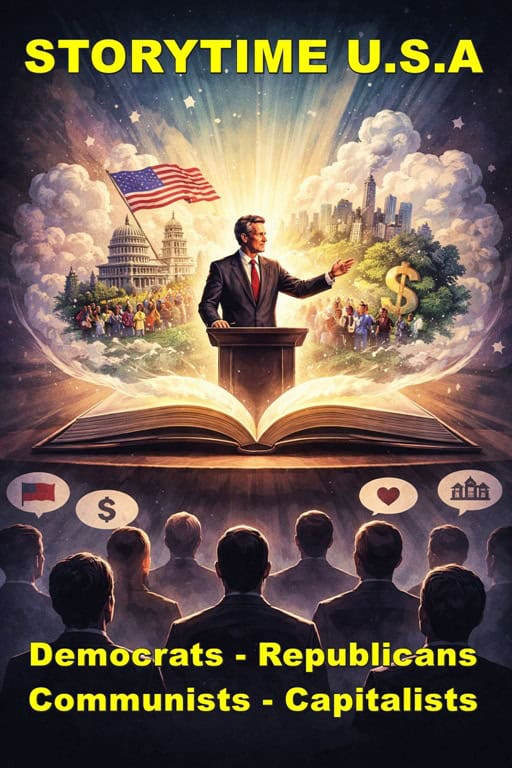
Politics is commonly framed as the realm of facts, laws, institutions, and power struggles. We are told it is about numbers, votes, policies, and procedures. Yet beneath this surface logic lies something far more human and enduring: storytelling. At its core, much of politics functions as fiction—not because it is entirely false, but because it relies on narratives that simplify reality to make collective action possible.
This is not an accusation of dishonesty so much as an observation about how societies operate. Politics works by telling stories that feel true enough to motivate belief, loyalty, and action. In that sense, all politics is functional fiction.
What “Functional Fiction” Really Means
The term “functional fiction” does not mean blatant lies or deliberate misinformation—though those certainly exist. Instead, it refers to narratives that are selectively true, emotionally resonant, and strategically incomplete. These stories work not because they are perfect representations of reality, but because they are helpful.
Political narratives reduce overwhelming complexity into manageable ideas. They explain who “we” are, who “they” are, what went wrong, and what must be done next. Reality is chaotic, but fiction imposes structure. That structure allows millions of people—who will never meet—to coordinate beliefs and behaviors.
Without these shared stories, politics would grind to a halt under the weight of nuance.
Politics as Storytelling Infrastructure
Every political system runs on stories. Nations are imagined communities. Constitutions are symbolic texts. Campaigns are narrative arcs with protagonists, antagonists, crises, and promised resolutions.
Phrases like “the will of the people,” “national security,” or “economic freedom” are not precise technical terms. They are narrative devices. Their power lies in their vagueness, which allows different audiences to hear what they want while still feeling united.
Even political institutions depend on fiction. Money only works because we agree it represents value. Authority only works because we collectively believe in legitimacy. Borders matter because we agree they matter. None of these are natural facts; they are shared stories that function well enough to hold societies together.
Why Simplification Is Politically Necessary
Modern political problems are extraordinarily complex. Climate change, globalization, automation, public health, and inequality involve systems so vast that no single individual can fully understand them—functional fiction steps in to bridge that gap.
Stories turn systems into villains, policies into moral choices, and uncertainty into purpose. They offer clarity where none truly exists. “This policy will fix it.” “That group is responsible.” “This leader understands you.”
These claims are rarely entirely accurate, but they are psychologically compelling. People need explanations that feel actionable, not exhaustive.
No Ideology Is Exempt
Functional fiction is not limited to any political ideology. Conservatives, liberals, progressives, populists, and radicals all rely on narratives that frame reality in ways favorable to their goals.
Each side tends to see its own story as common sense, while labeling the opposing story as propaganda or delusion. This asymmetry is revealing. Stories are most powerful when they feel invisible—when they no longer register as stories at all.
Political conflict, then, is often less about facts and more about competing fictions struggling for dominance.
When Functional Fiction Becomes Dangerous
Problems arise when political narratives become immune to challenge. A functional fiction becomes harmful when evidence no longer matters, when outcomes are ignored in favor of narrative consistency, or when questioning the story is treated as betrayal.
At that point, the fiction stops serving the public and starts serving power itself. Loyalty to the narrative replaces accountability. Policy failure is blamed on enemies, not assumptions. Reality becomes something to be dismissed rather than addressed.
History offers countless examples of political stories that worked—until they didn’t.
Narrative Literacy as Civic Skill
The solution is not to demand “pure facts” in politics. Facts alone do not mobilize societies. Stories always will. The real task is narrative literacy: the ability to recognize political stories as stories.
This means asking better questions:
- What assumptions does this narrative make?
- What does it emphasize—and what does it omit?
- Who benefits if this story is believed?
- What happens if the story stops working?
Narrative awareness does not require cynicism. It requires humility and attentiveness.
Bottom Line: Seeing Politics More Clearly
“All politics is functional fiction” is not a claim meant to discourage engagement. It is meant to sharpen it. When we understand that political life is shaped by stories, we become less likely to be unconsciously controlled by them—and more capable of choosing which ones deserve our support.
Politics will always involve fiction. The challenge is ensuring those fictions remain flexible, accountable, and responsive to reality. In a world governed by competing narratives, understanding the story may be the most practical form of power we have.
We are so screwed.
— Steve