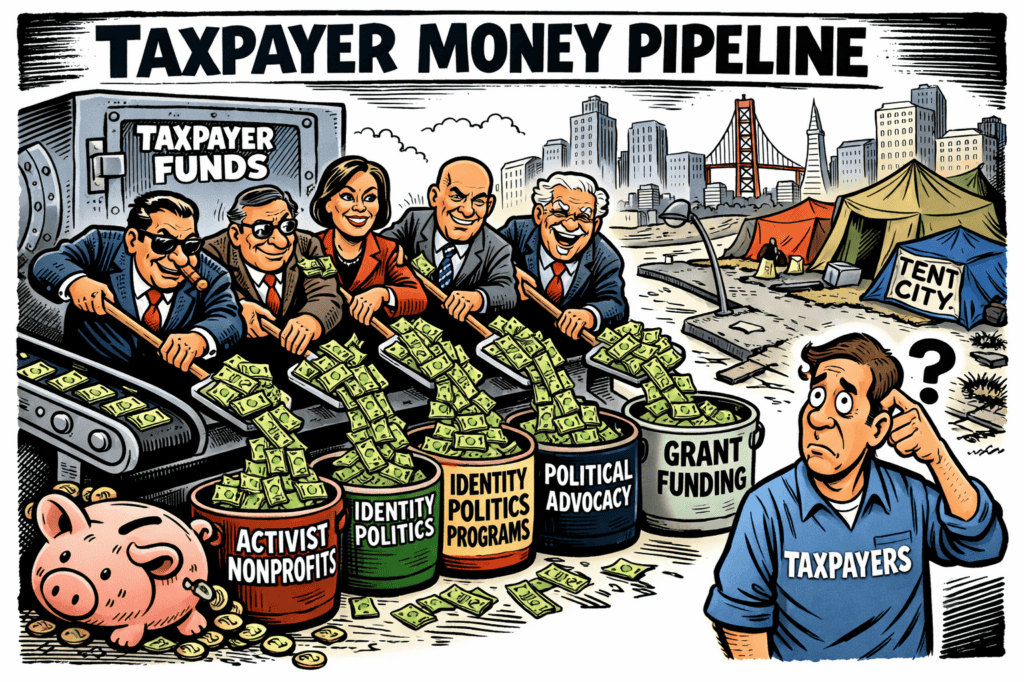
The Untouchable Nonprofit Industrial Complex
For years, taxpayers have been told that nonprofit organizations are noble institutions working tirelessly to “serve the community.” Questioning them has been treated almost like heresy. But the time has come to stop pretending that every nonprofit operating under the banner of “equity” or “social justice” is automatically above scrutiny.
In reality, many politically aligned nonprofits function less like charitable organizations and more like taxpayer-funded advocacy groups. They funnel public money into ideological projects, political messaging, and activist networks that conveniently align with progressive political agendas.
If these groups truly serve the public good, they should welcome audits, oversight, and transparency. Instead, many operate in a fog of vague mission statements, buzzwords, and minimal accountability.
That’s not charity. That’s a taxpayer-funded political ecosystem.
When “Community Investment” Becomes A Political Slush Fund
A prime example comes from San Francisco’s controversial Dream Keeper Initiative. Originally launched in 2021, the program redirected enormous sums of public money away from law enforcement and into a network of nonprofits supposedly dedicated to helping the Black community.
The initiative was framed as a moral obligation — even a step toward reparations.
But once the money started flowing, the results quickly raised eyebrows.
Tens of millions of taxpayer dollars were distributed to organizations with little oversight. Reports surfaced of lavish spending, including expensive galas and significant salary hikes. In other cases, funds allegedly vanished into complex webs of shell companies, raising fraud concerns.
Instead of measurable results, the program produced headlines about waste and mismanagement.
And yet, despite the controversy, the program is back.
Identity Politics Over Real Solutions
The revived initiative now allocates $36 million to organizations promoting programs such as “culturally affirming wellness,” Black feminist healing frameworks, ancestry DNA testing, and taxpayer-funded doulas for “African American birthing people.”
These initiatives may sound compassionate in press releases, but taxpayers deserve to ask a simple question:
What measurable benefit are these programs delivering?
Cities like San Francisco face severe challenges — crime, drug addiction, homelessness, economic decline, and public safety crises. Yet millions are still being directed into ideological projects built around identity politics rather than broad public benefit.
Instead of funding policies that improve safety, housing stability, and economic opportunity for everyone, taxpayer money is increasingly routed into niche activist programming with questionable outcomes.
The public isn’t being cynical by asking where the money is going. They’re being responsible.
“Nonpartisan” In Name Only
Another uncomfortable truth is that many nonprofits receiving public grants claim to be nonpartisan while quietly engaging in political activity.
Programs framed as civic engagement, voter education, or community organizing frequently morph into get-out-the-vote operations that overwhelmingly benefit one political party.
These groups operate under the legal cover of nonprofit status while functioning as unofficial campaign infrastructure for progressive candidates.
Taxpayer dollars should never be used to fund political influence operations — no matter which party benefits.
Yet the nonprofit ecosystem has become a reliable pipeline through which public money flows into ideological activism.
Oversight Isn’t Oppression — It’s Common Sense
When politicians propose auditing nonprofits, activists often respond with outrage. They frame oversight as an attack on marginalized communities.
But transparency isn’t oppression.
If an organization receives millions in taxpayer funding, the public has every right to know:
- Where the money goes
- What outcomes are achieved
- Who is being paid
- And whether the program actually works
Private charities rely on donor trust. Government-funded nonprofits rely on taxpayer money. That means the standard for accountability should be even higher.
Instead, many programs operate with the opposite philosophy: spend first, justify later, and dismiss critics as politically motivated.
That attitude erodes public trust and undermines legitimate charitable work.
The Bottom Line
America’s nonprofit sector does incredible work in many areas. But the rise of politically connected activist nonprofits funded by government grants has created a dangerous accountability gap.
Programs like San Francisco’s Dream Keeper Initiative highlight the risks: massive funding, ideological goals, and minimal oversight.
Taxpayers are not villains for asking questions. They are the ones paying the bill.
If these organizations truly serve the public good, then full audits, strict oversight, and measurable outcomes should not be controversial.
They should be the bare minimum.
Because when millions in taxpayer dollars are at stake, blind trust is not compassion — it’s criminal negligence.
We are so screwed.
— Steve