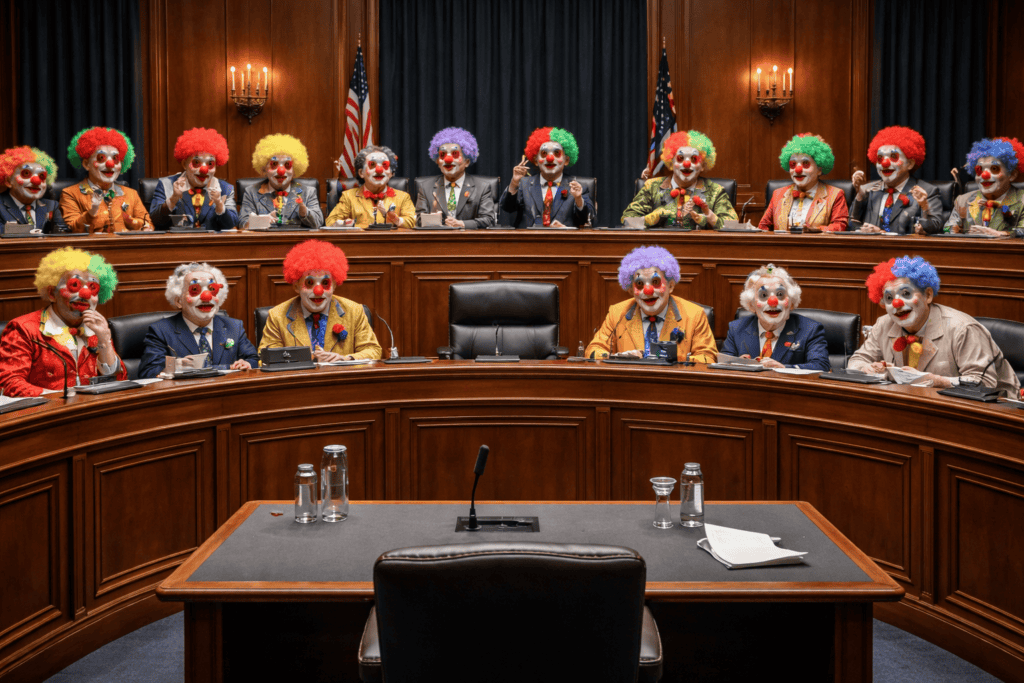
The Illusion Of Accountability.
Turn on any congressional hearing, and you’ll see the same tired spectacle: lawmakers leaning into microphones, delivering long, self-righteous speeches before asking a question they often already know the answer to. The public is told these hearings are about “oversight.” In reality, they’re mostly about optics.
Members of Congress technically get five minutes to question witnesses. But in practice, those five minutes are frequently consumed by political monologues designed for campaign ads and social media clips. By the time the lawmaker actually asks a question—if they ask one at all—the clock is nearly gone.
The result is predictable: witnesses dodge, lawmakers grandstand, and the truth remains buried somewhere beneath layers of political theater.
Congress calls it oversight. Anyone watching closely should call it what it is: a scripted performance.
Soundbites Over Substance
Modern hearings aren’t designed to uncover facts. They’re designed to produce viral moments: soundbites and snapshots to be exploited in social media, fundraising pitches, and future campaigns.
Lawmakers know that a dramatic accusation or an emotional speech can generate headlines and fundraising emails. A carefully crafted rant is far more valuable politically than a methodical, boring investigation that slowly uncovers facts.
The structure of hearings practically guarantees superficial exchanges. Five-minute questioning rounds make meaningful follow-ups almost impossible. Witnesses can stall, filibuster, or deflect until the buzzer rings.
The gavel falls. The time expires. The truth escapes once again.
But the clip lives forever online.
Tabloid Questions On The National Stage
Nothing illustrates the absurdity better than the spectacle involving Homeland Security Secretary Kristi Noem.
During a congressional hearing, a lawmaker demanded to know whether Noem had engaged in sexual relations with political adviser Corey Lewandowski. The rumor, circulating in tabloids, was suddenly elevated to the official stage of Congress.
Noem refused to entertain the question, calling it “tabloid garbage” and “offensive.”
Regardless of what anyone thinks about the personalities involved, the episode perfectly captured the dysfunction of congressional oversight. Instead of probing policy decisions or national security failures, lawmakers spent taxpayer-funded time chasing gossip.
That isn’t an investigation. It’s reality television.
Political Ping-Pong Instead Of Investigation
The same pattern played out in hearings about alleged fraud in Minnesota social service programs.
Republicans accused Minnesota officials of ignoring massive fraud in programs like Feeding Our Future, potentially placing hundreds of millions in federal funds at risk. Democrats countered with their own accusations about federal immigration actions and political targeting.
Back and forth it went.
Republican speeches. Democratic speeches. Accusations, counteraccusations, outrage, indignation.
But actual investigative questioning? That was rare.
Complex fraud cases involving billions of dollars require deep document review, forensic accounting, and sustained cross-examination. That work happens in audits, criminal investigations, and inspector general reports—not five-minute political showdowns broadcast on cable news.
The hearing stage simply isn’t built for real investigation.
Oversight Theater
The dirty secret of Washington is that congressional hearings are rarely where the real investigative work happens.
Serious investigations take months or years and involve professional investigators, lawyers, and analysts combing through mountains of documents. The dramatic hearing you see on television is usually just the final act, the press conference version of an investigation.
But increasingly, even that final act has devolved into partisan theater.
Members speak more to cameras than to witnesses. Questions are framed as accusations. Answers are rarely pursued with meaningful follow-up.
Everyone performs for their political base.
And taxpayers fund the show.
The Structural Failure Nobody Fixes
The dysfunction isn’t accidental; it’s baked into the structure.
Five-minute rounds incentivize speeches instead of dialogue. Committee members rotate in and out. Witnesses prepare rehearsed answers. Staffers script lines designed to trend online.
If Congress truly wanted serious investigative hearings, the format would look entirely different: longer questioning periods, professional counsel conducting examinations, and members intervening only when necessary.
Instead, we get political theater.
And everyone in Washington pretends it’s oversight.
Bottom Line
Congressional hearings increasingly function less as investigative tools and more as public relations stages for politicians. With five-minute rounds dominated by speeches and viral moments, the format rewards grandstanding over fact-finding. Whether the topic is tabloid gossip or billion-dollar fraud allegations, the result is usually the same: noise, spectacle, and very little truth.
We are so screwed.
— Steve