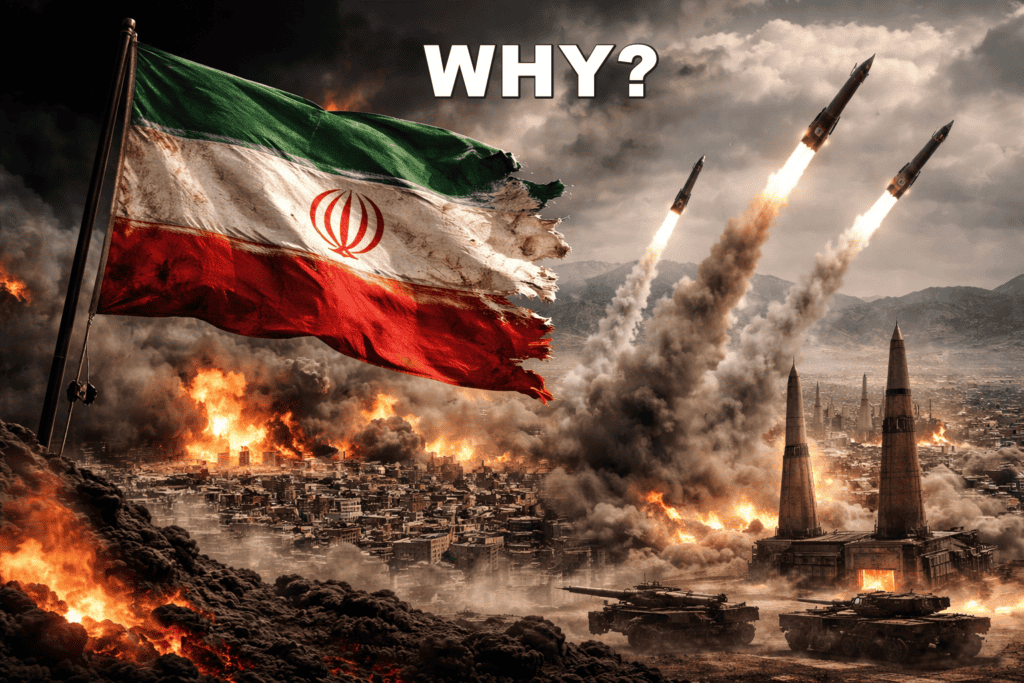
This Is Not About Toppling A Government — It’s About Drawing A Line
Let’s rip the mask off the argument.
There is no moral case for regime change in Iran. None. Not because the regime is admirable. Not because its internal policies are defensible. But because forced political transformation through foreign military power is not moral clarity, it is imperial arrogance.
The moral imperative here is far narrower, far sharper, and far less glamorous.
- This is not about choosing Iran’s leaders.
- This is not about redesigning its constitution.
- This is not about imposing Western liberalism at gunpoint.
This is about preventing catastrophic aggression.
Full stop.
The Line That Cannot Be Crossed: Nuclear Weapons
The first non-negotiable objective is simple enough for a child to understand: Iran must not become a nuclear weapons state.
- Not “monitored loosely.”
- Not “trusted eventually.”
- Not “managed diplomatically forever.”
- Prevented.
That means dismantling enrichment mechanisms capable of producing bomb-grade uranium. That means independent inspectors with real authority. That means irreversible rollback of weapons-grade capability.
A nuclear-armed Iran would not merely alter regional balance; it would ignite a proliferation cascade across the Middle East. Deterrence logic collapses when multiple rival states race toward an apocalypse.
Stopping that outcome is not warmongering. It is a moral responsibility.
Missiles That Reach Beyond The Region
The second non-negotiable objective: no intercontinental ballistic missiles.
ICBMs are not defensive tools. They are instruments of long-range coercion. They are built for projection, not protection.
Decommissioning stockpiles and halting development are not acts of humiliation. It is a firewall against escalation.
You do not allow a state that openly threatens neighbors and funds destabilization campaigns to pair that behavior with globe-spanning delivery systems.
That is not moral grandstanding. That is strategic sanity.
Chemical And Biological Weapons Are Beyond The Pale
The third non-negotiable objective: no chemical or biological weapons programs.
The world learned this lesson the hard way in the 20th century. Certain weapons cross a civilizational red line. They are not “strategic options.” They are moral abominations.
Preventing their creation is not an act of aggression. It is an act of preservation — preservation of the minimal standards that separate modern statecraft from barbarism.
End The Proxy War Machine
The fourth non-negotiable objective: no funding, training, or promotion of proxy militias in foreign states.
This is where moral clarity becomes unavoidable.
Arming non-state actors to destabilize neighboring countries is not “resistance.” It is engineered chaos. It corrodes sovereignty. It perpetuates endless low-grade war.
If Iran wants its sovereignty respected, it must respect others’ sovereignty.
Non-aggression is reciprocal.
What This Is Not
- This says nothing about Iran’s right to self-governance.
- This says nothing about who its people select as leaders.
- This says nothing about the suppression of individual freedoms or its internal human rights record.
- This says nothing about its religious proclivities.
Those are serious issues, but they are not the justification for military confrontation. They are not the moral trigger.
The moral trigger is external aggression and catastrophic weapons of mass destruction capability.
If diplomacy stalls, fails, or is weaponized as a delay, the question becomes brutally simple: Do you allow escalation to proceed unchecked?
There is a difference between regime change under an imperial regime and enforcing non-proliferation and non-aggression standards.
One is ideological overreach. The other is preventing disaster.
Power Used Reluctantly Is Not Power Used Illegitimately
Critics love to frame any use of force as inherently immoral. That’s intellectually lazy.
Military power used to impose ideology is indefensible. Military power used to prevent nuclear breakout, chemical stockpiles, and regional destabilization is not in the same category.
It is tragic. It is costly. It is dangerous.
But it is not immoral.
The moral failure would be to watch a hostile regime cross every red line and pretend restraint equals virtue.
Restraint without enforcement is surrender dressed up as sophistication.
Bottom Line
There is no moral case for regime change in Iran. There is a moral case for preventing nuclear weapons, stopping long-range missile development, prohibiting chemical and biological arsenals, and ending proxy warfare.
This is not about redesigning a nation.
It is about enforcing non-aggression in a world where the consequences of failure are catastrophic.
Sometimes the moral imperative is not inspirational.
Sometimes it is simply the refusal to let the worst happen.
We are so screwed.
— Steve