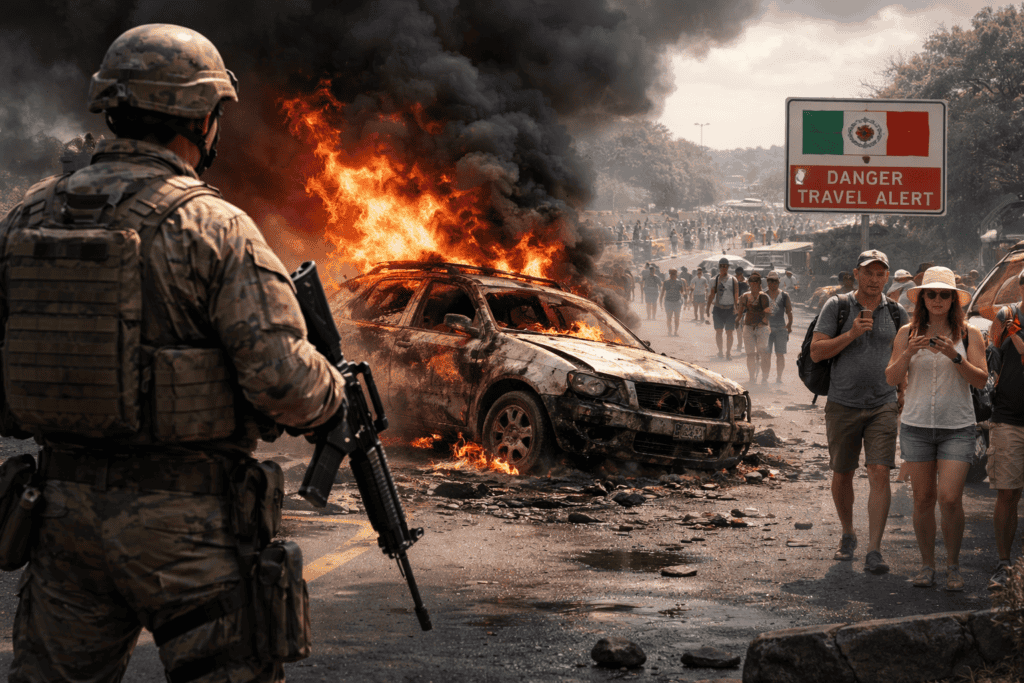
Victory Laps While Americans Shelter In Place.
While smoke billowed over highways and cartel gunmen torched vehicles across Mexico, officials in Washington and their cheerleaders in the progressive media were busy doing what they do best: congratulating themselves.
In the immediate aftermath of the operation that killed a powerful cartel leader, details of U.S. intelligence support spilled into public view. Press secretaries posted triumphal statements. Pundits framed it as a shining example of “unprecedented cooperation.” Headlines practically popped the champagne.
Meanwhile, Americans in Mexico were being told to shelter in place.
Airports closed. Flights were canceled. Highways were blocked in multiple states. Families huddled indoors in Guadalajara and Puerto Vallarta, unsure whether the next plume of black smoke signaled a distant confrontation or something much closer. The State Department’s warning was clear: stay put, stay low, stay safe.
But the messaging out of Washington? Mission accomplished.
Broadcasting The Playbook To The Cartels
Here’s the uncomfortable truth: cartels read the news too.
When officials publicly confirm that U.S. intelligence supported a lethal operation, they aren’t just informing voters. They are broadcasting to criminal organizations that Washington had a hand in the strike. In the volatile power vacuum that follows the death of a cartel kingpin, that kind of messaging can have consequences.
Cartels thrive on retaliation. They survive on spectacle. Roadblocks, arson attacks, coordinated violence across multiple states—these are not random outbursts. They are demonstrations of strength, warnings to rivals, and signals to governments.
So what happens when the narrative becomes “the United States helped kill our boss”?
You paint a bigger target.
Not on officials in Washington. Not on pundits posting hot takes from studio chairs. On the softest, most accessible symbol of American presence available: tourists, retirees, students, business travelers.
Americans in Mexico don’t travel with armored convoys. They don’t have intelligence briefings. They have hotel reservations and return tickets—when flights aren’t canceled.
The Reckless Politics Of Public Boasting
Let’s be clear: dismantling violent narcotics networks is a legitimate national security objective. No one weeps for cartel leaders responsible for flooding communities with fentanyl and terror.
But operational success does not require a public victory parade.
There is a vast difference between quiet coordination and loud self-congratulation. One protects ongoing efforts and minimizes blowback. The other feeds a 24-hour news cycle hungry for partisan wins.
The rush to frame the operation as proof of political toughness turned a security development into a branding exercise. The language was dramatic. The tone was defiant. The applause was immediate.
And in the background? Dozens dead in clashes. National Guard members killed. Criminal factions are mobilizing. Schools canceled. Borders reinforced. Highways ablaze.
Security professionals have long warned that leadership removals can trigger instability rather than calm. Power vacuums invite infighting. Retaliation becomes a tool for asserting control. Violence spikes before it subsides—if it subsides at all.
In that fragile window, restraint in public messaging isn’t weakness. It’s wisdom.
Americans Caught In The Aftermath
The images tell the story: charred vehicles, soldiers standing guard, smoke curling into the sky. Tourists stranded. Families are glued to their phones, waiting for updates that don’t come fast enough.
When officials celebrate intelligence involvement in real time, they are not operating in a vacuum. They are shaping perceptions on both sides of the border. Cartels are calculating. Rival factions are maneuvering. Anti-American narratives gain fuel.
It only takes one opportunistic cell, one reckless commander, one desperate faction looking to prove a point.
Americans abroad should never be made into props in a domestic political messaging war. Yet that is precisely the risk when sensitive cooperation is turned into a public relations trophy.
Operational details belong in secure briefings, not social media feeds. Strategic messaging should consider second- and third-order effects, not just cable news optics.
The priority should be protecting lives—American and Mexican—not harvesting headlines.
Bottom Line
Cartel leaders can be eliminated. Networks can be disrupted. Intelligence cooperation can save lives. But reckless, self-congratulatory leaks and partisan chest-thumping come with a cost. In moments of volatility, words matter. Timing matters. Restraint matters. When Americans are being told to shelter in place amid burning highways and grounded flights, the last thing they need is Washington turning a cross-border security operation into a political victory lap that paints an even brighter target on their backs.
We are so screwed.
— Steve