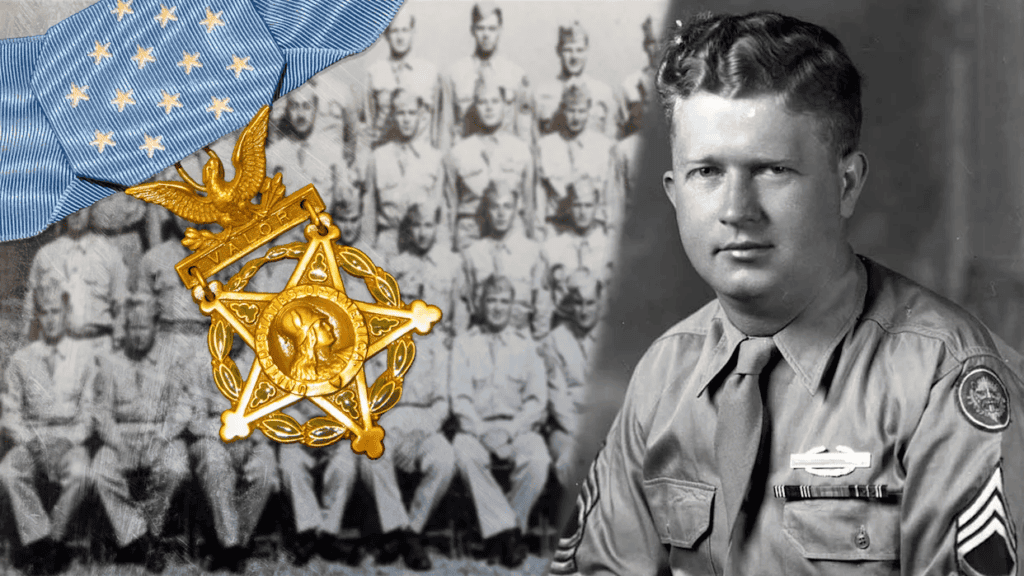
A Humble Hero Finally Recognized.
More than four decades after his death, Roddie Edmonds, a quiet Army master sergeant from Tennessee, will receive the nation’s highest military award—the Medal of Honor.
For years, his story lived only in the memories of the men he saved. Now, the country is formally recognizing a moment of moral courage that echoed far beyond the barbed wire of a German prisoner-of-war camp.
Edmonds didn’t storm a beachhead or charge a machine-gun nest. His battlefield was a prison yard. His weapon was resolve. And his victory saved nearly 200 Jewish American soldiers from likely death.
The Moment That Defined A Lifetime
Born in 1919 in Knoxville, Tennessee, Edmonds was captured during the brutal Battle of the Bulge in December 1944. He was sent to Stalag IX-A, where Nazi forces sought to identify and segregate Jewish soldiers from the rest of the American POWs.
As the senior noncommissioned officer, Edmonds was ordered to have only the Jewish soldiers step forward.
Instead, he commanded all 1,200 American prisoners under him to assemble outside their barracks.
When a German officer shouted that they could not all be Jews, Edmonds famously replied, “We are all Jews here.”
A pistol was drawn. A threat was made.
Edmonds did not flinch.
Invoking the Geneva Convention, he told the officer that prisoners were required to provide only name, rank, and serial number—and warned that executing them would constitute a war crime once the conflict ended.
The German officer lowered his weapon and walked away. The segregation never happened.
In that moment, Edmonds transformed captivity into defiance—and saved lives without firing a shot.
A Story Buried In Silence
Edmonds returned home to Tennessee after the war and lived a quiet life. He died in 1985 at age 65, never publicly speaking about what he had done.
His son, Christopher Edmonds, only learned the full story decades later after discovering his father’s wartime diary and connecting with surviving POWs. The men who owed their lives to him never forgot.
In 2015, Israel’s Yad Vashem, the World Holocaust Remembrance Center in Jerusalem, named Edmonds one of the “Righteous Among the Nations”—an extraordinary honor given to non-Jews who risked their lives to save Jews during the Holocaust. He is one of only five Americans to receive that distinction.
Now, the United States is formally recognizing what those soldiers always knew: their sergeant’s courage was nothing short of heroic.
Courage Without Calculation
The Medal of Honor is reserved for acts of valor that go above and beyond the call of duty. Edmonds’ stand meets that standard in every sense.
According to reports, President Donald Trump personally informed the Edmonds family that the medal had been approved. Lawmakers, including Marsha Blackburn, have also pushed to further honor him with a Congressional Gold Medal.
But perhaps the most striking aspect of this story is that Edmonds never sought recognition. He “took it to his grave,” as his son described.
His heroism was not performed for headlines or history books. It was an instinctive act rooted in duty, conviction, and moral clarity.
A Legacy That Transcends Time
Edmonds’ stand was about more than protecting fellow soldiers. It was about refusing to cooperate with evil—even under the threat of death.
He was a Southern Baptist from Knoxville who, by many accounts, had likely never met a Jewish person before the war. Yet in that prison yard, he chose solidarity over safety.
His words—“We are all Jews here”—have become a timeless declaration of unity against hatred.
In an era when courage is often defined by spectacle, Edmonds reminds us that the greatest bravery can be quiet, steady, and unyielding.
Bottom Line
Master Sgt. Roddie Edmonds did not see himself as a hero. He simply believed in standing by his men.
Now, more than 80 years after he faced down a Nazi officer’s gun, America is honoring a soldier who proved that moral courage can be as powerful as any weapon. His story is not just a chapter of World War II history—it is a lasting testament to leadership, integrity, and the unbreakable bond between Americans in the face of tyranny.
This is what makes American exceptionalism.
— Steve