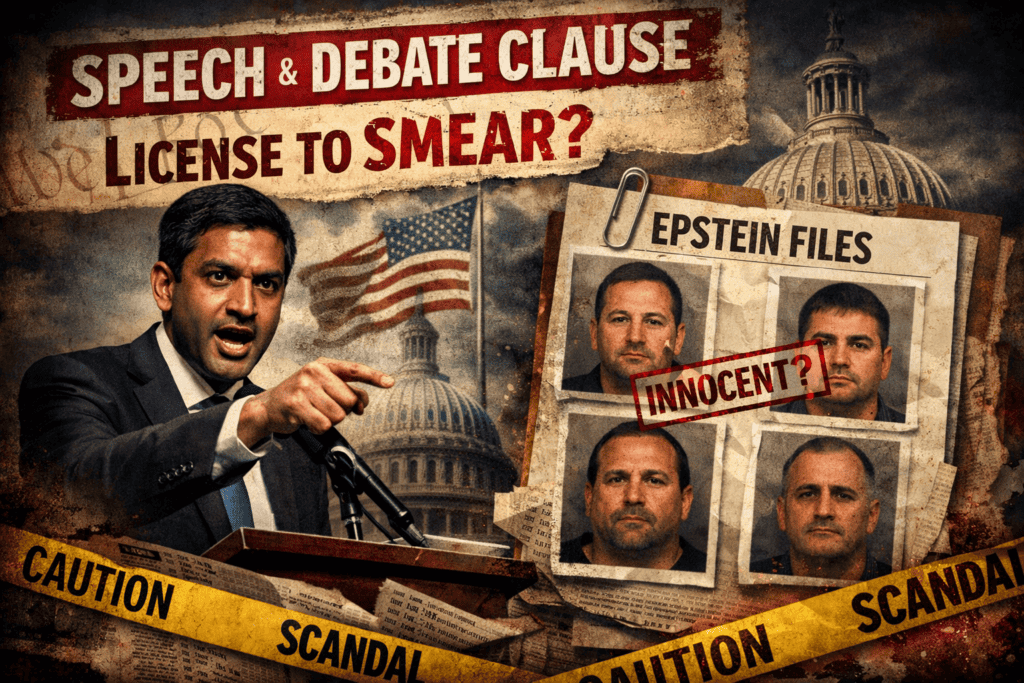
When The Floor Becomes A Firing Squad
Progressive communist democrat Ro Khanna (D-CA) stood on the House floor and read out six names, branding them “wealthy, powerful men” allegedly hidden in files connected to Jeffrey Epstein. The implication was unmistakable. In today’s digital mob culture, you don’t need a conviction—just a whisper in the right chamber.
But here’s the gut punch: four of those men, according to the Department of Justice, had no apparent connection to Epstein at all. They were reportedly part of a photo lineup assembled years earlier by investigators. Random faces. Ordinary citizens. Suddenly blasted across the congressional record under a cloud of insinuation.
And thanks to one constitutional shield, there may be zero legal consequences for the despicable media-whore lawmaker who said their names.
The Speech And Debate Clause: Shield Or Sword?
Buried in Article I of the Constitution is the Speech and Debate Clause. It exists for a noble purpose: to protect lawmakers from intimidation or retaliation for their legislative actions. Without it, Congress could be bullied into silence.
But what happens when that shield becomes a sword?
Under this clause, members of Congress are broadly immune from lawsuits for statements made in the course of official legislative activity. That means that if a representative stands in the well of the House and makes a defamatory, misleading, or flat-out wrong statement, the target of that statement often has no legal recourse.
Read that again.
If you or I publicly link a private citizen to a notorious criminal without evidence, we risk being sued into oblivion. If a member of Congress does it on the House floor? Immunity.
Innocent Names, Permanent Damage
Imagine sitting at home in Queens, minding your own business, and discovering your name was read into the Congressional Record alongside one of the most infamous criminals in modern history.
That reportedly happened to men like Salvatore Nuarte and Leonid Leonov—private individuals who denied ever knowing Epstein. They were not public figures. They were not charged in the Epstein case. They were not accused by prosecutors of wrongdoing.
Yet their names were amplified under the bright lights of national politics.
In the internet age, a single mention can follow you forever. Employers Google. Neighbors Google. Your children’s classmates Google. Even if corrections are issued later, the stain lingers.
Congressional immunity may protect the speaker—but it does nothing to restore the reputations of the mistakenly accused.
Transparency Or Theater?
To be clear, demanding transparency in high-profile criminal cases is legitimate. Lawmakers like Thomas Massie and others have argued that the public deserves to know whether powerful elites were shielded from scrutiny.
Fair enough.
But transparency without verification is not courage—it’s recklessness.
If the Department of Justice mishandled redactions, that deserves scrutiny. If wealthy offenders were protected, that deserves outrage. But reading out unvetted names before confirming their relevance is not accountability. It’s political theater with real human collateral damage.
And when politicians score points by tossing around names tied to scandal, they gamble with other people’s lives.
The Asymmetry Of Power
This is the core injustice: asymmetry.
A congressman has staff, media reach, and constitutional immunity. A private citizen has none of those things. When the powerful speak, the ripple effect is massive. When the powerless object, the echo barely travels.
The Speech and Debate Clause was designed to protect democracy from executive overreach—not to provide a safe harbor for careless accusations.
Yet time and again, we see it invoked as an iron wall against accountability.
Who Guards The Guardrails?
If courts cannot intervene, and defamation suits are barred, who checks abuse?
Voters can. Ethics committees can. Party leadership can.
But history shows those mechanisms are slow, political, and often toothless.
The Constitution did not anticipate a world where a floor speech would be clipped, shared, algorithmically amplified, and permanently embedded in search results within minutes. The framers imagined pamphlets and newspapers—not viral accusations.
Immunity made sense in an era of limited reach. In the digital age, it can become a weapon of mass reputational destruction.
The Non-Apology

Bottom Line
Congressional immunity under the Speech and Debate Clause serves an essential purpose—but it must not become a blank check for smears. When lawmakers invoke the gravest scandals of our time and attach innocent names without airtight verification, they exploit a constitutional protection meant for courage, not carelessness. Power demands restraint. And when restraint disappears, so does trust in the very institution claiming to defend the truth.
We are being screwed.
— Steve