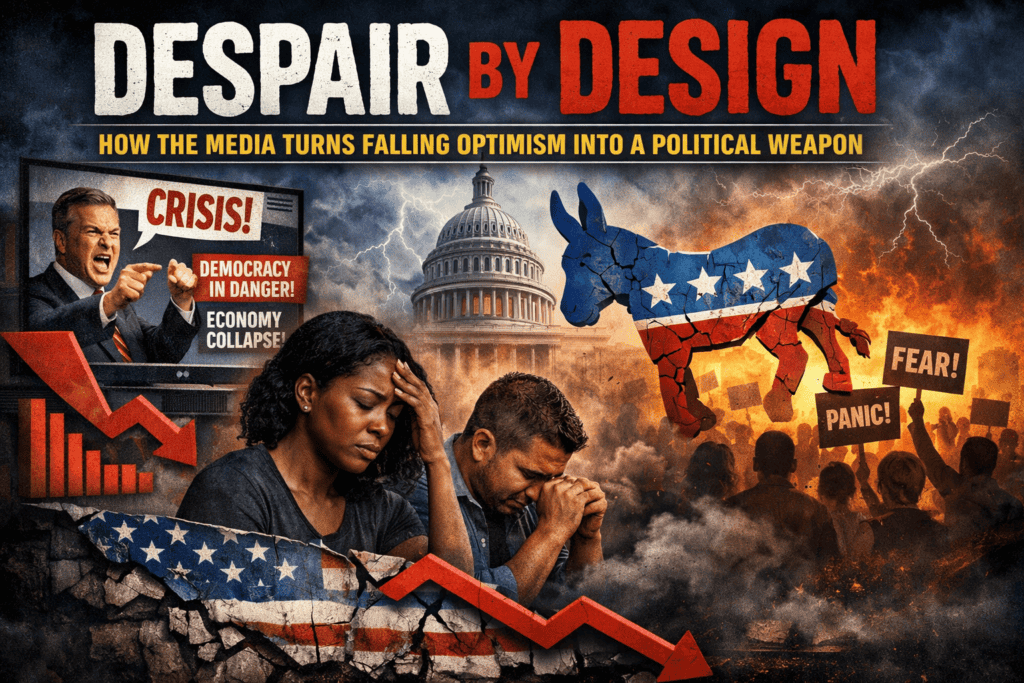
Record Lows, Relentless Narratives, And Manufactured Misery
American optimism just hit a record low. According to new national data, only 59.2% of U.S. adults believe they’ll have a high-quality life five years from now — the lowest level recorded in nearly two decades. Since 2020, that’s a drop of more than nine percentage points. Roughly 24.5 million fewer Americans feel optimistic about their future.
That should alarm everyone.
Instead, it’s being spun.
Headlines scream collapse. Panels predict doom. Social feeds amplify fear. And buried beneath the data is a political reality few in media want to admit: despair is not just a byproduct of bad news cycles — it’s being curated, targeted, and weaponized.
The Partisan Optimism Gap Is No Accident
The numbers show something striking. Between 2024 and 2025, Democrats’ future life optimism dropped another 7.6 points. Independents dipped slightly. Republicans remained essentially unchanged.
We’ve seen this movie before. When party control of the White House flips, partisan optimism often follows suit. From 2020 to 2021, Democrats’ optimism rose while Republicans’ fell. Now the reverse dynamic is playing out.
That’s human nature.
But here’s the problem: media ecosystems increasingly operate in ideological silos. Democratic voters are disproportionately exposed to outlets and influencers that frame political change in existential terms — democracy is “ending,” rights are “vanishing,” catastrophe is “imminent.” Constant crisis framing doesn’t just inform; it shapes. It conditions.
If you tell people every day that the sky is falling, don’t act shocked when they start looking up in fear.
Hispanic And Black Communities: Real Struggles, Amplified Anxiety
The data also show sharp declines in optimism among Black and Hispanic adults. From 2021 to 2024, Black adults saw the steepest erosion in future outlook, coinciding with inflation spikes that disproportionately hit food, housing, and healthcare costs. In the past year, Hispanic adults experienced the largest additional drop.
Inflation was real. Affordability pressures were real. Economic strain is not imagined.
But economic strain, combined with relentless alarmism, becomes something else: psychological fatigue.
Communities already navigating structural challenges are now consuming a steady diet of narratives emphasizing instability, discrimination, institutional collapse, and political hostility. Some of those issues are legitimate. But when every headline implies permanent decline, hope erodes faster than facts justify.
The result? A measurable collapse in future life ratings — even as pandemic pressures have eased and inflation has moderated from its peak.
When Future Hope Collapses, “Thriving” Follows
Gallup’s Life Evaluation Index classifies people as “thriving” if they rate their current life at 7 or higher and their future life at 8 or higher. As of late 2025, only 48% of Americans qualify — down more than 11 points from mid-2021.
Notice what’s driving that drop: not current life satisfaction alone, but future expectations.
In 2020, at the height of pandemic chaos, current life ratings cratered — yet future optimism actually ticked up as vaccines rolled out. People believed better days were coming.
Now? Current life ratings haven’t collapsed to historic lows. But belief in a better tomorrow has.
That’s not just economics. That’s narrative.
Crisis As A Mobilization Strategy
Political strategists understand something fundamental: fear mobilizes. Anxiety drives turnout. A base that feels under siege shows up.
Media outlets, particularly those aligned with partisan audiences, benefit from the same emotional intensity. Outrage fuels engagement. Catastrophe drives clicks. Despair keeps viewers tuned in.
But there’s a cost.
When millions of Americans — especially within Democratic, Black, and Hispanic communities — are consistently told that the future is darker than ever, optimism doesn’t just dip during election cycles. It reshapes identity and expectation.
People begin to internalize decline.
Economic Headwinds Versus Psychological Headwinds
Yes, inflation from 2021 to 2023 took a toll. Yes, affordability remains a real concern. But economic metrics alone do not fully explain why future life ratings have fallen more sharply than current life ratings.
Perception often outruns reality.
If Americans were solely responding to material conditions, optimism would track more cleanly with inflation curves and employment data. Instead, optimism appears tightly synchronized with political shifts and partisan media framing.
That suggests something deeper than pocketbook pain. It suggests belief systems are being nudged.
The Bottom Line
America has faced recessions, wars, pandemics, and political upheaval. Through it all, one constant kept the national engine running: belief in a better future.
When that belief erodes, democracy weakens — not just because of policy alone, but because of psychology.
Economic challenges deserve honest reporting. Political changes deserve scrutiny. But amplifying despair as a strategic tool — whether for ratings, clicks, or votes — is corrosive.
A country that loses confidence in tomorrow becomes easier to manipulate today.
And that should concern everyone.
We are being screwed.
— Steve