The Colossal Myth Of Absolute Control
For decades, China’s Three Gorges Dam has been paraded as a triumph of modern engineering—a concrete monument to centralized power, national pride, and the belief that nature itself can be mastered. At 7,700 feet long and rising more than 600 feet above the Yangtze River, it is the largest hydroelectric dam on Earth. It is also, quietly and inconveniently, one of the most terrifying liabilities ever poured in reinforced concrete.
In civil engineering circles, there is little real doubt about the uncomfortable truth: mega-dams fail. Not often—but when they do, the consequences are not measured in repair bills. They are measured in bodies, starvation, and political collapse. The Three Gorges Dam is not just infrastructure. It is a single point of catastrophic failure holding back unimaginable energy over the most densely populated river basin on the planet.
Engineering Hubris Meets Geological Reality
The Yangtze River does not rest on stable ground. The region surrounding the dam is riddled with fault lines, landslide-prone slopes, and seismic activity that predates the Chinese Communist Party by millions of years. Reservoir-induced seismicity is not a conspiracy theory—it is a documented phenomenon. Add trillions of gallons of water to fractured geology, and the earth responds.
Cracks in concrete, deformation in spillways, emergency reinforcement projects, and sudden water releases have already occurred. Each incident is officially minimized. Each one quietly confirms what engineers outside China already know: this structure is under stress, it was never truly designed to endure forever.
Concrete ages. Steel fatigues. Gravity never takes a day off.
The Unthinkable Math Of Collapse
If the dam were to fail—whether from earthquake, internal structural failure, or external attack—the destruction would unfold faster than evacuation orders could be issued. Entire cities downstream would be erased. Industrial hubs would vanish. Food production would collapse. Supply chains would shatter overnight.
The loss of life would be measured in the millions. Survivors would face famine, contaminated water, and mass displacement on a scale unseen in modern history. This is not hyperbole. This is basic flood modeling applied to an unprecedented structure holding back an inland sea.
Empires do not always fall to invading armies. Sometimes they drown in their own arrogance.
The Military Elephant In The Room
The dam is heavily fortified because everyone involved understands the obvious: it is a strategic vulnerability masquerading as a power plant. In an era of precision-guided ordnance, cyber-physical warfare, and asymmetric conflict, static mega-infrastructure is a gift to any adversary willing to think beyond traditional battlefields.
No details need to be spelled out. The reality is self-evident. A single, well-placed disruption—kinetic or otherwise—could trigger cascading failure. And even without hostile action, nature alone remains fully capable of delivering the same result.
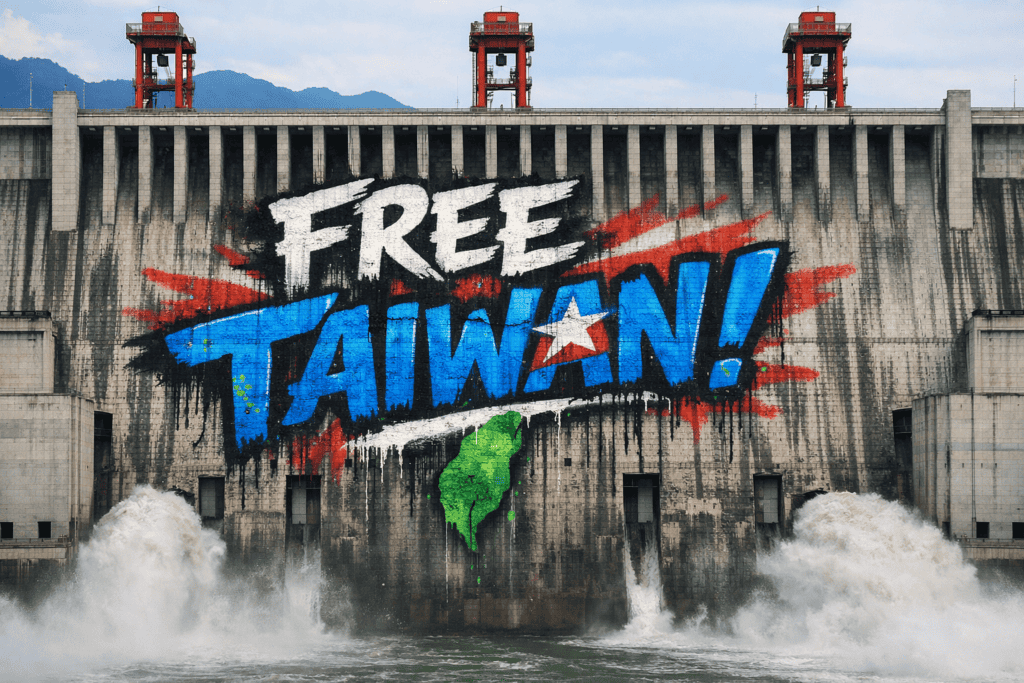
Taiwan doesn’t need to fire a shot for this to matter. The dam’s existence changes the strategic calculus. It looms over Beijing like a concrete hostage situation of its own making.
Regime Stability Built On Cracks
Authoritarian systems sell invincibility. They cannot afford public doubt. That is why discussion of worst-case scenarios is suppressed, censored, and dismissed as foreign propaganda. But physics is immune to censorship.
Mass famine, internal displacement, and industrial annihilation are the historical ingredients of regime change. Not ideology. Not rhetoric. Hunger and chaos. The Three Gorges Dam concentrates all of that risk into one monumental structure.
China did not just dam a river. It dammed its own future to a single engineering gamble.
Bottom Line
The Three Gorges Dam is not merely a marvel—it is a loaded gun pointed downstream. Whether through natural failure or human conflict, it represents the largest man-made disaster waiting to happen. What was meant to symbolize control may ultimately expose the fragility of centralized power itself. When infrastructure becomes destiny, cracks in concrete become cracks in regimes.
Someone is screwed.
— Steve