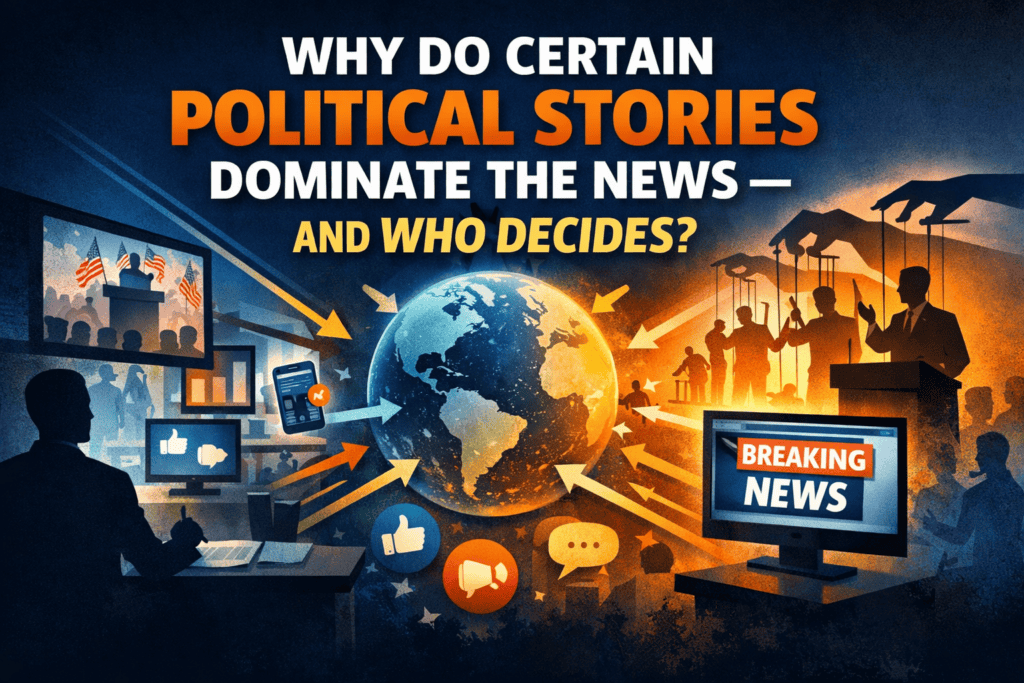
Every news cycle seems crowded, yet only a handful of political stories consistently dominate headlines, broadcasts, and social feeds. This repetition raises a reasonable question: why do some political issues receive sustained attention while others—often equally consequential—barely register? The answer is less about secret coordination and more about incentives, systems, and structural decision-making within modern media ecosystems.
Understanding how these stories rise to prominence helps explain not only what people see but also how public discourse itself is shaped over time.
Who Shapes Political News Priorities?
Political stories are shaped by overlapping actors rather than a single decision-maker. Editors, producers, platform algorithms, political institutions, and audiences all influence what receives attention.
News organizations respond to audience behavior data, including clicks, watch time, and shares. Political actors provide a steady stream of statements, conflicts, and events designed for coverage. Social media platforms further amplify stories that trigger engagement. The result is an ecosystem where attention is collectively steered rather than centrally controlled.
What Determines Which Stories Break Through?
Several measurable factors increase the likelihood that a political story will dominate coverage:
- Visual or emotional simplicity
- Clear conflict between identifiable sides
- Ongoing developments that support repeated updates
- Compatibility with existing narratives that audiences already recognize
Stories that require extensive background, involve complex systems, or lack immediate emotional hooks face structural disadvantages—even if their long-term impact is significant.
Why Do These Patterns Persist?
Once a political story gains momentum, feedback loops reinforce its dominance. High engagement signals encourage additional coverage, which in turn drives more engagement. This cycle rewards familiarity and continuity over novelty or depth.
From a business perspective, predictable audience interest reduces financial risk. From an institutional perspective, established narratives provide a framework that simplifies reporting under time pressure. Over time, these incentives normalize repetition as a rational editorial choice.
When Did This Approach Become Standard?
While agenda-setting has always existed, the intensity of narrative concentration increased with the rise of 24-hour news cycles and digital analytics in the late 1990s and early 2000s. Real-time performance data transformed editorial judgment from intuition-based decisions into metric-driven optimization.
The expansion of social media platforms further accelerated this shift by rewarding immediacy and shareability, often at the expense of contextual depth.
Where Are These Effects Most Visible?
The dominance of select political stories is most visible during election cycles, national crises, and high-profile investigations. Cable news programming, homepage layouts, and trending lists frequently mirror one another across outlets, reinforcing the same limited set of topics.
This convergence does not require coordination; it emerges naturally from shared incentives and audience behavior patterns across media platforms.
How Do Incentives Ultimately Decide What Gets Attention?
Incentives act as filters. Revenue models prioritize engagement, algorithms prioritize interaction, and institutions prioritize message discipline. Together, these forces shape which political stories are elevated and sustained.
Importantly, this process does not require bad intent. It reflects rational behavior within systems optimized for speed, attention, and scale—often at the cost of breadth and nuance.
Bottom Line
Certain political stories dominate the news not because they are always the most important, but because they align with structural incentives embedded in modern media systems. Editorial decisions, audience behavior, platform algorithms, and political messaging reinforce one another, narrowing public focus. Recognizing these patterns helps explain coverage choices without assuming conspiracy—and allows readers to engage with news more critically.
References
- McCombs, M., & Shaw, D. (1972). The Agenda-Setting Function of Mass Media. Public Opinion Quarterly
https://www.jstor.org/stable/2747787 - Pew Research Center. News Consumption Across Social Media
https://www.pewresearch.org/journalism/ - Shiller, R. (2017). Narrative Economics. American Economic Review
https://www.aeaweb.org/articles?id=10.1257/aer.107.4.967 - Reuters Institute. Digital News Report
https://www.digitalnewsreport.org/