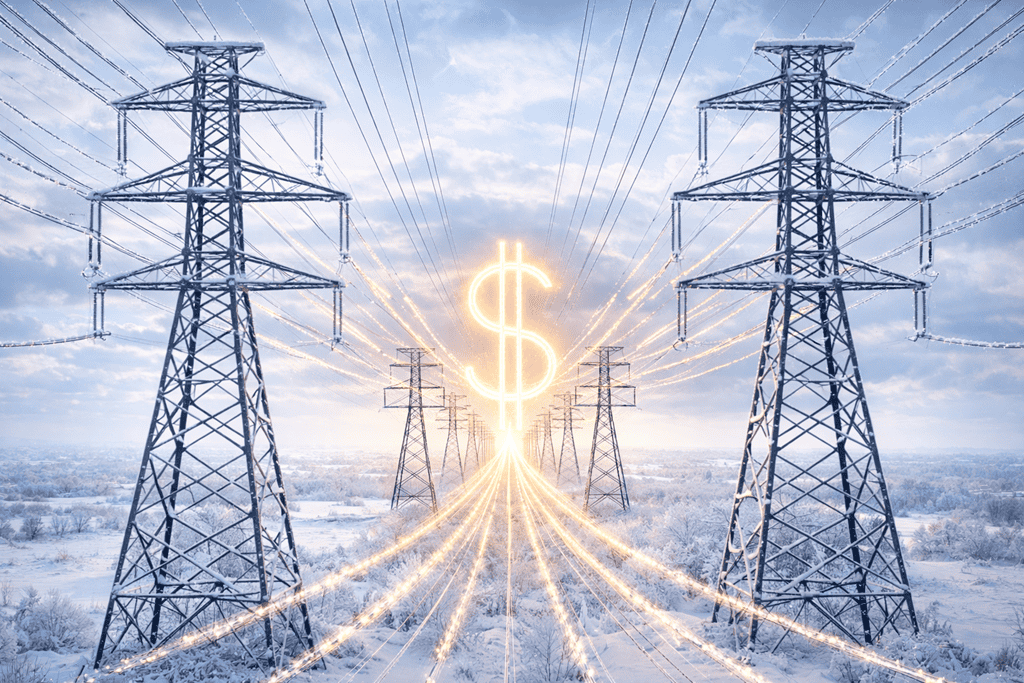
The Arctic blast sweeping across two-thirds of the country isn’t just extreme weather—it’s a stress test of America’s electrical grid. And as electricity demand surges, utilities are preparing the same way they always do: by managing expectations instead of fixing problems. When lights flicker or heat disappears, don’t expect apologies. Your power company has been far too busy lobbying regulators, inflating executive pay, and perfecting excuses to do the unglamorous work of preparation.
This failure isn’t sudden. It’s structural. And it’s profitable.
The Regulatory Capture Racket
Grid operators are openly warning of historic demand. PJM Interconnection, one of nation’s largest power grid managers (13 states plus the District of Columbia), alone expects winter peak loads that rival or exceed anything previously recorded. These warnings didn’t appear overnight. Utilities have known for years that extreme cold, heat waves, and storms would push the system to its limits.
Instead of building resilience, they invested in influence. Regulators became collaborators. Rate increases sailed through. Guaranteed returns replaced meaningful performance standards. Customers were locked into monopolies that profit whether the power stays on or not.
Regulatory capture isn’t theory, it’s the business model. Consumers pay more. Service degrades. Utilities still win.
The Infrastructure They Refused To Build
Rather than expand capacity or harden critical equipment, utilities chose the cheapest workaround: suppress demand. Punitive peak pricing, conservation alerts, and so-called “demand response” programs aren’t innovation, they’re avoidance.
Why spend billions upgrading substations, transmission lines, and transformers when you can simply price people into using less electricity?
The consequences become obvious during crises. When major transformers fail, they aren’t replaced quickly. These are massive, custom-engineered components with long lead times. What should be a temporary outage becomes a prolonged regional failure. Utilities accepted this risk because it didn’t show up on quarterly earnings calls.
Big Tech Gets Power—You Get Told To Shiver
Across PJM territory and beyond, data centers are multiplying rapidly. Artificial intelligence demands massive, uninterrupted electricity, and utilities love it. These industrial customers get priority access, long-term contracts, and fewer regulatory headaches.
Residential customers, meanwhile, get alerts asking them to lower thermostats “for the greater good.” Translation: server farms take precedence over frozen pipes and cold homes.
Utilities frame this as shared sacrifice. It isn’t. It’s preferential treatment wrapped in public-spirited language.
California And The China Transformer Trap
If you want to see where this model ends, look at California.
Years of ideological grid planning, deferred maintenance, and guaranteed utility profits have produced the nation’s highest electricity prices and some of its least reliable service. Rolling blackouts were rebranded as “public safety power shutoffs.” Grid failure became policy.
What’s discussed far less, but matters far more, is what happens when California’s grid equipment fails.
Many of the most critical components, large power transformers, are no longer manufactured at scale in the United States. They are custom-built overseas, often in China, with lead times stretching 12 to 24 months or longer. Each unit is engineered for a specific substation and load profile. There is no warehouse of spares waiting for emergencies.
When wildfires, heat waves, or overloads destroy a transformer, recovery doesn’t mean repair, it means waiting. Entire regions remain fragile long after the headlines fade. Utilities and regulators knew this dependency existed. They chose not to address it because resilience was expensive and delay was acceptable.
California isn’t an outlier. It’s the prototype.
The Climate Rhetoric Shield
Utilities have learned to wrap mismanagement in climate language. Under the banner of environmental responsibility, dispatchable generation was retired faster than reliable replacements came online. Political timelines replaced engineering timelines.
Cleaner energy matters. So does keeping the heat on when temperatures drop below zero. Yet questioning outages now invites accusations of opposing progress. Virtue signaling has become cover for incompetence, allowing infrastructure to decay while executives point to glossy sustainability reports.
This isn’t environmentalism. It’s negligence with better branding.
This Is Now A National Security Problem
At a certain point, grid failure stops being a consumer issue and becomes a national security liability.
Electricity underpins everything: water systems, hospitals, fuel pipelines, telecommunications, financial networks, emergency services, ports, and military installations. A grid that can’t withstand predictable weather—or recover quickly when it fails—is a soft target in an increasingly hostile world.
The vulnerability isn’t hypothetical. When critical transformers are custom-built overseas with year-long lead times, outages cease to be inconveniences and become strategic choke points. Weather already exploits this weakness for free. Any serious adversary would only need to watch and wait.
PJM territory alone includes population centers, logistics hubs, and defense-adjacent infrastructure essential to economic and military readiness. A brittle grid creates cascading failures that no amount of press releases can contain.
Utilities insist this is about climate goals, cost pressures, or complexity. National security planners see something else entirely: reduced redundancy, extended recovery times, and infrastructure dependencies outside U.S. control.
You don’t need sabotage when neglect already delivers the same result.
Bottom Line
The coming days will test America’s grid in ways utilities have long known were inevitable. Advertised capacity figures sound reassuring—until reality intrudes. “Operational” increasingly means “hoping nothing breaks.”
When outages ripple through frozen communities, remember: this wasn’t unavoidable. Utilities had decades, regulatory protection, and billions in guaranteed revenue. They chose lobbying over resilience, optics over engineering, and executive bonuses over public service.
A grid that can’t be repaired quickly isn’t just unreliable, it’s a national vulnerability. And the people paying the price aren’t executives or regulators. It’s everyone left shivering in the dark.
Stay warm, if they let you.
We are so screwed.
— Steve