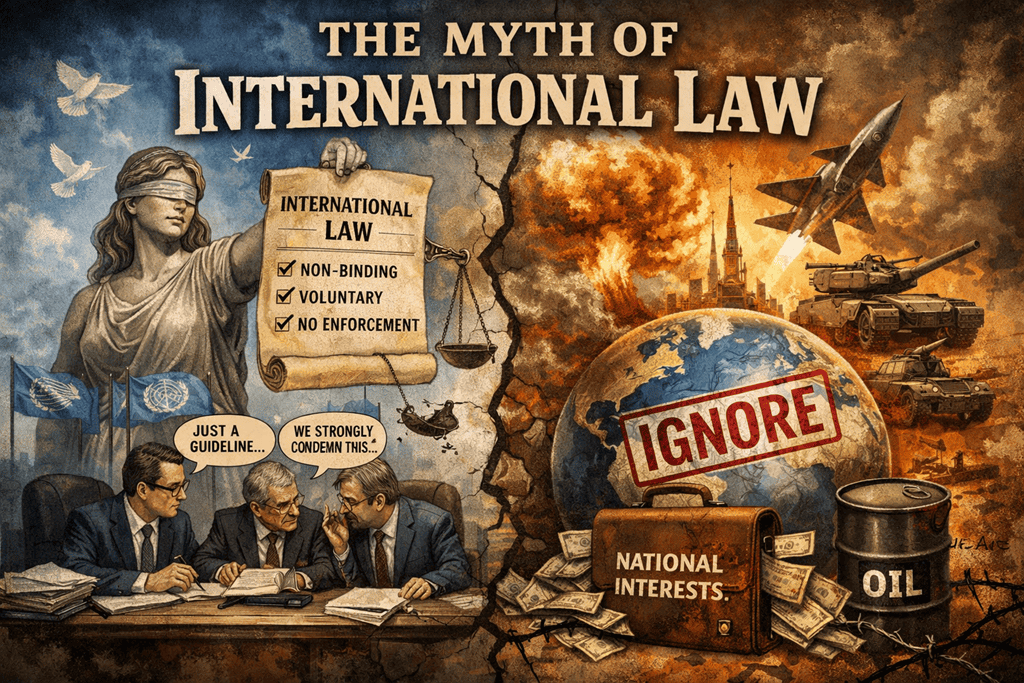
The Core Claim
International law is often portrayed as a binding, enforceable legal system comparable to domestic law. In practice, it is not. Much of what is called “international law” functions more like norms, expectations, and political commitments than hard law.
Next time someone cites “international law,” remember it is performative art and bloviating.
Here is a useful outline to ground your thinking.
Participation Is Voluntary
- States are sovereign. There is no global legislature with authority over them.
- Countries choose whether to join treaties, courts, or conventions.
- They can withdraw (e.g., Paris Agreement, ICC threats, Brexit from EU legal regime).
- No state is compelled to accept jurisdiction without consent.
- If participation is optional, compliance is inherently conditional.
No Central Enforcement Mechanism
Domestic law has police, prosecutors, and courts with compulsory authority. International law does not.
- No global police force
- No universal court with mandatory jurisdiction
- Enforcement depends on:
- State self-interest
- Diplomatic pressure
- Economic sanctions
- Military power (often selectively applied)
Powerful states routinely ignore rulings with little consequence.
Often Non-Binding by Design
Much of what is labeled “international law” is soft law:
- Declarations
- Guidelines
- Framework agreements
- “Norms” and “standards”
These instruments:
- Carry no penalties
- Are intentionally vague
- Allow broad interpretation
- Exist to signal intent, not compel action
Calling them “law” stretches the term beyond its traditional meaning.
Bureaucratic Construction, Not Democratic Law
Many international rules originate from:
- UN agencies
- Transnational NGOs
- Expert panels
- Career diplomats and civil servants
These actors:
- Are not elected by national populations
- Often operate with minimal transparency
- Draft language that later gets cited as “law”
This creates a legitimacy gap between who writes the rules and who lives under their influence.
Not the Same as Treaties
This is a critical distinction that is often intentionally blurred,
Treaties:
- Formally negotiated
- Ratified by governments (often legislatures)
- Clearly binding under international law
“International law” (broad sense):
- Includes customs, opinions, resolutions, and norms
- May never be ratified
- Still invoked as authoritative
Equating the two inflates the power and credibility of non-binding instruments.
Why the Myth Persists
The language of “law”:
- Creates moral pressure
- Confers legitimacy
- Discourages dissent
- Masks political preferences as neutral rules
It is rhetorically powerful—even when legally weak.
Bottom Line
International law is not fake, but it is not law in the domestic sense. It is a hybrid system of voluntary commitments, political norms, and selective enforcement—effective when aligned with state interests, ignored when inconvenient. Treaties bind; norms persuade; power ultimately decides.
We are being screwed.
— Steve
An Example: Dodge of Dictators
Despite President Trump’s social media pronouncement Sunday that “there will be no more oil or money going to Cuba — zero,” the current U.S. policy is to allow Mexico to continue to provide oil to the island, according to Energy Secretary Chris Wright and another U.S. official.
Cuba desperately needs the oil, since Venezuela is no longer supplying it, after Nicolás Maduro’s ouster just over a week ago.
“As history demonstrates, relations between the U.S. and Cuba, in order to advance, must be based on International Law rather than on hostility, threats, and economic coercion,” Cuban President Miguel Díaz-Canel Bermúdez said on X Monday.