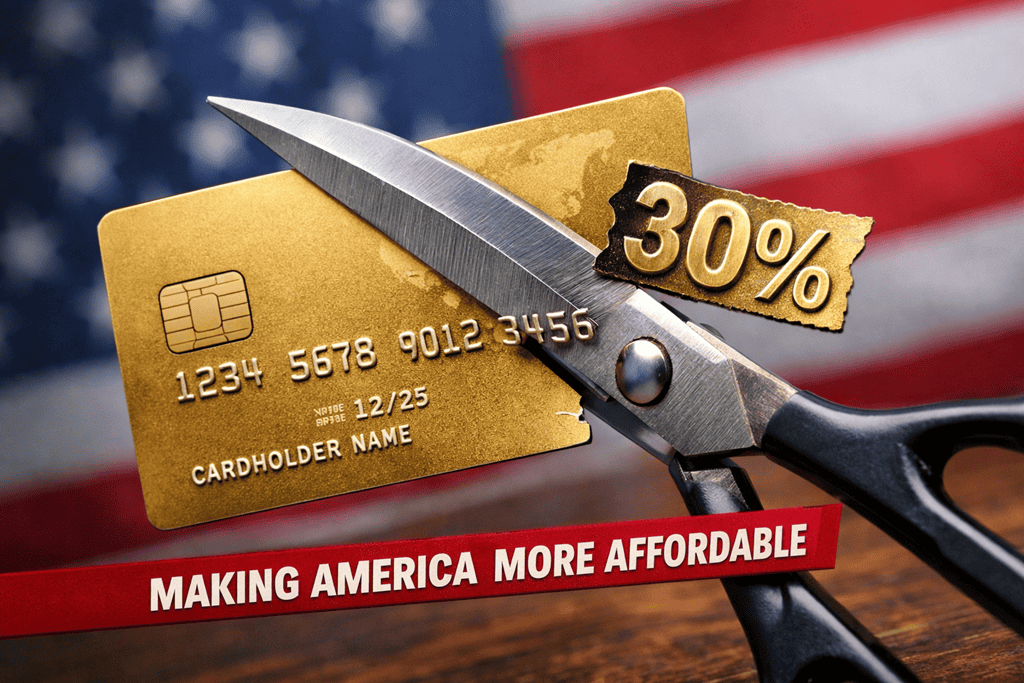
The Great Interest Rate Heist.
At some point, America quietly decided that usury wasn’t immoral anymore—it was just “financial innovation.” Credit card interest rates didn’t creep up by accident. They exploded because lawmakers abandoned centuries-old usury laws and replaced them with a wink, a nod, and a campaign donation. Today, 20%, 25%, even 30% APR isn’t considered outrageous. It’s considered normal.
Normal. Let that sink in.
For generations, charging those kinds of rates was illegal because it destroyed families, trapped workers, and hollowed out communities. Now it’s a highlight of the quarterly earnings call.
When Usury Laws Were Thrown In The Trash
Usury laws once existed for a simple reason: to stop lenders from preying on desperation. Those protections didn’t vanish overnight. They were slowly dismantled, deregulated, and outsourced to “the market,” as if a market dominated by a handful of megabanks would ever regulate itself.
The result? Credit card companies can charge whatever the traffic will bear, hide behind fine print, and relocate their legal headquarters to friendly states that rubber-stamp obscene rates nationwide. Congress didn’t just look away—it helped write the escape routes.
Enforcement Is A Joke, Not A Safeguard
Let’s talk enforcement. Or more accurately, the lack of it.
When regulators do step in, the penalties are laughable. A billion-dollar bank gets fined a few million dollars for abusive practices, calls it an “operating expense,” and keeps right on going. No executives in cuffs. No licenses revoked. No restitution that actually hurts.
Imagine stealing a car, paying a parking ticket, and driving off in a new one. That’s modern financial regulation in a nutshell.
Risk Isn’t Eliminated—It’s Exported
Here’s the part the credit card industry doesn’t advertise.
Credit card companies often don’t even keep the real risk of default. They bundle credit card debt, especially high-interest, high-risk balances, into securities and sell them to investors hungry for yield. The underlying debt is sliced, packaged, and marketed as an “investment opportunity,” with juicy returns driven by sky-high interest rates.
Translation: the lender gets paid upfront, transfers much of the default risk to investors, and keeps collecting fees and interest along the way.
When consumers default, the pain doesn’t always land where the profit was made. The system is engineered so that credit card companies win whether borrowers succeed or fail. That’s not capitalism—it’s risk laundering.
The Acceptable Cost Of Doing Business Scam
Credit card companies know exactly what they’re doing. They price in defaults. They price in complaints. They even price in lawsuits. When the math says exploitation is profitable, exploitation becomes policy.
This is why families juggling groceries, gas, and emergency repairs end up stuck paying triple the original cost of a necessity. Not because they’re irresponsible—but because the system is designed to profit from short-term hardship and long-term dependence.
Debt isn’t a bug. It’s the product.
A Rare Line In The Sand
That’s why the recent call to cap credit card interest rates at 10% landed like a political grenade. For once, someone said the quiet part out loud: charging 30% interest isn’t freedom—it’s predation.
This isn’t about punishing responsible lenders. It’s about restoring a moral boundary that never should have been erased. A temporary cap won’t fix decades of damage, but it does something radical in modern Washington—it admits the system is broken.
Predictably, defenders of the status quo are already screaming about “market disruption” and “reduced access to credit.” Translation: their profit margins might shrink, and that’s unacceptable.
Why Congress Is Squirming
If Congress refuses to act, it won’t be because the idea is unworkable. It will be because too many members are financially and politically tied to the very institutions bleeding their constituents dry.
This is one of those moments where the excuses wear thin. Either lawmakers believe 30% interest is ethical, or they don’t. There is no middle ground. Silence is consent, and delay is complicity.
Bottom Line
Credit card interest rates didn’t get this high because Americans demanded them. They got this high because lawmakers abandoned usury laws, regulators stopped enforcing consequences, and corporations learned they could treat financial harm as an acceptable cost of doing business.
Capping rates won’t end debt overnight, but it would end the lie that legalized loan sharking is just the price of modern life. The real question isn’t whether reform is possible—it’s who in Washington is brave enough to admit the scam and shut it down.
We are being screwed.
— Steve