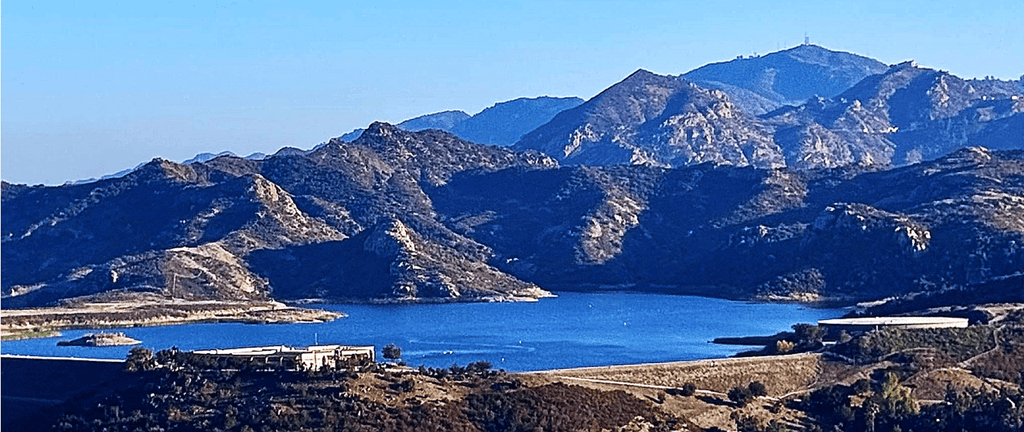
Located in the hills just south of Westlake Village, the Las Virgenes Reservoir can hold a three-month supply of treated drinking water for customers. The total capacity is approximately 9,500 acre-feet.The reservoir was created to assure reliable drinking water delivery to LVMWD customers during peak seasonal demand.
With only one source of drinking water serving our arid area, this local storage facility is critical, and a cheap insurance policy in the face of a natural disaster.
All drinking water served to LVMWD customers is imported because local water supplies are scarce and of poor quality. Supplies are purchased from the Metropolitan Water District of Southern California (MWD). This originates as snowpack in the High Sierras and is transported more than 400 miles through the State Water Project, which is owned and operated by the Department of Water Resources.
Water delivered and stored in Las Virgenes Reservoir is treated potable water from MWD. To help protect water quality, LVMWD owns 360 acres of land immediately surrounding the reservoir.
Ten Reasons Abundant Water Will Never Lower What You Pay
California finally has water. Reservoirs are brimming. Snowpack numbers look healthy. The endless drought panic has eased. And yet, your water bill keepsx climbing like nothing changed.
That is not an accident. It is the design.
For years, residents were told to conserve, sacrifice, and brace for shortages. The promise, spoken or implied, was that smarter use and better conditions would eventually bring relief. Now the rain has come, and the relief never did. Here is the uncomfortable truth about why your water bill keeps going up, no matter how wet the year is.
Reason 1: Water Rates Are Built On Fixed Costs, Not Reality
Water pricing does not behave like supply and demand. Agencies base rates on fixed expenses: staff, facilities, testing, administration, and compliance. Those costs exist whether reservoirs are full or bone-dry. More water does not shrink payrolls or pause maintenance schedules, so bills stay high even when scarcity disappears.
Reason 2: Infrastructure Debt Is Forever
Decades of borrowing for pipes, plants, pumps, and upgrades are baked into your bill. Bonds issued years ago still need to be repaid, and new ones are constantly issued. Rain does not cancel debt. It just makes it less politically awkward to keep collecting.
Reason 3: Conservation Shrinks Use, Not Costs
When people conserve, agencies sell less water—but their expenses barely change. To compensate, districts raise fixed fees and meter charges. The result is a bill you cannot escape, even if you barely turn on the tap. Conservation becomes a moral victory, not a financial one.
Reason 4: Emergency Spending Never Goes Away
Droughts justify rushed spending decisions. Backup systems, temporary supplies, and “urgent” projects get approved fast. When the crisis ends, the spending does not get reversed. Temporary fear creates permanent line items on your bill.
Reason 5: Wholesale Contracts Ignore Abundance
Many local districts are locked into long-term supply contracts that prioritize reliability over flexibility. They pay fixed charges whether they need the water or not. Excess supply does not reduce those obligations—it just exposes how rigid the system really is.
Reason 6: Labor And Energy Costs Only Go One Direction
Water delivery depends on skilled labor and massive energy use. In California, both are expensive and getting more so. Add increasing regulatory requirements, and agencies have a built-in justification for constant rate hikes, regardless of conditions.
Reason 7: The System Is Designed To Grow, Not Shrink
Public water systems are built for worst-case scenarios. That makes sense for safety, but it removes any incentive to scale down during good times. There is no reward for becoming leaner, cheaper, or more efficient when things improve.
Reason 8: Accountability Is Weak And Fragmented
Hundreds of water districts operate with minimal public scrutiny. Elections draw little attention. Budgets pass quietly. Ratepayers rarely challenge increases because the process is opaque and exhausting. Low visibility results in high costs.
Reason 9: Surpluses Encourage New Spending, Not Savings
When agencies have breathing room, they rarely talk about rebates or rate reductions. Instead, “extra” capacity becomes an excuse for new hires, higher benefits, or shiny projects of questionable necessity. Abundance feeds expansion, not restraint.
Reason 10: There Is No Built-In Mechanism For Giving Money Back
Unlike private markets, water agencies are not structured to share upside with customers. Rates go up easily but almost never come down. The system collects, adjusts upward, and moves on.
Bottom Line
Full reservoirs should be good news, and they are, operationally. But financially, they change almost nothing for consumers. California’s water pricing system was never designed to reward abundance; it was meant only to survive scarcity.
Until incentives, accountability, and cost structures are fundamentally rethought, Californians will keep paying drought prices in flood years. The water may finally be here, but bill relief is not coming.
We are so screwed.
— Steve