When “National Security” Becomes A Cover Story For Empire Building.
Let’s drop the euphemisms and call this what it is: colonialism with a stars-and-stripes paint job. When the White House casually floats the idea that using military force to “acquire” Greenland is “always an option,” it’s not strategic realism, it’s imperial muscle memory. The language alone should set off alarms. You don’t “acquire” a place where 56,000 people live. You invade it, coerce it, or bully it. And pretending otherwise insults everyone’s intelligence.
America claims to be the global champion of self-determination. Yet the moment an island is rich in minerals, strategically located, and inconveniently governed by people who say “no,” suddenly sovereignty becomes negotiable. Apparently, freedom is sacred—until it interferes with shipping lanes, rare earth supply chains, or Washington’s appetite for control.
Greenland’s People Are Not A Footnote
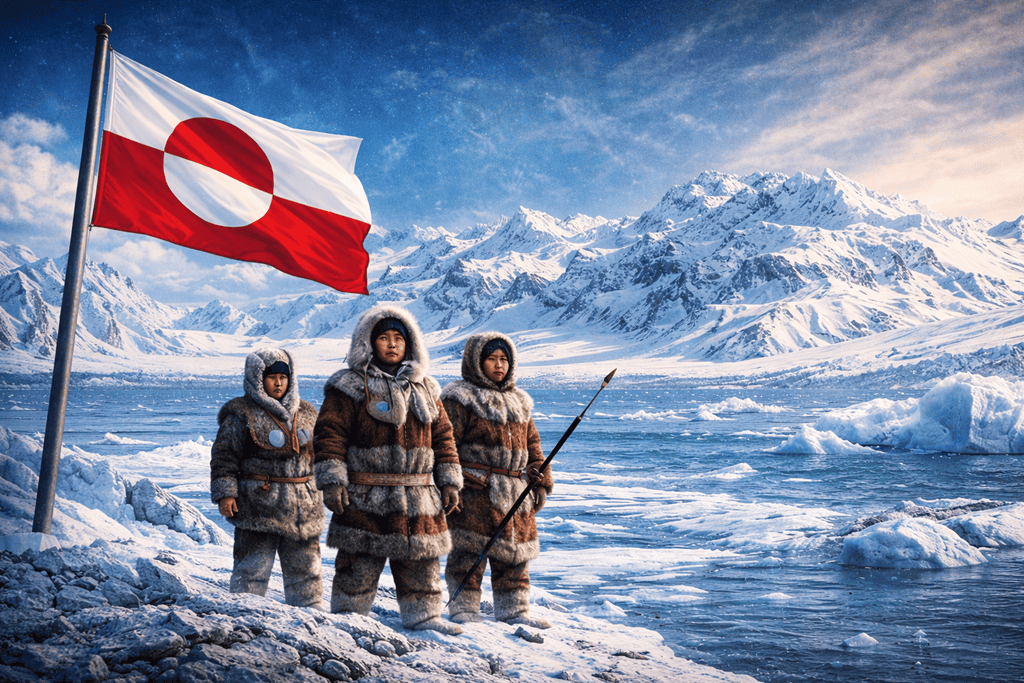
Greenland is constantly discussed as territory, terrain, and treasure. What’s missing? Greenlanders. Mostly Inuit. Mostly ignored. They are spoken about as if they were weather conditions—unfortunate, but manageable.
The people of Greenland have repeatedly made their position clear: they do not want to be dominated by the United States. Their elections reflected that reality. Their leaders have said it plainly. Yet the response from Washington is a shrug and a smirk, capped with the assumption that “nobody would fight the United States over Greenland.”
That statement alone exposes the rot. It assumes consent is irrelevant when power is overwhelming. That’s not diplomacy. That’s intimidation.
Buying An Island Is Still Colonialism
Let’s address the other proposal: buying Greenland. As if this were a distressed strip mall and not a self-governing society. The idea that Denmark could simply sell Greenland—over the objections of Greenland’s own government—reveals how colonial thinking never really died. It has just learned new vocabulary.
You can’t launder an empire through a real estate transaction. Money does not transform coercion into legitimacy. Whether through a contract or a carrier strike group, the result is the same: stripping people of agency to satisfy a superpower’s strategic cravings.
Denmark Selling An Island Is Not Unprecedented
Denmark sold its colonies in the Danish West Indies to the United States in 1917 for $25 million in gold. After the sale, the islands became what we now know as the U.S. Virgin Islands—specifically Saint Thomas, Saint John, and Saint Croix.
This transaction was motivated by a mix of strategic and economic factors: the U.S. sought to secure its position in the Caribbean during World War I to prevent Germany from using the islands as a base, while Denmark sought to divest from costly, increasingly distant colonies that were no longer central to its core interests.
The transfer officially took place on March 31, 1917, and the U.S. formally took possession, marking the first time Denmark permanently sold territory outside Europe.
NATO, Hypocrisy, And The Arctic Excuse
The irony is suffocating. An attack or forced takeover of Greenland would fracture NATO—the very alliance Washington claims to be protecting. European leaders understand this. Denmark understands this. Greenland understands this. Only the empire, drunk on its own indispensability, seems confused.
Yes, the Arctic matters. Yes, Russia and China are active there. Yes, rare earth minerals are critical. None of that grants the United States moral ownership over someone else’s homeland. Security concerns do not erase borders, treaties, or human dignity. If they did, every strong nation on Earth would have a blank check to devour weaker ones.
Climate Change As A Colonial Opportunity
There’s something especially grotesque about treating melting ice caps as a business opportunity. Climate catastrophe is opening shipping routes, and instead of confronting the damage, powerful nations are racing to exploit it. Greenland becomes less a place than a prize—unguarded wealth revealed by planetary breakdown.
This is disaster capitalism wearing a parka.
Bottom Line
Greenland’s sovereignty is not a strategic inconvenience to be overcome. It is a right. When the United States talks about military options or purchase plans, it exposes a truth many would rather ignore: American colonialism never disappeared. It just waits for moments of leverage to resurface.
If Washington truly believes in freedom, it should start by respecting “no”—even when that no comes from a cold, mineral-rich island it desperately wants to own.
Is Greenland’s strategic choke point between Europe and North America, and access to rare earth minerals critical to future technologies, worth subjugating a people, mostly Inuit (88) who speak a difficult language to learn, against their will? Why not ask American Indians?
We are so screwed.
— Steve