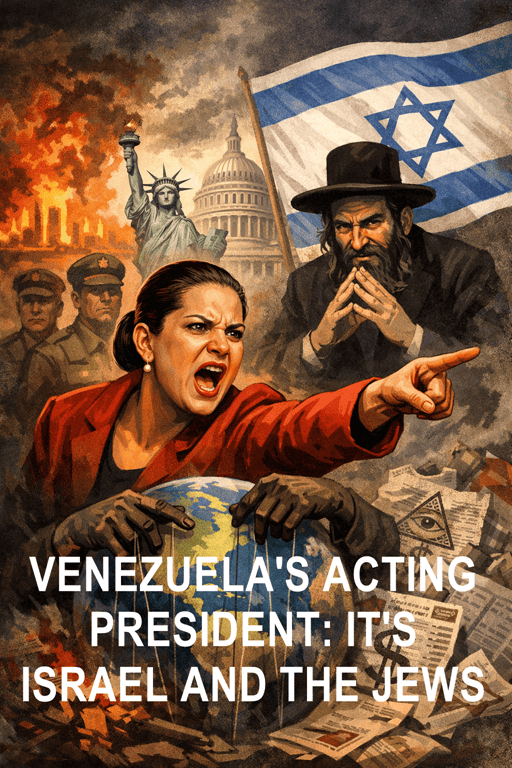
‘Zionist attack:’ Venezuela’s acting gov’t blames Israel for Maduro seizure.
Venezuelan Vice President Delcy Rodríguez asserted that the US operation that led to the arrest of President Nicolás Maduro seem “Zionist”
Venezuela’s acting president, Delcy Rodríguez, on Sunday accused Israel of orchestrating the U.S. operation that led to the arrest of ousted leader Nicolás Maduro, describing the move as a “Zionist attack” against the country.
Speaking in a televised address alongside senior figures from the ruling establishment, Rodríguez claimed that Israel was responsible for what she characterized as foreign aggression against Venezuela.
She offered no evidence to support the accusation and reiterated the government’s long-standing position that Maduro remains the country’s only legitimate president.
“The attack on Venezuela is Zionist,” Rodríguez said, repeating rhetoric frequently used by the Chavista leadership during periods of political crisis. Her remarks came days after U.S. forces detained Maduro in Caracas and transferred him to New York, where he was taken into federal custody. [Source]
The Oldest Scapegoat, Dusted Off Again.
Let’s be honest: nobody should be surprised anymore. When a collapsing regime runs out of excuses, when corruption and incompetence finally catch up, there’s a familiar script pulled from a moth-eaten drawer. Cue the dramatic tone, cue the nationalist outrage, and cue the accusation that Israel—or worse, “the Jews”—are secretly behind it all. It’s lazy, it’s dangerous, and it’s infuriatingly predictable.
This isn’t analysis. It’s scapegoating. And it’s been used for centuries because it works on people desperate for a villain who isn’t standing in the mirror.
From Political Failure To Conspiracy Theater
When leaders lose control, they rarely admit it. Admitting failure requires accountability, and accountability is kryptonite to authoritarian power. So instead, the narrative pivots. Economic collapse? Foreign plot. Public unrest? Outside sabotage. Arrested strongman? Obviously a global conspiracy.
Blaming Israel or invoking “Zionist attacks” is a shortcut. It wraps paranoia in political language and transforms a domestic crisis into a cosmic battle against an imagined enemy. No evidence required. No logic necessary. Just say the word, and suddenly, loyalists have someone else to hate instead of asking hard questions.
Why It’s Always The Same Target
There’s a reason this playbook keeps returning to the same villain. Anti-Semitic tropes are deeply embedded in global political culture, even where there are barely any Jews at all. Accusations of secret control, shadowy influence, and global manipulation are recycled because they’re familiar and emotionally charged.
What makes this especially enraging is how casually these accusations are deployed. Entire populations are blamed with a wink and a slogan, as if history never taught us where this kind of rhetoric leads. Spoiler: it never leads anywhere good.
Deflection Disguised As Defiance
Calling a political setback a “Zionist attack” isn’t bravery. It’s cowardice. It’s a way to dodge responsibility while pretending to stand tall against a powerful foe. It’s also a signal to supporters: don’t question us, rally around us.
This tactic doesn’t solve inflation, restore democracy, or feed hungry families. It only poisons public discourse and normalizes bigotry as a political tool. And once that door is open, it never stays neatly contained.
The Real Cost Of This Rhetoric
Words matter. When leaders blame Israel and the Jews for unrelated political events, they legitimize hatred far beyond their own borders. They give oxygen to extremists, validate conspiracy theories, and make Jewish communities everywhere less safe.
All of this, just so failed leaders can avoid saying three simple words: “We messed up.”
Bottom Line
Blaming Israel and the Jews for political failure is not resistance, strategy, or truth-telling. It’s an ancient, ugly reflex used by regimes that can’t survive honesty. The outrage isn’t that this happened. The outrage is that it keeps happening—and that too many people still pretend not to recognize the trick.
We are so screwed.
— Steve