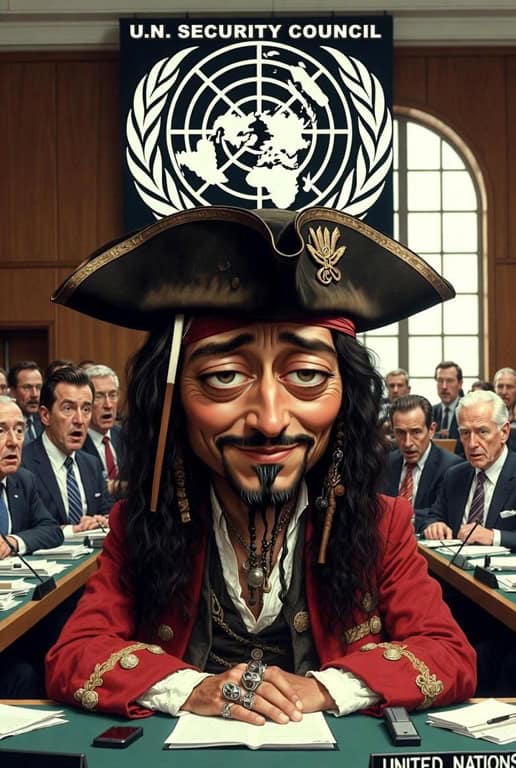
Hot Wars Everywhere, Sanity Nowhere.
The world is on fire, and the people paid to manage the flames are busy rearranging nameplates. Ukraine bleeds in a grinding war of attrition with Russia. Israel fights a hydra of Iranian proxies stretching from Gaza to Lebanon to Yemen. Shipping lanes are under attack, borders are dissolving, and escalation hangs in the air like gasoline fumes. This is not a moment for symbolism. This is a moment for seriousness.
Instead, the international system is doing what it does best: pretending process equals competence.
The U.N. As Performance Art
Enter the United Nations Security Council, the self-proclaimed cockpit of global security. In theory, this is where grown-ups sit around a table and try to stop the world from tearing itself apart. In reality, it increasingly resembles performance art staged for bureaucrats who confuse procedure with purpose.
The rotating presidency of the Security Council is defended as “mostly ceremonial,” a glorified gavel-passing exercise. That excuse collapses the second you admit the president sets agendas, frames debates, and signals priorities. Symbols matter—authority matters. And who you elevate says everything about what you value.
When A Non-Player Gets The Controller
So what does it say when a barely functional state is handed a position of respect at the exact moment the world is convulsing? This isn’t cruelty; it’s realism. Some states are players. Others are pieces on the board. Pretending otherwise doesn’t make the game fair; it makes it unplayable.
A country that cannot control its own territory, cannot secure its own population, and cannot suppress terrorist militias within its borders is not a contributor to global security. It is a case study. Treating it as a peer is not compassion; it’s institutional self-sabotage.
Failure, Sanitized By Bureaucracy
Apologists rush in with soothing language. The role is automatic. The term is short. The standards are low. Exactly. That’s the problem. In a world defined by hot wars and real consequences, the guardians of peace operate on autopilot. No pause. No judgment. No adult supervision.
The result is moral hazard, with legitimacy handed out like participation trophies. Ninety-plus percent approval votes are celebrated as progress, even when they reflect nothing more than diplomatic herd behavior. The failed state index might as well be a résumé booster.
Respect Is Earned, Not Rotated
Positions of respect should signal capability, stability, and seriousness of purpose. They should not be used as therapeutic affirmations for regimes still struggling with corruption, displacement, and internal fragmentation. Recognition without results is not encouragement; it is denial.
In wartime conditions, credibility is a form of currency. When institutions squander it, they accelerate their own irrelevance. Every empty gesture tells the world that the rules matter more than outcomes, and appearances matter more than lives.
The Cost Of Pretend Governance
While diplomats congratulate themselves on inclusivity, adversaries take notes. They see an international system unwilling to distinguish between capacity and collapse. They see weakness dressed up as virtue. And they exploit it.
This is how you end up with councils that debate endlessly while missiles fly, statements pile up while cities burn, and terrorists thrive in the gaps between resolutions and reality.
Bottom Line
The world is not short on crises; it is short on seriousness. In an era of active wars and escalating threats, elevating dysfunctional non-players into positions of symbolic authority is not harmless—it is dangerous. Respect without responsibility hollows out institutions from the inside. If global governance wants to be taken seriously, it must first learn to take reality seriously.
We are so screwed.
— Steve