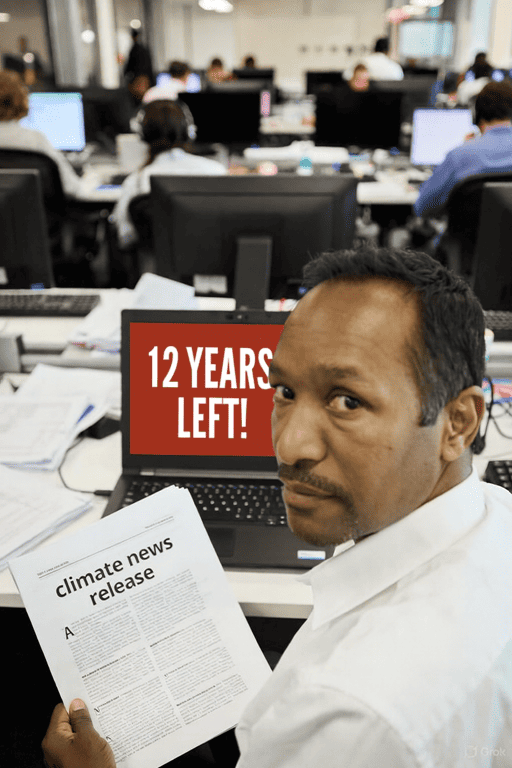
The Hidden Problem Distorting Climate Change News.
Climate change is often described as one of the most complex and consequential issues of our time, so it deserves rigorous, skeptical reporting.
Yet the public conversation is crowded with climate churnalism, a fast-food style of journalism where weak studies and hyped claims are recycled into dramatic headlines. Traditionally, churnalism meant reporters rewriting press releases. But in climate coverage, the problem goes much further: it’s the uncritical amplification of local data, flawed research, and exaggerated conclusions presented as global truth.
Climate systems are massive, interconnected, and wildly diverse—from Arctic ice to Amazon humidity—yet many headlines are built on the flimsiest foundation. A heatwave in one city becomes “proof” of global catastrophe; a cold winter in another gets spun as “evidence” that warming isn’t real. This kind of churnalism doesn’t just misinform—it erodes trust and fuels confusion about a problem humanity urgently needs to understand.
Why Climate Churnalism Is Especially Misleading
Climate stories are uniquely vulnerable to oversimplification. A reader encounters a headline about a local drought, an urban heat spike, or a surprising tree-ring study and naturally begins considering what it means for their community, their job, and their family. But unlike diet fads or exercise trends, climate findings often get projected onto planetary-scale narratives.
The hitch? Local data is not global destiny. And yet many journalists treat it that way.
A glacier retreat in one valley, a flood in one coastal town, or a temperature anomaly over a single season can offer important clues—but they are not universal indicators. Reliable climate science depends on long-term data, broad geographical coverage, and multiple layers of modeling. Churnalistic climate reporting often ignores these essentials in favor of quick, dramatic takeaways.
Without rigorous scrutiny, headlines turn into high-stakes game of telephone, where nuance disappears and drama takes over.
The Seven Sins of Climate Churnalism
Climate reporting suffers many of the same pitfalls as health reporting—but with consequences that scale to the entire planet. Here’s how the seven sins show up in environmental news:
1. Confusing Correlation With Causation: A single storm, wildfire, or cold snap doesn’t “prove” anything on its own. Yet correlations are often framed as ironclad climate truths.
2. Exaggeration Through Overgeneralization: A study in one watershed or one agricultural region gets spun as a global forecast. Projecting Local Results Onto a Global Scale, ignoring that climates vary drastically from the poles to the tropics. What happens in Greenland does not automatically apply to Ghana.
3. Ignoring Bias, Confounding, and Selection Errors: Climate datasets are enormous and incredibly complex. When journalists fail to ask how the data was collected or whether the comparison is fair, they risk overselling shaky conclusions.
4. Neglecting Plausibility: Some claims simply don’t pass the basic smell test, like suggesting a single weed species’ behavior predicts entire planetary trends. If it sounds implausible, it usually is.
5. The “Disclaim and Pivot” Maneuver: Writers acknowledge uncertainties (“Of course, one season doesn’t define climate…”) only to pivot right back into sweeping statements about global collapse or global safety.
6. Keep Testing; Report Once: In climate modeling, thousands of simulations run across dozens of parameters. Churnalism highlights the scariest or most surprising outcome rather than the full distribution.
7. The Sin of Incuriosity: Perhaps the most harmful: the failure to ask more profound questions.
-
Why does a local anomaly matter?
-
What are the limitations of the dataset?
-
Does this hold true across regions, decades, and climate zones?
Without curiosity, journalists simply echo claims rather than illuminate them.
How To Spot Climate Churnalism
1. Local ≠ Global: If a headline treats a local heatwave, flood, drought, or glacier shift as proof of global trends, be skeptical.
2. One Study, Big Claims: If a single paper supposedly rewrites decades of climate understanding, something’s off.
3. Missing Time Scale: Climate is long-term. The weather is short-term. Churnalism blurs the line.
4. Sensational Outliers: If the headline quotes the most extreme model output instead of typical projections, it’s churnalism.
5. Vague Methods, Vague Sources: No mention of how the data was gathered? No alternative explanations? That’s a red flag.
6. “Disclaim and Pivot” Language: Phrases like “Of course, this might not prove anything… but scientists say—” usually precede an overreach.
7. Implausible Claims: If it sounds unbelievable (either too optimistic or too doomsday), pause and check the science.
Bottom Line: Why This Matters for the Planet
Climate change requires public understanding, broad cooperation, and sustained action. Good climate reporting can motivate informed decisions, build trust in science, and inspire global stewardship. Churnalism does the opposite. It amplifies outliers, flattens nuance, and leaves readers feeling whiplashed by contradictory or exaggerated claims.
Worse, it undermines the credibility of legitimate climate science, science that has taken decades of global measurement, satellite observation, paleoclimate reconstruction, and modeling to assemble.
To face a planetary challenge, we need planetary-scale thinking, not local data stretched into global prophecy. We need information that informs our need to develop resiliency in personal behavior, clothing, shelters, and systems exposed to the weather. We must secure our water and food sources. We need to be better prepared for natural disasters. And above all, we need to realize that some phenomena are beyond man’s ability to control. And those who tell you different, pointing to taxes, rules, and regulations, and nonsensical solutions, are climate charlatans and should be consigned to the dustbin of history.
We are so screwed.
— Steve