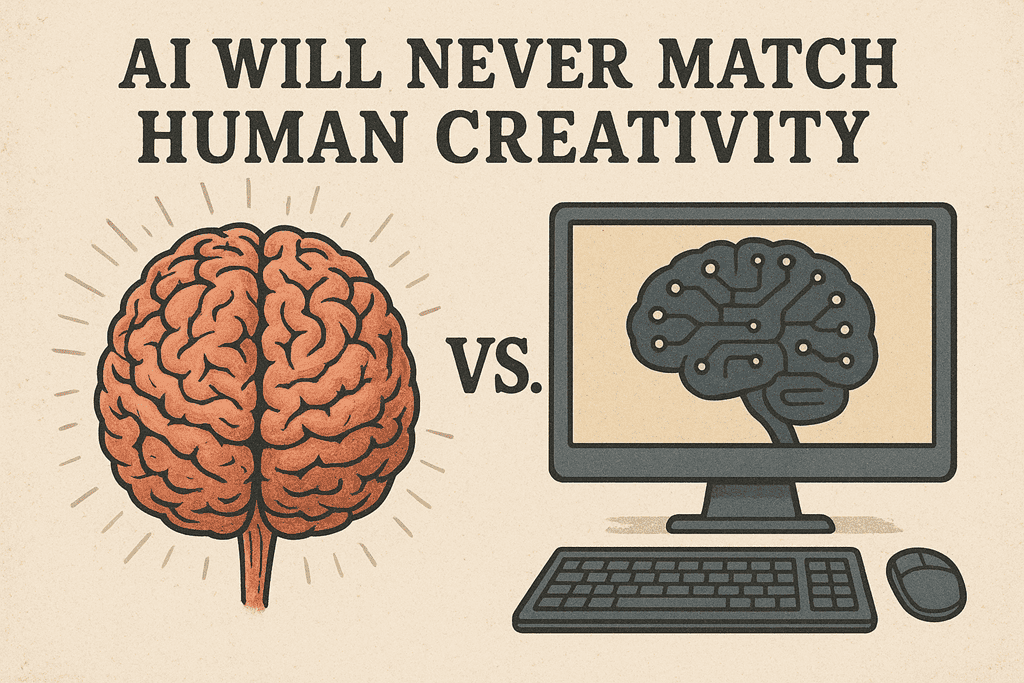
AI Isn’t Coming For Your Creative Job — And Here’s The Math To Prove It.
Let’s get one thing straight: if your job requires varied tasks, creative decision-making, and actual original thought, AI is not replacing you. Not now. Not soon. And according to new research, maybe not ever—unless someone reinvents the entire concept of a large language model from scratch.
We’ve been force-fed the breathless narrative that ChatGPT and its cousins are about to surpass human creativity, wipe out professional creators, and churn out groundbreaking ideas like effortless magic. But the latest theoretical analysis—published in the Journal of Creative Behaviour—torches that fantasy from top to bottom.
And frankly, it’s about time someone did.
The Big Reveal: AI Is Mathematically Capped At Amateur Creativity
David H. Cropley, an engineering innovation expert, took a scalpel to the hype and applied actual math to the mechanics of large language models. His conclusion?
AI creativity hits a hard ceiling—a low one.
Specifically, the equivalent of a mildly clever amateur human.
- Not a professional.
- Not a seasoned creator.
- Definitely not an expert innovator.
Why? Because models like ChatGPT are shackled to one core function: predicting the most probable next word based on past data. They are statistical parrots, fast, impressive, and sometimes charming, but parrots nonetheless.
And here’s the kicker, Cropley proved:
- When the model chooses probable words, it becomes practical but boring.
- When it chooses surprising words, it becomes novel but nonsensical.
The two variables actively sabotage each other.
- Mathematically.
- Inevitably.
- Permanently.
Cropley calculated that the maximum creativity possible within this architecture tops out at 0.25 on a 0–1 scale—the border between “average person doodling in a notebook” and “entry-level professional.”
In other words, AI cannot reach expert creativity. Not with probability-driven design. Not ever.
Why This Matters: AI Becomes Worse As It Tries To Be Better
Here’s the brutal irony: As AI tries to be more accurate, it becomes less creative.
The better it gets at choosing the “correct” next word, the more it sinks into predictability and sameness. This is not a bug. It’s the entire system.
- Want novelty? Raise the randomness, then watch coherence fall apart like wet tissue.
- Want coherence? Reduce randomness, then get recycled ideas wrapped in shiny phrasing.
This trade-off is baked into the architecture itself. You don’t escape it without inventing an entirely new kind of AI.
The Harsh Truth: AI Mimics, It Doesn’t Understand
Cropley’s findings hit directly at the core misconception: people confuse output with ability.
Just because AI generates something that looks like writing or sounds like an idea does NOT mean it actually created anything. It stitched together statistically average patterns from its training data.
That’s imitation, not insight.
This is why AI outputs frequently sit in the 40th to 50th percentile when evaluated against human work. Impressive to the average person? Sure. Threatening to an expert? Not even close. Professional creatives instantly spot the formulaic fingerprints.
Your Job Is Safe—If You Actually Use Your Brain
So here’s the real message: Generative AI is a tool for routine, repetitive, average-level tasks. It can smooth workflows, draft starting points, or spark small ideas, but it cannot autonomously produce the kind of transformative, high-impact creative work professionals are valued for.
If your job requires:
- genuine idea generation
- creative synthesis
- cross-domain insight
- strategic judgment
- intuition
- read human reactions to effectively sell a product or service
- or the ability to break patterns rather than mimic them
Congratulations: AI cannot replace you.
Cropley said it bluntly: “An LLM never will.” Until computer scientists invent an entirely new architecture that isn’t chained to historical probability patterns, the highest levels of creativity belong to humans—and only humans.
Bottom Line: Relax.
Are you required to think for a living, create for a living, or innovate for a living? Your job is safe. And the math says so.
— Steve
Reference:
Cropley, D. H. 2025. “ ‘The Cat Sat on the …?’ Why Generative AI Has Limited Creativity.” The Journal of Creative Behavior 59, no. 4: e70077.