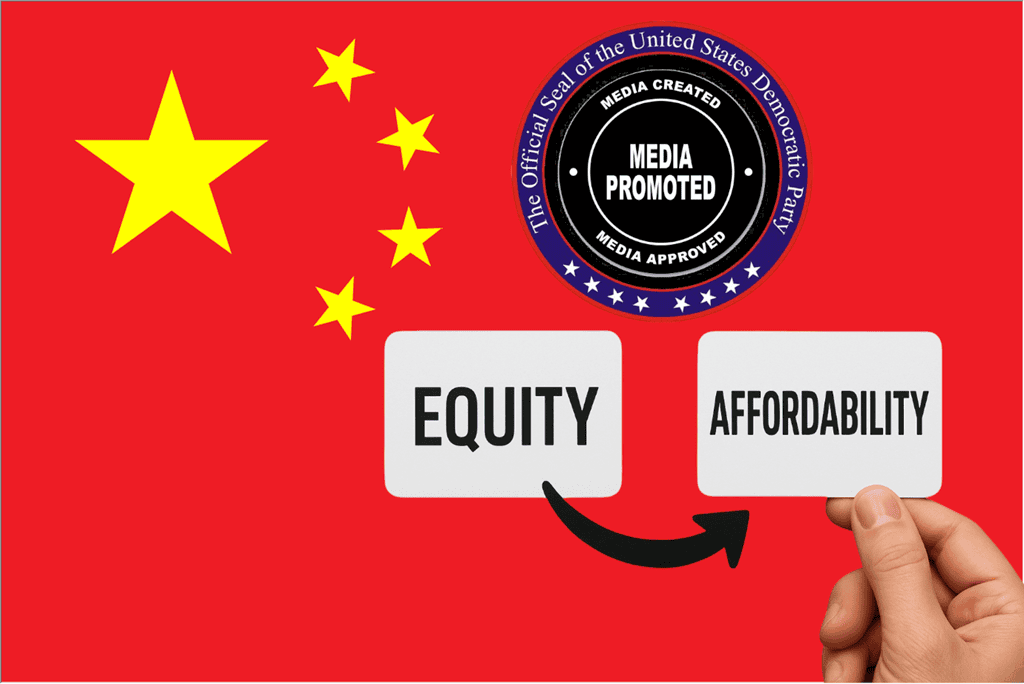
The Party of Slippery Definitions Strikes Again.
There they go again. The progressive communist democrats, the self-appointed masters of language gymnastics, are busy reworking the dictionary to save themselves from the consequences of their own corrupt politicians and failed policies.
They’ve realized that the word “equity,” their holy grail of bureaucratic social engineering, has become a little too charged, a little too revealing, and a lot too unpopular with the average American who’s struggling to afford the basics. So they’re trying a new trick: quietly swapping out “equity” for a softer, friendlier term—”affordability.”
Don’t be fooled. This isn’t some benevolent awakening. It’s not a sudden concern for your grocery bill or your electric costs. It’s a political survival tactic. A linguistic sleight of hand designed to mask the failures of leadership that have led to the highest prices in nearly every category of daily life.
From “Equity” to “Affordability” — A Strategic Retreat
Let’s be blunt: “equity” never meant fairness. It meant control—a top-down redistribution obsession wrapped in moral language. It meant bureaucrats picking winners and losers based on ideology rather than merit, efficiency, or actual need. It meant endless diversity offices, regulatory chokeholds, and spending sprees disguised as social justice.
But Americans caught on.
The average family doesn’t care about an ideological crusade. They care about the price of eggs, rent, medicine, electricity, and gas. They care that their paycheck feels smaller every month. They care that after all the promises, the “most compassionate” administration in history left them financially drowning while insisting everything was “progress.”
So now, suddenly, the same officials who lectured about systemic disparities are pivoting to “affordability,” hoping you’ll forget who made things unaffordable in the first place.
A Rebrand to Escape Accountability
This new rhetorical packaging isn’t about solving inflation—it’s about escaping blame for it.
When a government drives up the cost of energy, over-regulates industries, balloons the money supply, and punishes productivity, prices rise. Everyone knows this. Everyone feels this. So instead of fixing the economic damage, they’re fixing the vocabulary.
“Equity” became a liability because it exposed their priorities—ideological engineering over economic stability. “Affordability” sounds practical, relatable, empathetic. It lets them pretend to be on the side of the very people crushed under policies they pushed and celebrated.
They want credit for diagnosing the problems they themselves created.
A Convenient Proxy for Failure
The shift toward “affordability” is a confession without accountability. It’s an admission that the public is furious about skyrocketing costs—but with the usual attempt to dodge responsibility.
- Food is too expensive? Must be corporate greed, not policy failures.
- Electricity bills doubling? Climate mandates, not mismanagement.
- Medicine costs rising? Blame the companies, never the regulators.
- Housing unaffordable? Ignore zoning disasters, interest-rate chaos, and federal distortion.
Every issue Americans raise is a mirror reflecting incompetent leadership. And the leadership is desperately trying to fog that mirror.
Americans See Through the Word Games
No rebrand can hide the lived reality of families who can’t stretch their dollars far enough, retirees losing buying power, or young people shut out of homeownership. You don’t need a dictionary to know when your wallet is empty.
Americans aren’t looking for a new label. They’re looking for relief.
And until policymakers face the economic consequences of their own ideological experiments, the public will continue seeing the rebranding for what it is: political marketing in place of real solutions.
Bottom Line
Language games won’t fix inflation. Definitions won’t lower grocery bills. And renaming a failed ideology won’t make it successful.
The American people know it. And no amount of reimagined meaning can hide it.
We are so screwed.
— Steve